


On Tuesday I addressed the question: Why Christendom? Today I will look at the second word in my title. In what sense is Christendom being reborn?
If we take “Christendom” to be something like “Christ’s Body considered in its political aspect,” there is a sense in which it is perpetually being reborn. As I never tire of observing, the Christian tradition is continually growing, changing, and adapting. It doesn’t really make sense to identify any particular period as either a “golden age” or a time of utter ruin. Every era wrestles with problems that will not be resolved until the next one. “Good times” can breed decadence and “bad times” greater fidelity. And so on. The Church is always “moving forward” in one way or another, and usually also declining in some respect.
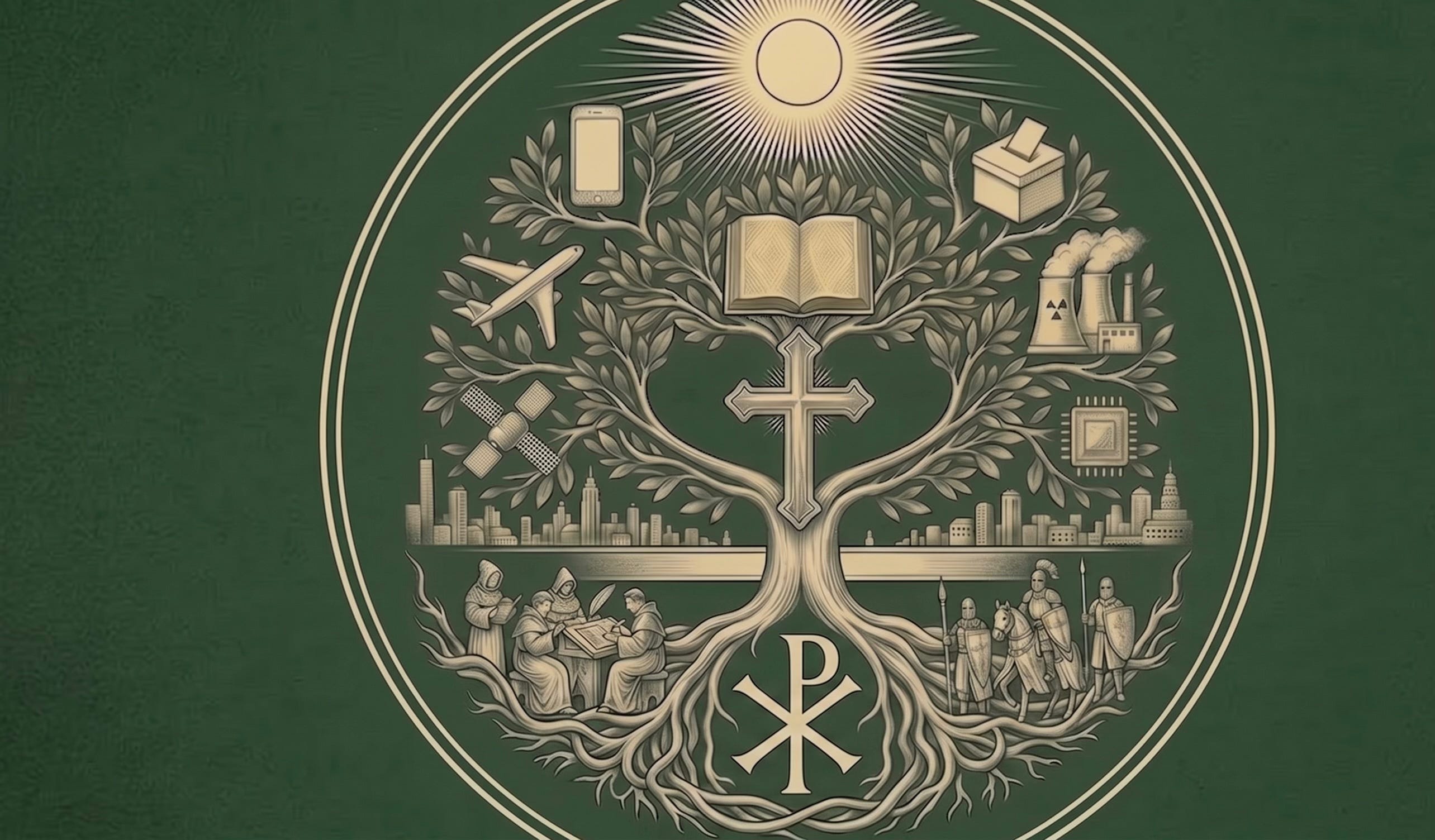
Nevertheless, I think it may be possible in a few succinct paragraphs to draw out the aspects of Christian political history that can make clear the sense in which I see Christendom “being reborn.” In fact, I can summarize my grand narrative in a few sentences. The early Christians devised strategies for living transcendent Christian truths in a fallen world, which they continued to develop through the Middle Ages. Modernity “broke containment” and we’ve now spent a few centuries wrestling with the hard truths and slippery falsehoods that fell out of that upheaval. But at this point, Christians have already done a significant amount of rebuilding. We’ve reached a point where we can see how the old strategies, redeployed in situation-appropriate ways, can still work for us.
Let’s begin at the beginning. First, the early Church. Some people obsess over this period, which I fully understand because it is quite thrilling to imagine a time when it was unambiguously daring (even life-threatening!) to join the Jesus Movement. Who doesn’t cherish the wild, creative energy of those early Christian days? Desert hermits! Virgin martyrs! People standing atop pillars! The sheer concentration of philosophical genius in this period is astonishing, and who isn’t delighted by the thought of mixing it up with St. Justin Martyr or St. Irenaeus at the coffee and doughnut hour (or ancient Christian equivalent)? I can sort of sympathize with those funny people who argue that Constantine was the worst thing that ever happened to Christianity.
I don’t agree, though. And the early Christians were clearly grappling with real challenges, even beyond the lions. It’s worth reflecting on these for a moment, because I think we have inherited them to some extent, perhaps more here in the West than in the Global South even though the latter are far likelier to find themselves in mortal peril on account of their Christian faith.
Viewing the matter in a certain light, one can start to understand why the Romans found the Jesus Movement so outrageous. Lofty Christian principles didn’t translate all that easily into practical patterns of life. The Christians’ philosophy seemed crazy and their worship practices suspicious. They claimed to be loyal citizens but refused to worship pagan gods, which to the Romans made little sense. But the universalism and radical charity were, if anything, even more outrageous. Christians believed, not only that everyone mattered, but that anyone at all (women! slaves! anyone!) could be issued a special God-given assignment that overrode ordinary civic or pious obligations. This just looked like a recipe for chaos. You can’t build a whole society of desert hermits and virgin martyrs.
They didn’t, though. Over time Christians developed strategies for making transcendent truths livable. These can be helpfully understood with reference to the “three keys” outlined in yesterday’s post. In a sense, these are strategies for bringing transcendent truths into the realm of the real (and fallen). The early Christians bridged faith and reason, developed sound dogma, and laid the foundation for a rich philosophical tradition. They learned to put some space between the Kingdoms of God and man, enabling the faith to survive across multiple political upheavals. Meanwhile, they also developed an intricate social infrastructure, which gave form to Christian universalist commitments without devolving into anarchy. (Defined vocations were a key element of this.) Medieval Christians really did live in a world that reflected and reinforced a Christian worldview on many levels.
Why couldn’t it last? I’ll say more about this on Monday when I pick up Mark Greengrass’ Christendom Destroyed, but a short list of reasons: the Reformation, the Scientific Revolution, the printing press, the Wars of Religion, global exploration and trade. And okay fine, philosophical nominalism may factor somewhere. But we really shouldn’t blame everything on William of Ockham. Metaphysics matters, but it’s also true that Medieval Christendom was, in a geopolitical sense, a bit of a hothouse flower. It was wonderful in its way but not built to withstand that barrage of external pressures.
So what happened after that? That’s a long conversation but let’s begin here.
I sometimes feel that the world has been asking the same plaintive question for the past half-millennium, in different ways and different words. Can we still have nice things, or not? The “nice things” I have in mind are Christendom’s most precious fruits: expansive human understanding, freedom, beauty, human dignity, virtue, love. Can these exquisite flowers survive and flourish outside the hothouse of medieval Christendom? Of course, the moderns have built and enjoyed a great many nice things, and yet they always feel fragile and ephemeral. There is also a deep sense, at least in the West, in which modernity’s fruits are still the fruits of the Christian tradition (or at least from Christian rootstock). It’s unclear how much can survive a radical loss of contact with the source, which is a reasonable reason why rapidly declining religiosity provokes the kind of panic and despair I discussed in Wednesday’s post.
Reflect back for a moment, though, on the early Christians, grappling with enormous, lofty ideas in a fallen world that seemed extremely hostile to them. No doubt the whole thing seemed wildly impractical, but, spurred on by a zeal inherited from the Apostles, the early Christians cultivated strategies to make those lofty truths livable. Over time, they remade the world, stamped with Christ’s image.
Today’s problems feel larger in scope, because they are. It’s a bit crude, but perhaps not totally unhelpful, to think of the early moderns unceremoniously ripping the training wheels off the medieval design. In describing the matter that way, I don’t mean to patronize, for instance, the Scholastics, who I love very ardently. I simply mean this.
The medievals had certain advantages (from the standpoint of building a cohesive Christian world) that could not last. Their world was relatively homogenous, with the flow of information limited by hard practical constraints. For us, pluralism is just reality; a cacophony of views and perspectives bombards us daily from all sides. A mature Christianity should be “up to” that challenge, but the medievals were largely sheltered from it, which enabled them to develop many of the rich resources they bequeathed to us.
Those early Christians did in fact care about reconciling their theological views with science, but there wasn’t nearly as much science to reconcile back in the day. Now, the treadmill just seems to keep moving faster, as new scientific breakthroughs keep pushing new metaphysical and moral questions to the fore. God’s creation is amazing; we should welcome the opportunity to take stock of it more fully. But it’s hard. And perhaps there is a very real sense in which this expanded technical knowledge makes the world feel less “enchanted.”
Political upheaval was certainly a reality of the pre-modern West, but everything moved a lot slower in those days. The God-and-Caesar debates of the Roman and medieval ages were fascinating and often very sophisticated, and I’ll say more about them in future weeks. But in those days human freedom was preserved to a great extent by some stringent constraints on what a centralized state could realistically do. The dimensions of today’s political controversies are starker, and the risks graver. It’s not strange at all to feel nostalgia for the medieval hamlet, even if they didn’t have top-notch healthcare.
Finally, pre-modern Christians believed that God could call any person to a unique and particular task, but let’s be honest. Most people were farmers. They married and raised kids, who were also farmers. Organic pre-modern life patterns were disrupted in certain ways by Christianity, but the disruption of our own time is on a different scale. Questions of vocation, purpose, and proper social relations have all become extremely complicated.
So we have some big questions to answer. The project feels daunting, because it is. It’s worth bearing in mind, though, that there are a whole lot more of us today to work on it. Modern Christians also have the benefit of a thick, long-developed tradition from which to draw wisdom and nourishment. We can do this. We’re already doing it. Tradition supplied the tools, and now we do the work of rebuilding Christian societies, “scaling up” the old version to fit new realities.
That wraps up the first week of Christendom Reborn! I hope I have succeeded in laying a basic framework for the project. Next week will be a book week: Each day will feature a recent book along with my commentary on it. You can see how I view my project in relation to Tom Holland’s Dominion, Rod Dreher’s The Benedict Option, or Philip Jenkins’ The Next Christendom. Thanks for reading! Stay tuned.
Thinking about this a bit more: this is a notably Catholic take on Christian history. To Protestants, the Middle Ages were not a sheltered time, by a time when the Christians they would sympathize with were persecuted. The Orthodox, too, would tend to see the Middle Ages as a time when a schismatic movement drove the Christian heartland into a dystopia of crusades and inquisitions. Both would tend to see the breaking of the Catholic stranglehold as a liberation of genuine Christianity.
I can see all three sides of this debate at once. I admire the High Middle Ages, yet I think the 11th-century papal revolution was a wrong turn. I like the tolerant pluralism that Protestantism ultimately precipitated, and I regard it as a triumph rather than a defeat for Christianity. But I don't admire the Protestant reformers or agree with the Protestant doctrines.
Probably no Christian other than a Catholic could quite look back on the high Middle Ages and think, mainly, "Why can't we have nice things anymore?" Dostoevsky's "Grand Inquisitor" is a good window on a different, still thoroughly Christian, perspective on that history.
Also: https://matiane.wordpress.com/2019/05/12/the-five-deaths-of-the-faith-from-the-everlasting-man-by-g-k-chesterton/