


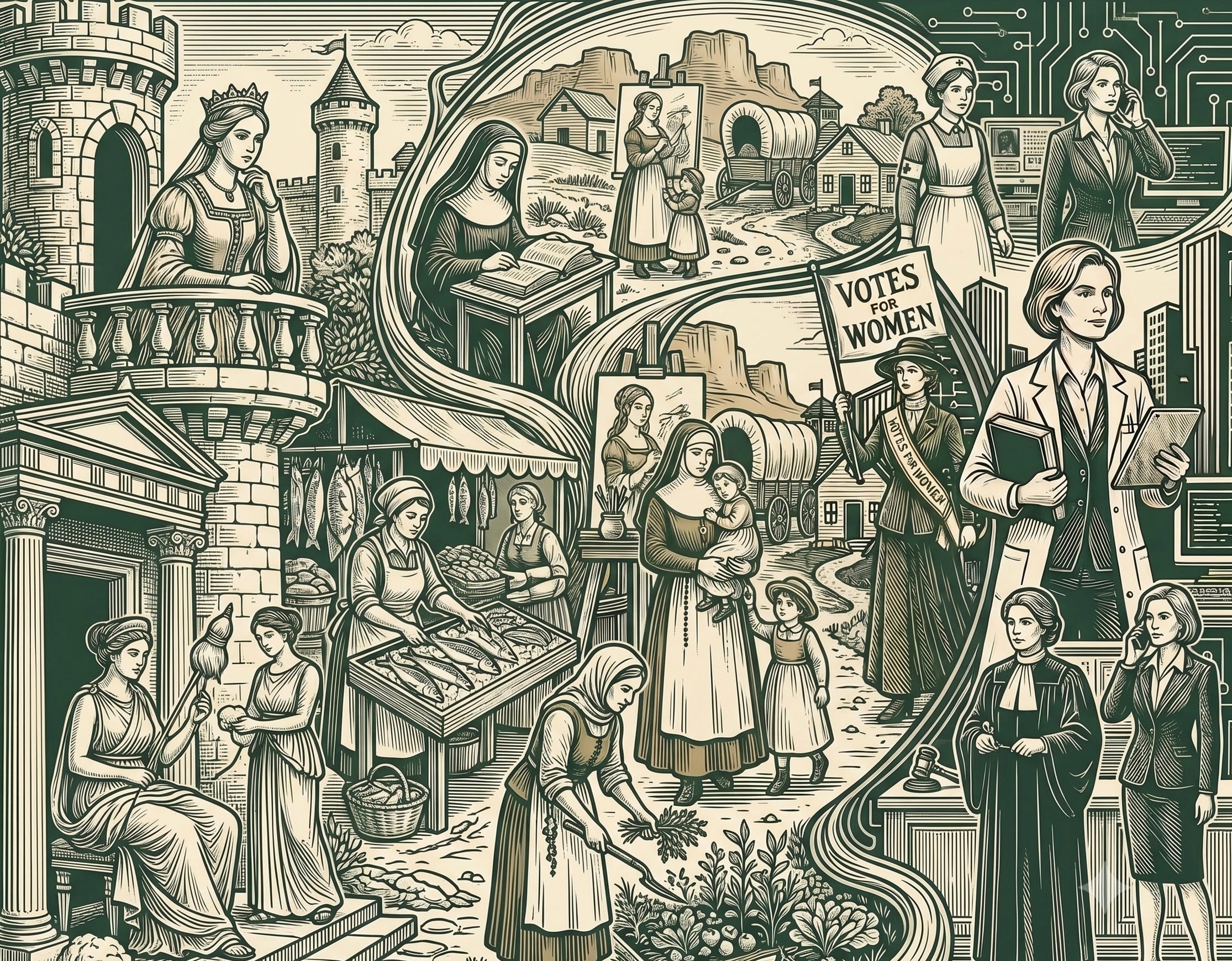
Let’s begin by stating the obvious. Modern people are very confused about sex and gender. We are deeply confounded by the moral significance of “male” and “female.”
Next, a harder question. Why? How did we get so confused?
I’ll throw out some theories. See if you can find one you like.
People need tradition to teach them how to behave appropriately. Our age is quite hostile to it; indeed, many modern people take a gleeful pleasure in defying nature and denying natural distinctions that have heretofore been obvious to practically everyone, everywhere. Obliterating clear distinctions between the sexes is part of this larger trend.
One defining feature of modern times is the glorification of “victimhood,” combined with an insistence on punitively laying low anyone who is naturally advantaged or dominant. This broader “war on health, privilege, and normalcy” takes many forms: Marxism, anti-colonialism, Critical Race Theory, etc. Also feminism. It’s basically what Nietzsche described as ressentiment, and it’s led to an aggressive effort to elevate women to positions of advantage or power, as a kind of cosmic rectification of historical injustice.
Most people historically have been “assigned” (by custom if not by law) to particular social roles, which society needed them to occupy for their own and everyone’s survival. On the ground those social conventions tend to be reinforced by widespread assumptions about the people themselves: uneducated peasants are presumed to be naturally stupider, aristocrats more noble, “barbarians” less naturally civilized. Women’s roles historically have been heavily shaped by reproductive realities, often leading to the assumption that they are built for childbearing and caretaking, and intrinsically unsuited to other things. As society at large became wealthier, and education and opportunity more widespread, those assumptions rapidly eroded. As labor markets shifted, increasingly valuing cognitive ability and interpersonal skills over physical strength, women became more professionally competitive. We’re still working through the implications for family, community, and society at large.
I could keep going, of course. I could talk about the (empty?) quest for autonomy, and whether modern societies adequately value caretaking and community building. I could ruminate on resentful men, vindictive women, how the entitlement state has warped everyone’s incentives and sensibilities. I could discourse on body-alienation in the digital age, and delve into the value (or false promises?) of sociobiology. Let’s just stop here for now.
I expect some astute readers have anticipated my take. All of these theories contain some truth. There are many reasons sex and gender are confusing to us, many kinds of mistakes people can make in this space, many ways in which these culture wars bring out the worst in men, women, progressives, reactionaries, everybody. This is genuinely hard.
Given that complexity, it’s understandable that some people would see “feminism” as unquestionably good, while others see it as a scourge on modern life. If we’re identifying it mainly with theories (1) and (2), it’s terrible, responsible for a great deal of suffering and injustice. It’s largely to blame for the embrace of abortion, widespread divorce (most often initiated by women!), the breakdown of our social fabric. If you’re thinking more in terms of (3), you’ll see feminism as the main reason women can now be doctors and lawyer, get university degrees, run for office. It’s the reason women can now take over the family farm or business when their husbands unexpectedly die, instead of being placed under the guardianship of some distant cousin. Are we now… opposed to those things?
As often happens in the midst of rapid change, I think the good and bad are quite hard to disentangle. It’s probably not reasonable to associate “feminism” exclusively with either one. Setting our own social situation alongside various historical ones, the truth is that we’ve made significant gains on some fronts, with losses on others. Domestic violence and rape are widely condemned today as serious crimes. That’s good! But abortion, fornication, and divorce are all widespread. That’s bad. Marriage and birth rates are declining. Bad! But, almost no one seriously questions whether girls are worth educating, and indeed, everyone knows today that women are capable of very high levels of scholastic achievement, and many forms of rarified excellence. I think that’s very good.
So perhaps we should be neutral on “feminism,” given that range of benefits and evils. But reflect for a moment on this final point about achievement and excellence. Though assessing all the historical evidence is a lengthy task, I think it’s really quite clear that people today have a much better appreciation overall of the range of women’s potentialities, and of the excellences they can attain. To some extent this is true of people generally, but the change is more striking for women, because their opportunities and education have historically been considerably more constrained. Girls can do a whole lot more than was commonly believed across most of history! And they often like to! Given real choices they don’t always prefer the hearth, the quilting circle, the protective arms of a man. Women’s abilities and interests are as diverse as men’s, in fact. They don’t just naturally occupy a static role as the domestic anchor that enables men to achieve.
Women can come to feel that it is their assigned task to be living totems of a sweeping rejection of modernity, affirming with their dress, demeanor, activities and life choices that they have escaped the false consciousness of the modern woman.
Though proving the point would be a lengthy task (involving complex conversations about metrics, evidence, shifting social norms), I really do think that this is a discovery of sorts; it’s contrary to what many or most people have believed historically. And if that’s true, Christians should welcome that discovery. Because we should always want to understand as much as possible about the human condition, and what enables human beings to thrive.
Free and prosperous societies have massively increased available evidence on women and their potentialities and preferences. What we are. What we want. What we can do. We’ve learned new things about men too of course, but more about women, because we were previously more ignorant about women. Insofar as those are “the fruits of feminism,” then I’m for it. I think all people should be for it, but Christians should feel a particular obligation here, because cherishing the precious uniqueness of each individual is very much part of the Christian mandate.
I planned this essay as part of my “new things” week, in which I discuss certain ways in which modernity has opened new truths or lines of enquiry that Christians should welcome. It should be clear now why I considered the subject relevant, but I reiterate once again that new truths tend to go hand in hand with new errors, which need to be combatted. This is where I often find the work of thoughtful sex-realist feminists, like my friends Erika Bachioichi and Ivana Greco, quite helpful. They know that men and women are different in some ways. They want both to thrive. Perhaps most importantly, they know that both men and women are at their best when they “pay their lives forward,” accepting serious responsibility and giving themselves to others in love. Everyone loses when we let ourselves get dragged into a scorched-earth war of sexes, fighting and clawing for a larger share of autonomy. That dynamic is all too visible in the world today, and not just in America.
It’s been quite interesting to see the furious and immoderate responses to Erika’s work in particular, mainly from right-wing anti-feminists, who are presently enjoying an hour in the sun. They especially hone in on her work on the early feminists such as Mary Wollstonecraft. As I mentioned yesterday, Erika thinks that Wollstonecraft, in company with some other early feminist thinkers, pressed her contemporaries to deepen their understanding of woman’s nature, which seemed important to her precisely because she believed that errors on this front were leading to poor education and moral formation for girls. Wollstonecraft wanted women to be better wives, mothers, and social contributors. Erika has made very strong arguments to this effect, based in Wollstonecraft’s actual writings, which her detractors never seem to engage with any substance or seriousness. They generally content themselves with attacking Wollstonecraft’s character, life choices, associates, and… the French Revolution. I guess it doesn’t matter what the woman actually wrote?
In fact it does matter, to all concerned parties, not because Wollstonecraft’s legacy should be our highest concern but because it speaks to the question of whether “feminism” can ever be healthy. The anti-feminist wants to present it as a kind of malevolent beast to be slain, a damnable error that has dragged modern society into its present wretched state. If there were good feminists, especially at the start, we may have to acknowledge this to be a more complex phenomenon.
I’m for it! Add me to team “Complex Phenomenon.” Even when I disagree with my sex-realist friends (which happens), I think they’re making an honest effort to understand and reckon with those complexities, which is clearly the right thing to do. Anti-feminism has had its moments too, and I’ve found good insights in thinkers like Midge Decter (who skillfully diagnosed certain pernicious feminist errors), but today’s antifeminists are mostly just selling their own flavor of resentment. That won’t help us to build better marriages or families, or to heal our social fabric. It won’t help us to improve our understanding of womanhood (or manhood, for that matter).
I appreciate that my argument in favor of feminism, or at least a certain brand of it, faces a serious objection: How much can we learn from the choices of women today when those choices are being made in the context of a society deeply confused about sex and gender? Sure, women are choosing to be doctors and lawyers and petroleum engineers, often instead of marrying and having children, but maybe those are bad choices. There are some good reasons, in fact, to think that they are. (Happiness studies are often brought into the conversation at this point.)
It’s a complication, I agree. We certainly can’t work from the assumption that women’s choices, or anyone’s, reliably reflect a clear understanding of their real good. But it’s one thing to draw proper distinctions between “expressed preference” and “real good,” and quite another to dismiss the entire modern woman’s experience as a massive exercise in false consciousness. Learning the correct lessons from modernity is admittedly difficult, but surely there are some; only the laziest of social critics contents herself with treating the entirety of modern history as one big cautionary tale.
As a young woman, I felt a deep distaste for “feminism” as I then understood it, partly I think because it seemed to paint its accusatory brush across almost the entirety of human history, casually tipping great men, great civilizations, inspiring works of art and literature, practically everything it seemed, into a petty little dust bin marked “sexist.” Why would we want to do that? Why shouldn’t I, as a girl, claim a share in Western Civilization instead of shaking my fist at it?
My feelings on that point haven’t changed. Rejecting the past wholesale, because “sexist,” is dreadfully impoverishing. But longer experience has shown me that antifeminism is prone to its own kind of poisonous narrowness. It paints its own vague-but-sweeping condemnation across our entire modern age, angrily rejecting serious efforts to achieve greater clarity or understanding. That tendency is quite glaring in the antifeminist response to serious work like Erika Bachiochi’s. But it also pervades the online river of genderslop, and one begins to realize after awhile that the sloppiness and imprecision aren’t just a product of laziness or stupidity. They’re a refuge, even a strategy. Antifeminists don't want to address the philosophical questions with more clarity and precision; that would effectively put them on Team Complex Phenomenon, which for them is admitting defeat. If you acknowledge that the questions are genuinely hard, you might soon find yourself admitting that feminists were right about some things. That some of the changes they pushed for were needed and just. That a blithe re-upping of more traditional gender norms really could be repressive in some deeply unjust ways.
Perhaps it’s not worth worrying about those clownish online debates, which aren’t necessarily reflective of ordinary people’s views. But antifeminism does have an impact on actual women in reactionary communities, which can be fairly oppressive. Women can come to feel that it is their assigned task to be living totems of a sweeping rejection of modernity, affirming with their dress, demeanor, activities and life choices that they have escaped the false consciousness of the modern woman. This is how you end up with little reactionary subcultures in which the men get degrees and normal jobs and wear blue jeans, while the women dress like pioneers and insist they would never work. Those are the extremes, but many women wrestle with less-extreme forms of the same phenomenon. It’s unhelpful. And it often prevents traditionalists from having much impact on the broader conversation. Could we possibly move past those unseemly pathologies?
For blinkered ideologues of all persuasions, I think the road to recovery begins here. Let’s be open to learning. What are men and women actually like? How are their experiences similar and different? What helps them to thrive? As Christians we should assume that all people, male and female, are rational and loving, reflecting the image of God in particular ways. But maybe we should be open to being a little surprised, at times, by the ways in which they do that. That’s fine. It’s good to learn.
We can learn from many sources: tradition, great books, wise teachers, and also real women navigating novel circumstances today. It’s possible to love old things without being closed to discovery! That’s sort of the point of “new things” week.
From my mother, Merina Smith. For some reason her computer won't post this, but I thought her reflection was valuable and wanted everyone to see it. So I'm posting here, with her permission:
"I think the second wave feminists had a difficult task. They could only make a splash by perhaps overstating their case along the lines of "a woman needs a man like a fish needs a bicycle". I remember reading a particularly condescending article around 1980 by a woman who was trying to figure out why any woman would become a housewife. She said that she spent countless hours having coffee in living rooms trying to get to the root of this mystery, but as I recall never managed to come up with the answer that women were responding to the very great needs of their families, especially their children. It was thus easy for women who were engaged with the important (though often tedious) work of raising children and caring for families to dismiss feminists as out-of-touch with the real lives of women.
Friedan's life was probably not so meaningless and trivial as she made out in order to make her point, but there was definitely a problem for women who needed to support their families. When my Mom started teaching in the early 60s for example, she was paid less than male teachers because they were supporting families, except that she also was supporting a family. When I was growing up the big three (low-paid) professions for women were teacher, nurse and secretary. There is nothing wrong with these professions, but that is waaaay too limiting given the considerable talents and desires of women. So feminism has done a lot of good.
Once, early in married life, a Yale grad student working on some sort of counseling degree wanted to interview us about our marriage. She asked lots of questions about division of work and the like, and was surprised that we agreed on so many issues. I think she was used to a lot more conflict between couples. At the time, I was kind of proud of this and thought that our agreement stemmed from a very traditional understanding of roles with which we had been raised and to which we generally adhered. I thought that was good, especially in light of the controversies of the day. This understanding helped us know what our duties were. There are and were many good aspects of tradition, among them the desire to come together at all and create a family, something that is much weakened these days. But over the years we have had to grapple with problems that stemmed from this traditional understanding. A true partnership really can't happen with the view that the man has the last word when there is a disagreement, as the traditional view dictated in those days. Rather, controversies have to be talked out and worked out. Couples have to grapple with what is most important to each of them and how to compromise for the good of the family. It's not an easy task. It requires thought and compromise. So, while I recognize the importance of tradition, it can't do all the work that I then thought it could.
Second-wave feminists were able to moderate their views somewhat after they had become an important part of the culture. I remember Steinem admitting at some point that maybe having a husband and children could be valuable, after younger women began to revolt against a feminist message that rejected these important aspects of life. Abortion, though, has been a feminist staple from the get-go. I think a more nuanced approach to abortion would still benefit hard-core feminists. In general, the Christian traditions regarding sex and marriage are right and true IMHO (and feminist efforts to destroy the Christian understanding have led to terrible things), but some of the adjacent beliefs, likely designed by religious leaders to simplify conflict in marriages, didn't really do what needed to be done. Contemporary efforts to renew these beliefs lead to similarly cartoonish results. People want simple ways to work through problems. It is not hard to understand this desire. But some things cannot really be made simple, especially anything having to do with human relationships, which very much includes the male/female relationships and the divide between the sexes. Bridging this divide in marriages and culture in general, is absolutely necessary to the human race, but it will never be easy."
Solomon spoke of his search for a good person (a bit like Diogenes) and he said:
"Behold, this is what I found, says the Preacher, while adding one thing to another to find the scheme of things— which my soul has sought repeatedly, but I have not found. One man among a thousand I found, but a woman among all these I have not found."
I like to take him literally. When we do the math, we find that men are 1/10th of 1% better than women.
This is fairly in the range of Freud's narcissism of small differences, and any man who takes pride in it is probably the same kind of man who plays the lottery. As in, a man who is worse at math than "math is hard" Barbie.