


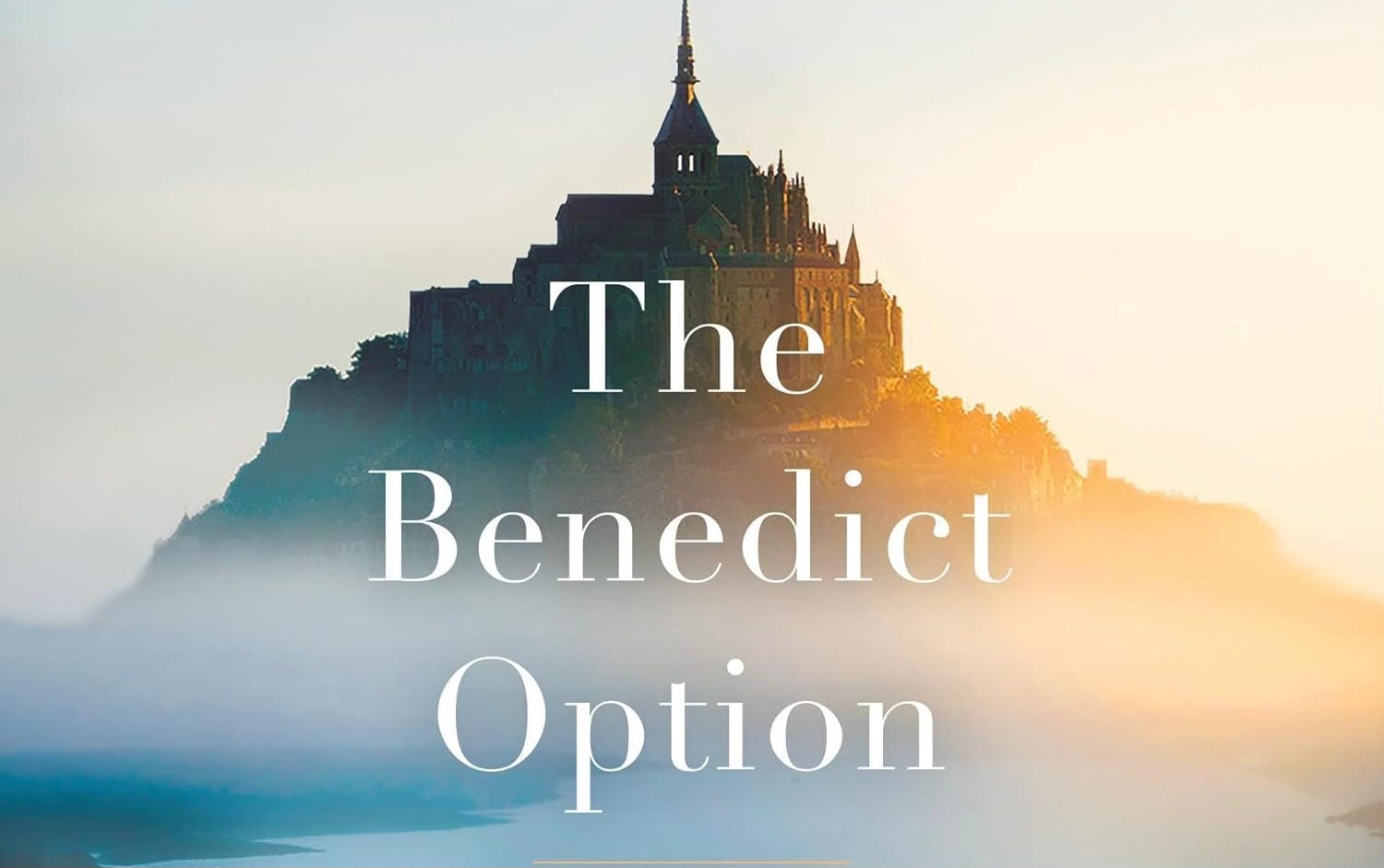
Realistically, I couldn’t go too long without saying something about Rod Dreher’s The Benedict Option. No doubt people were already thinking about it last week when I discussed “despair books” and my frustration with them. Dreher’s book was clearly the flagship of that fleet. He wouldn’t like that, but it’s just the truth.
I still have some praise for The Benedict Option. More on that soon. First, allow me to present my (totally unsubstantiated) theory of Dreher. I think he read the Lord of the Rings as a boy and really, really identified with the character of Frodo. So powerful was Frodo’s influence on the young Dreher’s mind that he got trapped in a kind of Tolkien Doom Loop, in which the only narrative he can fully process is that of a “little person,” innocent and humble of heart, trying desperately to preserve the good in the face of colossal evil. No matter what happens in the world, the country, or Dreher’s own life, he will always in some sense be a hobbit journeying towards Mount Doom.
As a writer it’s worked out for him. Many people today do feel like hobbits picking their way through Mordor, and Dreher is very good at creating a sense of solidarity in the journey. On the level of social criticism, the Tolkien Doom Loop is a serious limitation. LOTR is a wonderful epic series, but that narrative isn’t always the right one for describing every situation.
The Benedict Option contains a lot of solid life advice. Its best feature, which really is rather wonderful, is a lively and attentive documentation of ways in which Christians are building the Kingdom on a grassroots level, pouring their energies into thriving communities instead of fulminating fruitlessly over the culture wars. That’s inspiring, and deeply harmonious with my goals here at Christendom Reborn. Dreher recognizes that this work can be both joyful and, in its way, innovative, and he sees the contrast between that fertile terrain and the appalling rage-scape that is (too often) our public square. I have met people who mentioned Dreher as one influence that persuaded them that there are times for focusing on work, family, community, and faith, and leaving the world to sort itself out. That’s wise. And it’s not necessarily tantamount to “giving up.” Our families and communities may become the seeds for wider-reaching cultural renewal. Dreher understands that too; indeed, it’s the main point of his monastery metaphor.
Unfortunately, once one moves beyond that straightforward application, Dreher’s thesis doesn’t make much sense. Certainly many Christians today have a strong feeling of impending doom, which makes the “new Dark Age” idea evocative, but it doesn’t actually capture our situation at all well. Indeed, it’s a very funny metaphor for a man deeply concerned about the collapse of Christian faith. This was arguably the period, more than any other, in which the West became Christian. How do you think we got from “warring pagan tribes” to the almost-uniformly Christian Europe of the 11th and 12th centuries? There was a lot of evangelization and cultural dissemination. A huge amount of it happened in the “Dark Ages.”
Dreher glosses over this with multiple references to “barbarians” and to the Benedictines preserving pockets of order and “teaching people to pray.” Sure, they did that. The Benedictines were great. But the Gospel was also being spread far and wide in this era, and not primarily by Benedictines sitting in monasteries. As Dreher repeatedly notes, their defining charism was to stay put. That’s not great for teaching, preaching, and evangelizing. The Benedictines inspired and influenced wide-ranging efforts to spread and preserve the faith, but the vanguard of the missionary effort included Anglo-Saxon institutionalists like St. Boniface, ethereal wandering Celts like St. Columba, and of course the Franks and Carolingians who conquered Gaul and Christianized it (unfortunately sometimes at sword-point). The latter also precipitated the famous “Carolingian Renaissance,” without which the Benedictines would have had considerably less success in their own efforts at cultural preservation.
The Dark Ages are truly “dark” in one sense: Because literacy levels were low, we don’t know that much about them. Sources are few and thready and it’s hard to know what life was like for ordinary people. Pagan and Christian customs and beliefs were clearly butting up against each other, but this also seems like an age in which ground-level devotion was fairly intense. In any case though, Christendom clearly emerged from this period very deeply steeped in the faith. So… is this what Dreher sees ahead? A period of political fragmentation, material poverty, and intense religious devotion?
I’m guessing not. And though I don’t like to be an obsessive literalist, it just doesn’t seem to me that The Benedict Option does much to sharpen our appreciation of what lies ahead. It just runs through a familiar litany of culture war complaints, stoking his readers’ existing sense of catastrophism without doing much to sharpen or distill it. Insofar as Dreher does supply an explanation of our present malaise, it’s the familiar narrative about philosophical nominalism and the replacement of a grounded metaphysics with epistemology and emotivism. (Basically, we used to believe in Objective Truth and Goodness, and then we became relativists.) That’s a classic conservative take, and there’s some truth in it. But those problems have been developing for centuries. What’s new?
Dreher’s “Benedict” narrative clearly resonated with many people, but in the end it does almost nothing to illuminate our real problems. Sure, we’ve got some! But show me the generation that didn’t. I can tell you this much: we’re definitely not late-antique Christians hiding from barbarian warlords in a newly fractured Europe. Our anxieties, resources, and responsibilities are all completely different.
That leads us to the most serious problem with Dreher. He tends to drag people into his Tolkien Doom Loop. The Benedict Option left readers utterly confused and divided about most of the questions that matter (What are the main threats? What can we do about them? What larger goals are worth pursuing?) but it solidified their confidence on one point: Life as we know it is about to go up in smoke. We’re in freefall here, people.
People in that head space don’t see much value in workaday prudential reasoning. You don’t worry about the electric bill or the overdue library books when a meteor is about to hit the Earth. I worried when this book was released that it would exacerbate traditionalists’ already-prevalent tendency to spin off into various forms of revanchist radicalism. A decade later (almost), I wish I could say that those fears now look foolish and paranoid.
Christendom Reborn is in this sense the antithesis of The Benedict Option. I do agree that ground-level cultural rebuilding is vitally important. But where Dreher warned Christians to prepare for a long existence at the margins, I want us to rebuild the city with every expectation that we’re going to live in it.
That will lead us straight into Tom Holland’s Dominion. Sunnier skies forecast for tomorrow.
I'm very skeptical about triumphalist views of Christianity, especially of Catholicism, which is the kind of Christianity I'm interested in because I believe it to be true. The Benedict Option started from a very realistic consideration: that Christians in the West aren't reproducing. Their children are leaving the Church, and new converts are few. Catholicism is only growing in Asia and Africa. Rod concludes that faithful, orthodox communities, with a well-defined identity, are much more likely to transmit the faith to the future generations than atomized Christians. And I think he's completely right. As for Rod's civilizational pessimism, I think he's right too. But I take a Gramscian view about that: "pessimism of the reason, optimism of the will".
Rachel - I’m really enjoying your thoughts and looking forward to the book! Like you, I’ve long been worried about the direction some have interpreted or taken The Benedict Option. To the extent it is about inspiring or encouraging building and evangelism, I’m in favor, but I worry a lot about the impulse to retreat from the outside world.