


Before I start talking about politics, let me first issue a disclaimer. Though I am about to discuss some more political themes, I am not going to unveil any radically new political platform or theory. No shining pathway will be illuminated towards a brighter and more just future. We have problems, but I alone cannot fix them. Just diagnosing them seems to me like a tall order.
My goal is far more modest. I want to suggest an angle of approach to political questions that is prudent and grounded. Possibly, that sounds a bit boring. Don’t worry! I’ll surely pick a few fights along the way.
Today though (in what was meant to be my Tuesday essay), I want to set something on the table. It’s just this. I think we are living in a kind of “fulcrum moment,” an age of particularly dramatic flux. It’s fairly obvious that what lies ahead will be quite different from what lies behind, though in ways that are hard to foresee. The apocryphal Chinese curse has found us. We live in interesting times.
Maybe that sounds too obvious to be worth stating. Then again, some may question whether it’s true. Isn’t the world always changing? And don’t people always have anxiety about the future? Also: hasn’t Tom Friedman made an entire career out of unspooling this exact point from his perch at the NYT?
He has, and I promise not to ramble on at his trademark length. I think, nevertheless, that his signature claim is basically true, and maybe even a bit helpful for re-orienting one’s perspective, in ways that are quite relevant to Christendom Reborn.
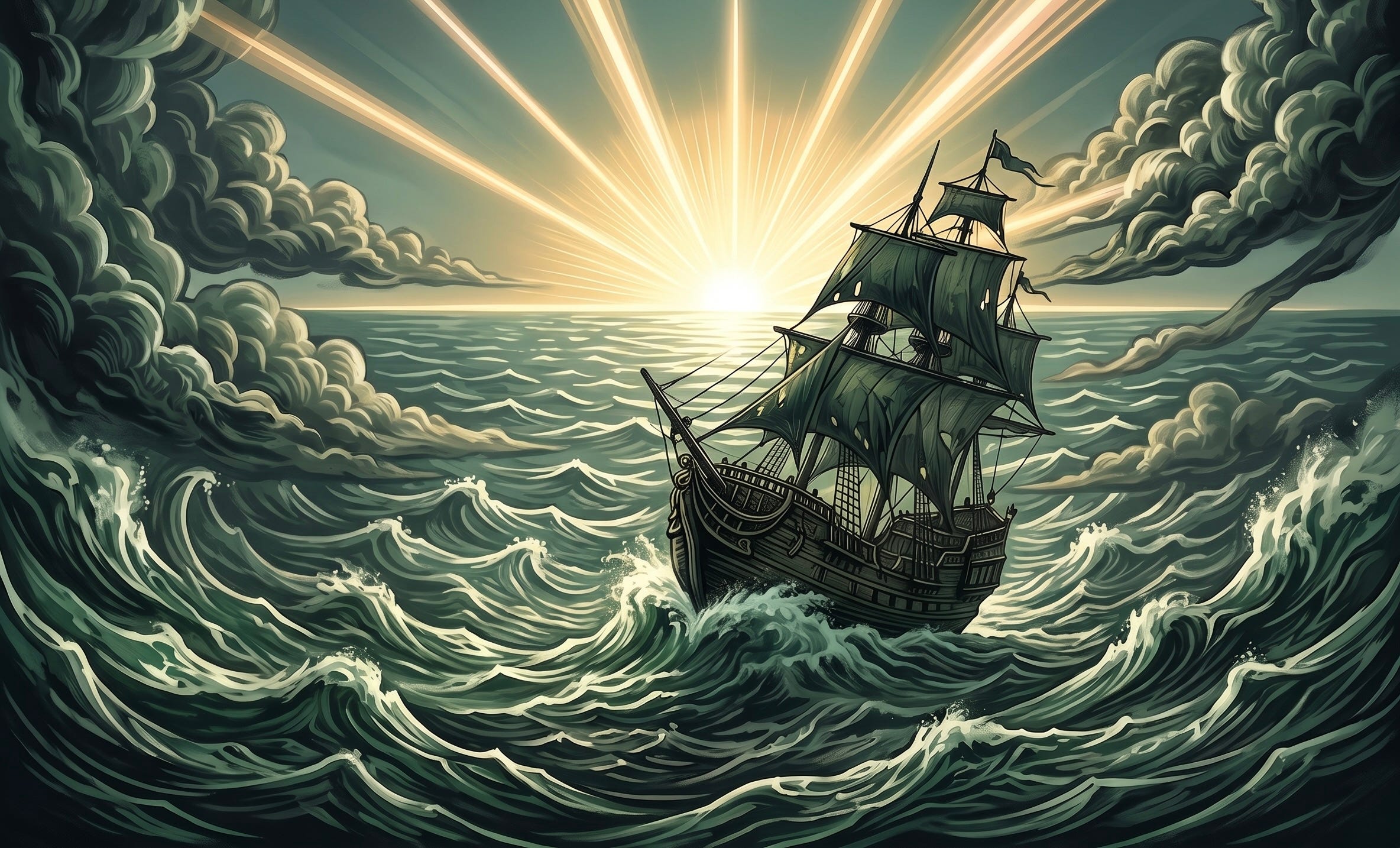
It’s a bit like this. If you find yourself suddenly and unexpectedly overwhelmed with nausea, and none of the usual remedies seem to help, you might start to worry. Maybe I have a brain tumor. Maybe I’m dying! Then someone points out to you that you’re on the deck of a ship passing through a violent storm. The ship, we’ll assume, is large enough that it’s very unlikely to capsize. Now you probably find yourself feeling much calmer, even if the nausea is as bad as ever. You’re not dying. You’re just seasick. It will pass.
Our age is rife with vicious partisanship, demagoguery, conspiracy theorizing, a fraying cultural fabric. It feels sometimes like our civilization must surely be broken in some catastrophic way. But maybe this is more like the seasickness: it feels terrible, but it’s not truly a deadly illness, just the vertigo that comes with erratic movement. Perhaps this too shall pass.
It’s hard to come up with metrics to test for “fulcrum moments.” The world is constantly changing, and there are of course many different ways it can change. Here’s something I’ve noticed, though. In conversations with people a generation or two older than me, especially discussing (for instance) their parenting choices, or how their kids have turned out, I often hear some version of this sentiment: “It’s shocking how much the world has changed. I didn’t anticipate it. I just figured my kids would do more or less stuff that we did.”
Maybe in some ages that would be normal. It’s not my experience of parenting, though. I think I and most of my peers have already grasped that our kids’ adult lives probably won’t be very much like ours. My own kids are now getting towards college age and I’m thinking, “Hey, look at that! College is still a thing! Here we go!” I really did wonder, when they were first starting school, whether we’d still be doing all this college-visit-standardized-test stuff by this point. Likewise, looking over the next hill, I see friends with 20-something sons getting married and think, “It’s still happening! Marriage hasn’t vanished!” Genuinely heartening.
In short, my perspective has flipped somewhat. I assume that my “normal” is passing. It almost feels quaint when it hangs on in particular ways. It’s hard to relate to older generations that acknowledge a level of complacency about many of their parenting choices (school choices, religious formation, advice about relationships or sexual morals) on the grounds that “I assumed my kid would do the done thing.” A done thing? You still believed in that?
I might be a little extreme, but fundamentally I think parents have moved with me in a serious way. We know that labor markets, marriage markets, even supermarkets have been transformed. We know that young people are “failing to launch” to a very sad degree, meandering through physical adulthood with no apparent ability or willingness to do grown-up things. Parents, because they have especially strong reasons to think about the future, are particularly attuned to the reality that they are navigating a major historical turning point, one of those transitional periods in which things change very fast.
Is this exciting? Disastrous? A mix? I’ll acknowledge that I don’t particularly love it. Fulcrum moments may precipitate catastrophic wars, the rise and fall of empires, etc. Still, if this is where we are, we’d best take the curve as gracefully as we can. I’ll leave the more proactive component of that for my next essay. Here I’ll just buzz through a few errors endemic to “fulcrum moments” that I think we should make particular efforts to avoid. On some level it really just boils down to “Don’t Panic.” But there are recognizable “panic traps” that are particularly worth flagging.
First, people living in chaotic periods are prone to a kind of Survivor Syndrome. Recognizing that many things are passing away, they latch onto particular things with a white-knuckled death grip, and act as though nothing else matters. Imagine you’re packing a small bag before fleeing from a natural disaster. You pack the things that matter most, right? Everything else gets left behind.
If people were holding tightly in this way to their families, communities, or devotion to God, that might be fine. Too often they choose causes of various sorts, particular fragments of tradition, nostalgic visions of the past, or utopian visions of the future. Realistically, Survivor Syndrome has a strong element of cosplay, a deep unseriousness grounded in too many years of comfort. If you were actually packing a small bag for a desperate flight, you’d maybe slide in a cherished photograph and pocket Bible, but you wouldn’t make room for yearbooks, teddy bears, or energy drinks. Most of the space would go to food, matches, woolen socks. Westerners today are exploding with luxury causes and luxury beliefs. There’s a strong element of cosplay even to their zealotry.
Let’s move on to zealotry though, because that’s my second “panic trap.” Fulcrum moments involve high levels of uncertainty, which is uncomfortable and even paralyzing. In such moments, people are extremely susceptible to oversimplified worldviews: conspiracy theories, political ideologies, half-baked religions. The appeal is obvious: they create the illusion that the ship has stopped lurching, at least for a short time. Even if the “diagnosis” is extremely grim, that may feel preferable to radical uncertainty. The problem of course is that they aren’t true, and may leave the credulous at the mercy of unscrupulous actors. In saner times, it’s sometimes possible to build healthy cultures in which gullible, undiscerning people can mostly get along without mishap. In fulcrum moments, there’s really no adequate substitute for prudent discernment, combined with a willingness to tolerate some uncertainty.
When that gets too hard though, there is a third panic trap: the suicide mentality. If the world were really ending tomorrow, what would you do? I’d try to get to Confession, pray a few Rosaries, and spend the rest of the time with my family. A good game of backyard football seems to me like excellent preparation for eternity. But no doubt many people, knowing the world was ending, would go on a rampage, looting shops or torching buildings. Why not? Nothing matters anymore!
People do terrible things when they feel like nothing matters. I think that says a lot about the mad dash towards socialism, nihilistic populism, and other modern maladies. Panic and despair can do a lot to erode healthy inhibitions. How often nowadays do we hear drastic political measures justified with the argument, “Yes, it’s non-ideal, but we really have no choice?” That’s panic talk. Be very suspicious of such people.
I started with my Taxonomy of Panic because I think it’s important groundwork for a fruitful political conversation. Our public square is distorted at every turn by panic, the “civilizational vertigo” of rapidly changing times. It’s poisoning our politics and threatening social stability. I’m definitely concerned about all of this, and I think it’s important to keep working the problems, but I also think one of our most important survival skills in such a moment is the capacity to remain calm. Panic makes for bad decisions. People are making a lot of those nowadays.
If panic is bad, what’s a good way to get through a fulcrum moment? My short answer is “be a conservative!” I’ll elaborate in my next essay.