


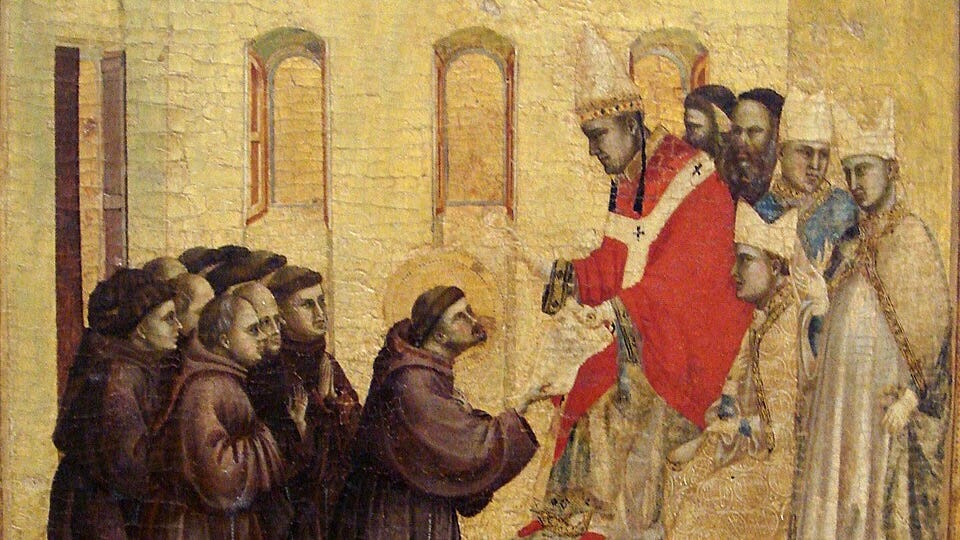
He made it look easy. This, I think, is the short explanation for how St. Francis, the little Poor Man of Assisi, became one of the most beloved human beings of all time. Everyday experience teaches us that love is often arduous, painful, even heartbreaking. He made it look as effortless as breathing.
They say you shouldn’t meet your heroes, and that’s often true. But there are a few historical persons I’d love to meet, even for just a few minutes, because it seems clear they must have had a presence that affected everyone around them. Achilles. Socrates. Alexander the Great. But Socrates captivated people by winning arguments, Alexander by winning battles. Francis did it by racing to the bottom of the social ladder, then refusing to fight anyone. God’s love just seemed to pour from him like a spigot, watering the world.
He died 800 years ago this very evening. I feel a personal debt to St. Francis (more on that presently), on account of which I have thrown a party in celebration of him every October for the past twenty years. Always incorporating garden produce into the meal. I’m not that much of a party animal, and not that great of a cook, but it feels like the appropriate way to honor a man who seemed always to be bringing people together in joyful camaraderie.
Francis’ example was so lovable and inspiring that many people, including our previous pontiff, have wished to imitate him, themselves becoming “virtuosos of love,” making it look easy with their effusive, theatrical outpourings of good humor and charity. What we learn from them is that it is not easy. Francis was a rare bird.
One of his secrets, it seems, was living with nothing to lose. I don’t mean he lived as if he had nothing to lose. No pride. No possessions. No family except those who chose to follow him, and no comforts except those that happened to fall into his lap, but even then he tended to pass, ardent in his embrace of “Lady Poverty.” St. Francis didn’t “imagine” no possessions (and then lecture other people about it); he simply gave everything away and worked from there.
It might seem strange that God would choose that moment to order a young wastrel in Umbria to “rebuild my Church.” Rebuild? Wasn’t it basically flourishing at that time?
Most of us probably shouldn’t try to be him. It takes a special calling, and in our influence-obsessed world, the pitfalls and temptations would be harrowing. Anyway, most of us would do real injustice to our loved ones if we “raced to the bottom” in imitation of Francis; our kids would be hungry and our responsibilities unfilled. He was, at the time he heard the call, a dissolute young man with wealthy parents.
So most of us can’t be Francis, any more than we could be Mozart or Michelangelo, but we can enjoy his stories, the way we might enjoy a symphony or a painting. And we can be inspired, in our less-dramatic ways, to be more loving and more joyful, gripping our worldly goods and honors less tightly.
I wrote earlier this week about the many tensions and puzzles that one finds within Jesus’ teachings on love. They leave us with a lot of questions. How do natural and transcendent loves come together? How can we be constant in our commitments without losing sincerity, joy, spontaneity? Francis seemed to navigate all of those faultlines with a remarkable grace. He did love natural things (even the sparrows, or especially them), but saw all as a radiant mirror of God’s love. And in reading about the life of St. Francis, one reflects on how much we need such an exemplar, a man who ministered to the sick and poor but also had time for singing and preaching to sparrows.
Jesus is obviously the greatest example of love, but his life and persona are austere and in many ways deeply mysterious. Mary’s example is immensely beautiful (fiat mihi secundum verbum tuum), but most of her life is shrouded from us. Il Poverello delights us with his scores of quirky, amusing stories, preserved in The Little Flowers roughly a century after his death from oral tradition passed down by his closest friends. His strangeness is endearing, not alienating. His theatrics entertain without ever smacking of insincerity.
There is a further point to be drawn from the life of St. Francis, of great relevance to this Substack. The 13th century was in many ways high times for the medieval Church! Her spiritual dominion over the West was basically uncontested; philosophy was moving towards its zenith; the papacy was arguably at its strongest and most influential. The Benedictines had built wealthy, flourishing centers of intellectual and cultural life. It might seem strange that God would choose that moment to order a young wastrel in Umbria to “rebuild my Church.” Rebuild? Wasn’t it basically flourishing at that time?
That’s sort of the point, though. The mendicant orders (e.g. the Franciscans and Dominicans, which came into existence within a few years of each other) were both the product of this very-Christian age and a rebuke to it. Power and prosperity breed corruption and vice, so against that very considerable political strength, the mendicants functioned as a conscience or counter-weight, advocating for core elements of the Christian vision that were in danger of being forgotten. And they did it quite literally from street corners! Renewal can happen in times and ways that we don’t necessarily expect.
Across history, Christendom is regularly being reborn. And of course, I must note that each of these great orders (still very much in existence, with thousands of members now spanning the globe) had a particular charism, corresponding quite nicely to one of the “dynamic keys of Christianity.” The Dominicans made truth their special province. The Franciscans had a special kind of vocation to personal love.
Before concluding, I promised to expand on my personal debt to St. Francis. It dates back to the time of my Catholic conversion in 2005. I really feel, looking back, that he swam with me, perhaps even pulled me, those final few yards across the Tiber. Those ones can really be the hardest; after gleefully gobbling many of the “goodies” of Catholicism (philosophy! Liturgy! All the colorful history!), and feeling free for many years to browse and sample at leisure, you suddenly find yourself standing at a yawning church doorway, realizing with a certain shock that it’s time for some goodbyes. Not literally, in my case; nobody I loved stopped speaking to me. But I was the first (to my knowledge) from a huge, sprawling, multiple-generation Mormon family to walk right away from the faith of my fathers. Not just to lapse a little but literally to become something else. I knew people would still love me, but things would never be quite the same, and I knew that too. My whole life, indeed, was going to be quite different from what I’d grown up expecting, and in those final few weeks before my Catholic baptism, those losses felt pretty searing. I slept poorly. I found that my subconscious was working continually to produce merely psychological explanations of my religious convictions. And at the same time, the faith all of a sudden seemed strangely without luster. My philosophy books seemed oddly dull. Things that had lit my mind on fire in college now held a haunting aura of sadness. I still prayed my Rosary, but it felt monotonous.
Only one thing still truly appealed: The Little Flowers of St. Francis. It wasn’t a college book! I had known that one from childhood, almost the only Catholic touchpoint (or so it seemed at the time) that stretched all the way back to my earliest years. My father had read us those stories sometimes at bedtime, and they had delighted me; I couldn’t remember a time when I didn’t know about the wolf of Gubbio, or know several verses of All Creatures of Our God and King.Francis felt like one friendly face from childhood that didn’t require any kind of farewell. And in him, I found I could still catch some intimations of joy.
So I took St. Francis as my patron, at my baptism and confirmation. Many people found that odd. Wouldn’t a philosopher be the expected choice for me? Yes, maybe. There are certainly many that I love! But Saint Francis was the bridging figure. The guide that delivered me safely to shore. In our darkest, loneliest hours, aren’t we all just ravenous for love?
He always had plenty of it, which he’s showered freely on scores of people, including me. He makes love feel easy, but also readily abundant, surrounding us at every moment of our lives. And here’s the beautiful part. It is.
I apologize for not posting my promised Thursday essay on “Nature Most Foul.” I was at our Law & Liberty “Conservatism and Liberty” conference, and my mind was so full of the conference discussions and readings that I couldn’t quite change gears. (Clearly then, it was a good conference! At a bad conference I’d walk out of a session with the whole post written in my mind.) But I’ll finish that one for Tuesday, and possibly write something for Thursday on the conference and themes relevant to Christendom Reborn.
Right now though, let’s celebrate St. Francis, and 800 years of finding effervescent joy in love.
Beautifully written. Although I incline more towards Orthodoxy, you caught the very essence of Catholicism: pragmatic, conflicted, self-aware. And what better emblem for the mendicant tendency within a worldly Catholicism than Francis?
With apologies to my Substack list, I have now corrected this post to refer to our PREVIOUS pontiff, not the current one. I'm aware that Leo XIV is now the pope!