


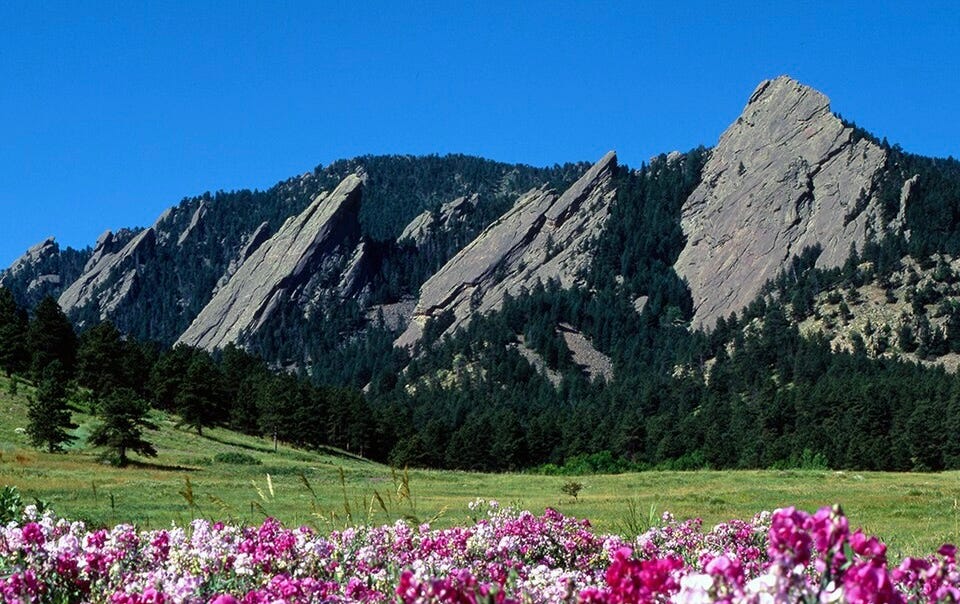
I was mostly off grid this past week, up in Rocky Mountain National Park celebrating my parents’ Golden Anniversary. It was a powerful nostalgia trip and I’m still sifting through the emotions. Colorado was my home from the second grade through high school graduation. My family then moved on, exactly when I did. It was a pretty sharp break. It was my childhood home, and suddenly, just two weeks after my graduation date, I no longer had any family in Colorado. And never would again (or at least not to date).
It was my parents’ decision, not mine, but there was a huge upside for me: I got a free Notre Dame education. They relocated to South Bend, IN, so that my father could join the law faculty there, and my (and my brother’s) admission and tuition were effectively rolled into the deal. As you see, I was a true nepo admit, and this wholly unexpected and unmerited blessing left me quite abashed. I’d never for a moment set my sights so high. It’s not the sort of gift you send back though, so I did my best to pay it forward.
That turned out to be transformative for my life. I think college did more for me than for many, not least because up through that point I mostly saw myself as a person of average intelligence who happened to be related to a lot of smart people. I acknowledged, too, that since long habit had made me comfortable around smart people, I did have a knack for befriending them. But I definitely tended to view myself as a sidekick-type figure, facilitating the genius of the more brilliant. (Every Holmes needs his Watson, right?) When a Notre Dame education fell into my lap, I was excited but also genuinely terrified that I might not be able to hack it, so I threw myself into the work. I discovered that I was not quite as dumb as I’d believed. I graduated summa cum laude, found my way to an Ivy League graduate program, and embarked on a somewhat different life from what I’d envisioned.
I know my parents made real sacrifices to give me, and my siblings, those chances. I’m grateful. But when I breathe that light, dry air again, and hear the wind through the pines I used to love, part of me does want to sit and cry a little for what my family lost in that move. In the short term it affected my parents and younger siblings the most; we older kids, after all, were already headed out the door. But looking back across decades, I now understand that despite the very significant gains, we older kids paid a real price too. We lost a much-loved childhood home and never got it back. You don’t get to grow up again. The closing of the Colorado chapter relegated our childhood to albums and anecdotes. My own sons have visited my parents’ childhood stomping grounds (in Idaho Falls, where we still have family) more than mine.
Our parents would eventually settle in Southern California, where they built a very good life for themselves. They’re still there, as is my youngest brother, fully habituated to coastal culture. It’s a fun place to visit but it’s never been home to me. Last Monday, when the purple-blue shapes of the Rockies first appeared like old ghosts on the horizon, I found myself humming the folk tune Shenandoah, which initially seemed odd: that’s a totally different part of the country (where I’ve never lived). On reflection I saw the dots that my subconscious had already connected. Shenandoah is about Western settlers looking back nostalgically on the home they left behind, in the gorgeous Shenandoah River Valley. It was clearly a much-loved place, and its loss makes them sad. But they’re not going back. Away, we’re bound away…
There’s a point to this nostalgic reflection, of relevance to Christendom Reborn. Many people have a funny idea that Christianity is ill-suited to modern life, with its rapid and relentless change. Modern people, we are told, are too alienated, rootless, and disconnected from tradition to make sense of Christianity. One needs context (or so the story goes) to find it meaningful; as that soil gets washed away in the currents of modernity, the roots wither and the faith will die. It sounds plausible, but in some ways is an exact inversion of the truth. Alienation, rootlessness, and loss of context are characteristic modern problems, and Christians struggle with them like everyone else, but the faith, far from becoming obsolete, is all the more relevant when other traditional sources of meaning are passing away. It makes the losses bearable, in part because we know that nothing precious is truly lost forever. It can hold onto memories without being crippled by them, honoring history without idolizing it.
It’s perfectly true of course that faith and family are strongly connected, and their fragmentation also tends to track. Unsurprisingly, people are much likelier to be practicing Christians in adulthood if their parents read the Bible aloud and taught them to pray. They’re also likelier to marry and form families if they are rooted in Christian faith. The two things are mutually reinforcing. That however is not really a unique feature of Christianity. The dynamic holds to a large extent across all faiths and even just “traditions” in a very general sense. There are lots of benefits to staying put, perpetuating a way of life, imitating your parents and grandparents. The further people get from the ways of their fathers, the likelier they are to end up adrift on life’s high seas.
Even so, it’s neither possible nor wise to imitate one’s ancestors blindly. People can have excellent reasons for moving, breaking with the past, and forging new pathways into the future. You get a chance to give your kids a Notre Dame education and decide that it’s worth it, even though the Rocky Mountains are too big to pack. It’s tricky at times to find the right balance between tradition and traditionalism (the living faith of the dead and the dead faith of the living). We need the capacity to remember, but also, sometimes, to retranslate.
It was comforting to reflect on those themes this week as I took my kids (and their cousins) on once-beloved hikes, walked through sunny pine forests again, joined my siblings in revisiting old trips and reunions and the ridiculous songs we made up in the car. I thought about the grain of wheat that falls and dies. I reflected on how all things are held in the eternal memory of God. I cried a little as we stopped in Boulder on the way back East, and I took my boys on one last hike through Chautauqua Park, so saturated in memories of good times and old friends. Away, we’re bound away…
At moments like this, it’s easy to get a little envious of families like one in My Big Fat Greek Wedding, who are so immersed in a faith-oriented culture (or subculture) that theology, blood, history, and custom seem to fuse together in a thick, unified whole. It would be nice to feel less fragmented, less alienated, not constantly pressed by the weight of competing goods. And yet, I do really think that my family is extraordinary too. In some ways absence and distance actually accentuate how much we do have in common, when in fact we find ourselves gathered in one place. It’s beautiful, in a way, to be able to gather together in a place that was once home, sing the songs, rehash the memories, argue a few points of philosophy or politics… and return to the lives we’ve built now. Which we have done. We’ve landed in many different places, but all of us have set our hands to one plough or another. We’re scattered, but not really drifting. Moving mountains? Or maybe someday?
No earthly roots are truly strong enough to withstand the ravages of time. In the end there is only one table around which we can gather eternally. Fifty years is a long time to be married, but what we really admire in long-married couples is not just their success in hanging on, but the many things they discovered, built, and nurtured together. You look at those fresh-faced wedding photos, and then at their lives and our family, and feel overwhelmed. The bittersweet notes have ultimately become part of a glorious whole.
If all that can come from the union of two people, how much more from Christ and his Church?
For another, rhyming perspective on this same family history, see my post. :)
https://lancelotfinn.substack.com/p/the-author-as-a-case-study-of-the