


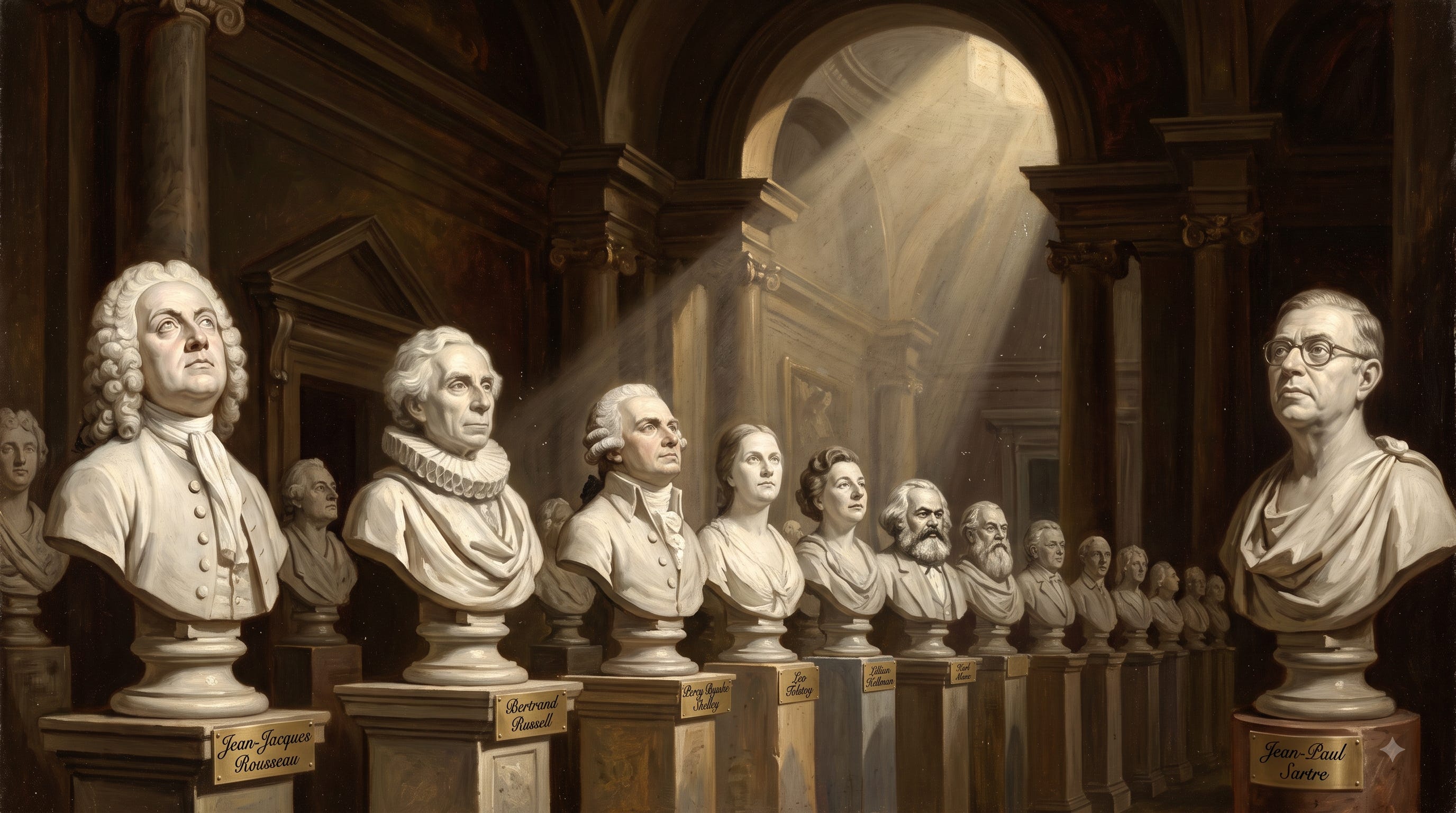
I promised levity for this week. I like to keep my promises, but I also considered, after my deep bow to Lady Philosophy, that it might be prudent to instill some balance by highlighting the many characteristic failings of hyper-thinky people. And I do mean “many.”
All arrows are pointing here to Paul Johnson. His 1988 Intellectuals is merciless in its send-up of Great Thinkers. It’s also extremely funny.
This book is a bit of a guilty pleasure for me. It’s basically a collection of hit pieces on modern thinkers, and Johnson approaches his targets in the mode of a tabloid writer or oppo researcher, reveling gleefully in every broken vow or destroyed friendship, delighting in the absurd hypocrisies that define all of these lives. It’s intensely polemical, and sometimes unfair, but so very entertaining. Who can get to the end of this paragraph without guffawing?
Behind [Rousseau’s] self-pity lay an overpowering egoism, a feeling that he was quite unlike other men, both in his sufferings and his qualities. He wrote: ‘What could your miseries have in common with mine? My situation is unique, unheard of since the beginning of time…’ Equally, ‘The person who can love me as I can love is still to be born.’ ‘No one ever had more talent for loving.’ ‘I was born to be the best friend that ever existed.’ ‘I would leave this life with apprehension if I knew a better man than me.’ ‘Show me a better man than me, a heart more loving, more tender, more sensitive…’ ‘Posterity will honour me… because it is my due.’ ‘I rejoice in myself.’ ‘…my consolation lies in my self-esteem.’ ‘…if there were a single enlightened government in Europe, it would have erected statues to me.’ No wonder Burke declared: ‘Vanity was the vice he possessed to a degree little short of madness.’
Vanity is a vice possessed by most intellectuals. They tend to think they know everything. Here is the first paragraph of Johnson’s chapter on Bertrand Russell:
No intellectual in history offered advice to humanity over so long a period as Bertrand Russell, third Earl Russell (1872-1970). He was born in the year General Ulysses S. Grant was reelected to the US Presidency and he died on the eve of Watergate. He was a few months younger than Marcel Proust and Stephen Crane, a few weeks older than Calvin Coolidge and Max Beerbohm; yet he lived long enough to salute the revolting students of 1968 and enjoy the work of Stoppard and Pinter. All this time he put forth a steady stream of counsel, exhortation, information and warnings on an astonishing variety of subjects. One bibliography (almost certainly incomplete) lists sixty-eight books. The first, German Social Democracy, was published in 1896, when Queen Victoria still had five years to live; his posthumous Essays in Analysis (1973) came out the year Nixon resigned. In between he published works on geometry, philosophy, mathematics, justice, social reconstruction, political ideas, mysticism, logic, Bolshevism, China, the brain, industry, the ABC of atoms (this was in 1923; thirty-six years later came a book on nuclear warfare), science, relativity, education, scepticism, marriage, happiness, morals, idleness, religion, international affairs, history, power, truth, knowledge, authority, citizenship, ethics, biography, atheism, wisdom, the future, disarmament, peace, war crimes and other topics. To these should be added a huge output of newspaper and magazine articles embracing every conceivable theme not excluding The Use of Lipstick, The Manners of Tourists, Choosing Cigars, and Wife-Beating.
He’s just so good. Johnson, I mean.
Is it wrong to take some pleasure in this defiant refusal of intellectual charity? Possibly. I do think one should bear in mind the character of the book one is reading. It’s not the whole story on these people. Nevertheless, their failings were very real! Fairly egregious in fact, and their personal failings really did flow over into moral and intellectual errors, which is part of the point of the book. It’s full of salutary warnings about the tremendous harm intellectuals can do, to everyone around them and the world as a whole. Even tiny two-bit thinkers like me can benefit from occasional reminders of how absolutely monstrous intellectuals can become.
Thinkers easily persuade themselves that they’re better than normal men, but are they in fact much worse? This seems to me like a complex question. Certainly, they are prone to characteristic temptations. People whose IQ is a standard deviation or two above other people’s do tend to experience the world a bit differently, and easily persuade themselves that this is a mark of great superiority. A rarefied economy gives them many possible outlets for using those gifts abusively. And, in an age that often glories in the destruction of custom and tradition, it’s child’s play for a high-IQ person to make the case that “people like me can’t be expected to tell the truth, keep promises, share, or care for others. It is precisely to facilitate the genius of men like me that we tore down all those stodgy old rules.”
Truthfully, there are also real burdens attendant on an intellectual life, which we shouldn’t lose sight of completely in our (justifiable) eagerness to bring thinkers back to earth. Other people don’t readily understand brilliant people, which makes them lonely. They’re easily prone to persecution complexes, but that’s partly because they are likelier than most to be persecuted for their ideas, even or perhaps especially if they have the courage of conviction. Even if you don’t end up in prison, alienating people who used to like you really is an occupational hazard for anyone who “works with ideas,” and honesty and integrity won’t save you. Dishonesty probably won’t either, actually, but at least it gives you more of a sense of control.
I have a pet theory that the most defining failing of intellectuals is really cowardice. The hubris is more obvious, but the argument runs like this: Living an honorable life as an intellectual actually does require considerable courage, or at least it may. But intellectuals’ early life experiences don’t often cultivate courage. In youth they get all the gold stars, win all the prizes, attract patronage from important people. Later on, when it comes time to accept real risks or sacrifices for the sake of the truth, they just don’t have the grit for it. Their intelligence, unfortunately, helped them to bypass the morally formative experiences that are needed to attain virtue.
I don’t say this to excuse anyone, though. Intellectuals have their problems, sure. Who doesn’t? It doesn’t justify moral turpitude, and one of Johnson’s points is that intellectuals are often in a position to do far greater damage than most others, in light of their disproportionate influence. In excusing themselves from moral requirements, they end up demolishing guardrails for everyone. The book is almost 40 years old now, but the insight certainly holds. There’s no magic solution, but the best thing we can do for thinky people (or the best things they can do for themselves) is to hold onto the normal moral requirements. Maybe you can be forgiven for being absent-minded or having a poor sense of fashion. Maybe you’re permitted to become a professor instead of taking over the family farm. But keep your promises. Take your commitments seriously. Above all: Tell the truth.
Paul Johnson's "Intellectuals" added to the reading list