


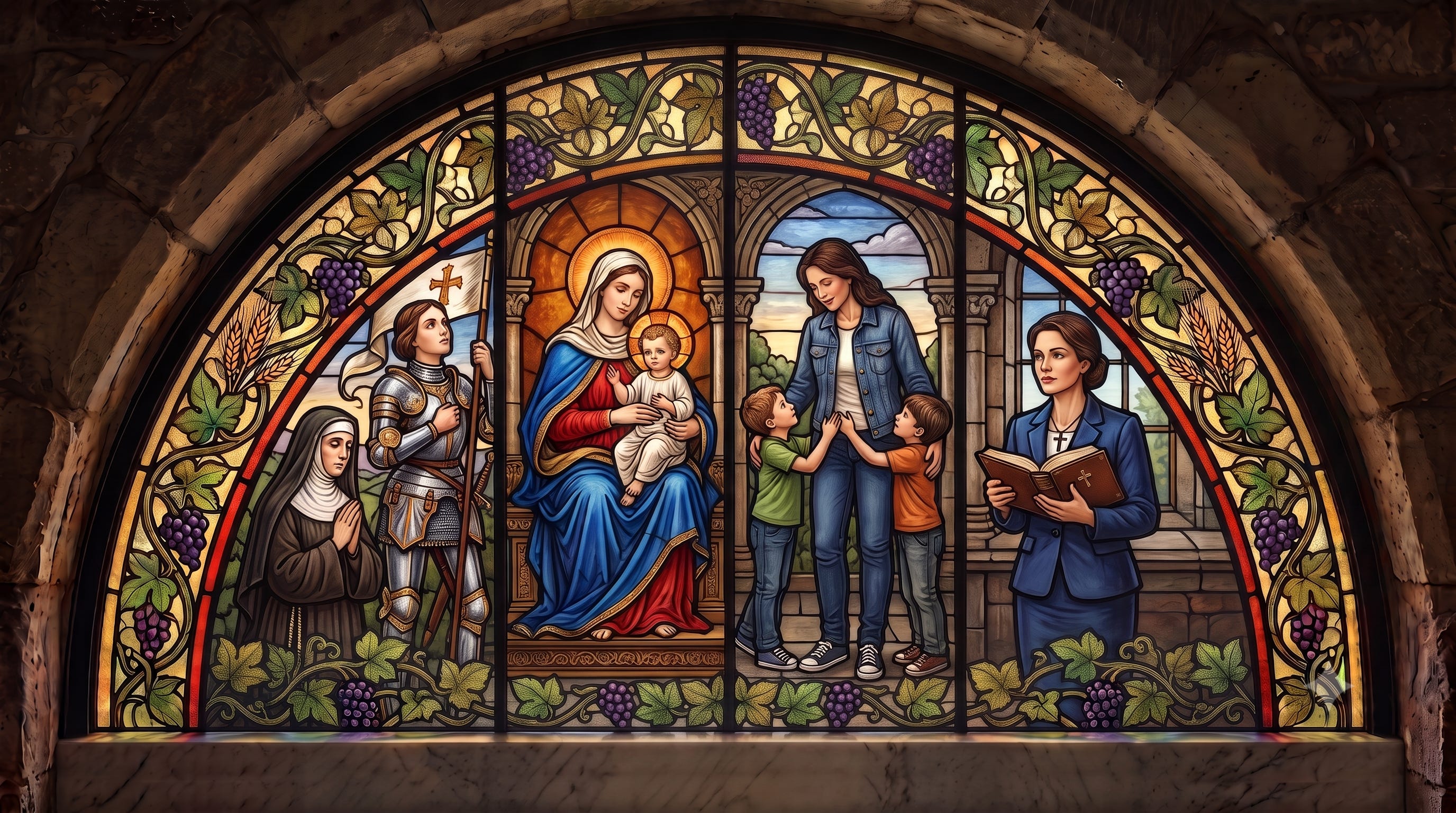
I’ve been up in the ether these past few days, thinking about liturgy, worship, and other timeless themes. Today I’m moving closer to earth. I’m talking about the place of women within traditional communities. I’ll think a little about traditional communities and the challenges many are having in attracting and retaining young women. Then, at the end, I’ll offer a few pointers specifically for women who might be weighing the costs and benefits of membership in such a community.
Traditionalism has real upsides for women (historically the more religiously devout sex), but right now it’s got a branding problem. The most visible trad influencers have leaned heavily into antifeminism and masculinism, which is appealing to a few women but alienating to most. Perusing online discussions of traditionalism and gender, women understandably get the impression that liturgical Christianity requires them to embrace a caricatured countercultural persona: abandoning their careers, junking their wardrobes, and learning to bake. That’s before we get to the marriage-and-maternity parts. There are women out there who want to cosplay 1950s housewife, but most do not.
If you have any interest at all in religious demography, you’re probably already aware that: 1) young men are today are showing a real attraction to traditional Christianity, most notably Orthodoxy, which young women do not seem to share in equal numbers, and 2) some traditional churches, most notably Mormonism and conservative Evangelicalism, are having real trouble retaining Gen Z women. The retention rates between men and women are diverging sharply, particularly in churches that have had, at least in very recent history, a strong “complementarian” bent. (That is, they place very deliberate stress on maintaining distinctive familial and social roles for men and women).
It’s not that mysterious. Complementarian communities demand a lot of both men and women, but the ask is far more countercultural for the women. Boys are told to get an education, build a career, become respected contributing citizens, and use the natural fruits of that success to support the wife and children who will be cheering them on from home. It’s not simple to do of course; achieving all that normally requires hard work and discipline, and there’s a real possibility of failure. But it sounds pretty appealing right up-front, and crucially, that life path qualifies as “happy and successful” by the normal metrics of a developed, modern society. A boy raised in that culture can picture himself doing well by doing good. As one of my sons jokes, “It’s probably not too hard to win over young men with the pitch, ‘in this culture, the dudes make money and the ladies make pies.’”
How the ladies feel about that? Well, some will probably be into it. But if maintaining rigid complementarianism is a high priority for your church, you really have to get them excited about the pies. Girls in that kind of subculture must be persuaded to junk the normal script, which in the developed world today is pushing men and women a lot closer together. Strategies differ here; some communities discourage advanced education for women, while others put heavy stress on careers as the thing women must presumptively forego. (In the 90s, Mormon girls were taught in Sunday School that it was good to go to college, but mainly so that “we could teach our children in the home.”) Complementarian subcultures nearly always lean hard on social conditioning, working to persuade girls that domesticity is intrinsically fulfilling to them specifically as women. However you tailor that message though, there’s a major built-in challenge. Women as a group are doing pretty well today in the education-and-work game, which most people in our time basically just view as “normal adult life.” If you want the girls to embrace a very different, distinctively feminine role, you have to convince them to reject that.
On a macro level, it’s clearly a losing battle. My anecdotal impression is that Mormons, along with many Evangelicals, have on the ground been softening their positions on (say) career-seeking women, in comparison to what I was taught in my Sunday School years; nevertheless, the gender retention gap is sizable. Clearly, committed complementarians are still working through some things. At the same time, the influencers seem to be in a war of zealous one-upmanship, trying aggressively to outdo one another with their extreme gender views. Once again we find ourselves groaning at “traditionalists” whose online behavior is oh-so-modern, and the optics could hardly be worse for traditional Christian communities trying to attract, or even just retain, young women.
How should traditional communities respond to all this? Do they need to adapt their positions on women? I would answer that with a cautious “yes and no.” I think it’s clear that gender roles are changing within Christian communities, and sometimes they need to change. But we don’t just want to swap one questionable gender theory for another. As in so many areas of life, I think organic adaptation will generally be the healthiest. And, as always, vocation can do some of the necessary work.
I’ll admit up-front that I’m not a particularly big fan of complementarian social conditioning. Even in its more moderate forms, I’m fairly “meh” on the kind of messaging that tries to persuade little girls that domesticity is their heart’s true desire. It’s possible (as the six men of my own household often suggest) that this is partly just a consequence of being an outlier for my sex in some noteworthy ways. Maybe? I don’t know. It’s true enough that the complementarian conditioning of my Mormon youth (even though it was far more moderate than what I encountered among Catholic liturgical traditionalists) was more misleading than helpful to me, such that I now have little use for it. That doesn’t mean that everything I learned was false, of course, far less that the people who transmitted it had any evil intent. It wasn’t helpful. That’s all. It was for me more of an obstacle than an aid in answering the question, “What sort of creature am I, and how therefore ought I to live?”
Even if I am a “gender outlier” in certain ways though, I’m clearly not alone in my aversion to robust gender complementarianism. So. I don’t think this is just about me.
As a Catholic I don’t feel much need for a “normative complementarianism” because the direct requirements of Catholic life are pretty clear and plenty onerous. In an open-to-life Catholic marriage, you won’t need a catechism to explain to you in that men and women are different. You’ll figure out, if you don’t already know, which one of you grows the babies. Further divisions of labor tend to follow on that, which is perfectly good and fine, but the task of bearing and raising many children is hard enough without everyone stressing about the most gender-appropriate division of chores. There’s a strange kind of liberty in a task hard enough to force everyone to focus on the distinctions that really matter. I’ve found traditional Catholic families, in general, to be quite adaptable, even entrepreneurial, in their efforts to raise thriving children. Reactionary excess is a luxury that nobody can afford.
I see a similar dynamic within the Catholic Church. Some things are clearly fixed, which leaves us room to adapt in other areas. We have an all-male priesthood because “God’s fiat,” which is good enough for me. It’s been clearly communicated that the subject is closed. Some people like to speculate about why God might have arranged the world that way, which is fine but also (for me) a bit of a shoulder-shrug. Your mileage may vary. In Moses’ time the Sons of Levi were chosen to be priests at the altar, and what was so special about Levi? Not a clue. God wanted it like that.
Because that’s all so clear, though, I don’t really see the kind of angst that my Evangelical Protestant friends describe, wondering whether it’s all right for a woman to give a parish talk or run a committee. (Yes, of course. Why not?) I’ll freely acknowledge that I don’t have a particularly nuanced read on “female influence within the Catholic church.” I’m a reclusive writer. I’ve never craved institutional power. But I can say this: except among the most reactionary Latin Mass hardliners (a special breed), I’ve never felt judged or harassed over niggling questions about what is or isn’t appropriate for a Catholic woman. Most Catholics seem pretty relaxed about it, even in fairly traditional or conservative communities. Vocational lines have already given us sufficient clarity for operational purposes.
There’s a general principle here that can help us to chart a path. Fix the defining principles. Stand behind those. Then allow for adaptation in other areas. We’re still learning a lot about men and women, and how they naturally relate to one another under contemporary circumstances! So, let’s keep learning things. But you do need a framework for holding the community together while you figure out the best ways to use everyone’s energies and gifts. Tradition supplies it.
Traditional Christian communities have plenty to offer women. A thick communal support network. Good husband material. Also graces! Truth! Salvation! But I appreciate that the external view can be off-putting, so here are my pointers for any women who might be on the fence.
If you’re worried about becoming a reactionary weirdo, here’s the play. Join. And don’t be a reactionary weirdo. Wear normal clothes! Keep the Taylor Swift songs on your playlist! Continue doing your Pilates in yoga pants! There’s a difference between actual requirements and cosmetic cultural practices. You’ll be doing the community a favor by retaining some normalcy. Especially those young men. Oh, especially them.
Remember that tradwifery is overwhelmingly an influencer phenomenon. Most women in traditional Christian communities aren’t like that at all. The internet thrives on manufactured controversy, but real-world traditional women thrive on solidarity and mutual understanding, and importantly, they know. They know how hard the Christian life really is. Real-world traditional women have deep reserves of human sympathy. Don’t be scared of them.
Religious faith should shape you, but it’s a rebirth, not a hobby. Your “Orthobro” types haven’t always realized that, and yes, it’s fairly normal for converts to relate to faith as a “new enthusiasm,” but at some point everyone moves on from that. You’re not necessarily at a disadvantage if you simply skip over that period of devotional geekery. Focus on the big questions. Cultivate a prayer life. Think carefully about where you yourself need both healing and moral growth. Be patient. Conversion entails big commitments, and ultimately those will shape you. You don’t need to quit your job or burn your wardrobe to pre-emptively signal that you’re the right sort of people.
Religious communities need women. Even when men supply most of the leadership, women have always been the glue that held parishes and congregations together. It’s great that young men are finding meaning in religious tradition, but don’t let them rebrand traditional faith as a guy thing! Women need it too. And those men need us. Onward, Christian sisters!
So I don't really disagree with the advice here.
But I see a lot of generalizations that don't seem to be grounded in data.
For example: yes, Orthodox churches are attracting a lot of young men. But is that because they specially affirm traditional gender roles? I've attended quite a few Orthodox churches of different jurisdictions over my 20 years as an Orthodox Christian, and I've heard little of any advocacy from the pulpit, and not much even in casual conversation with other believers, for women staying in traditional gender roles and avoiding careers. I don't see a lot of vocal or prescriptive anti-feminism. If there's a causal mechanism at work where Orthodox Christianity advocates traditional gender roles and that attracts young men but not young women, I would expect that causal mechanism to operate through what priests say from the ambon. Without that, I don't really believe the explanation. I don't have an alternative, exactly. I don't really understand why Orthodoxy has become a male thing.
You also have some general language about how women are doing well with education and careers, but that's only true of a somewhat elitish subclass. "Go to college and then get a professional career" is a minority life trajectory for both genders. You run a risk care of giving advice that is aimed only at relatively successful people and has nothing to offer that the majority. Suppose it turned out to be the case, as I think some survey evidence that I've seen suggests, the most non-college educated women would rather stay home with their kids if they could, but their households can't make ends meet that way. Would you craft a different set of advice for that class of people? You assume that the breadwinner/homemaker specialization model is more appealing to men than women. It's not at all obvious to me that that should be true, and I don't think the data particularly support it. But it's a dated question, anyway, and just quoting random opinions from your sons really doesn't rise to the level that's needed for the question.
Someone might get the impression from this post that marriage is a particular problem for traditionalist young men, because they're hunting for a tradwife deal that's not available. But the reality is that marriage is falling through the floor for everybody. Huge numbers of people are lonely and sexless, and men and women just don't seem to like each other very much anymore. There's less dating, less romance, less fertility... Just a kind of all-around fail. I guess grappling with that mystery isn't really the purpose of this post... But I think it's needed. And I don't think cheerily complacent moderate feminism that trusts there is some satisfactorily feminism friendly but also marriage friendly equilibrium on the other end of a period of transition is the answer.
I am a bit late to this but I was wandering what you make of female altar servers. AFAK there is no theological reason to exclude girls from being altar servers. Still, in many traditional communities girls are not accepted in this role due to tradition. Has this ever been an issue for you? Since you only have sons this is probably not front and center on your radar. I have a daughter that is a passionate and dedicated altar server. So that would be a considerable issue for her. But maybe in the US the attitudes are somewhat different?