


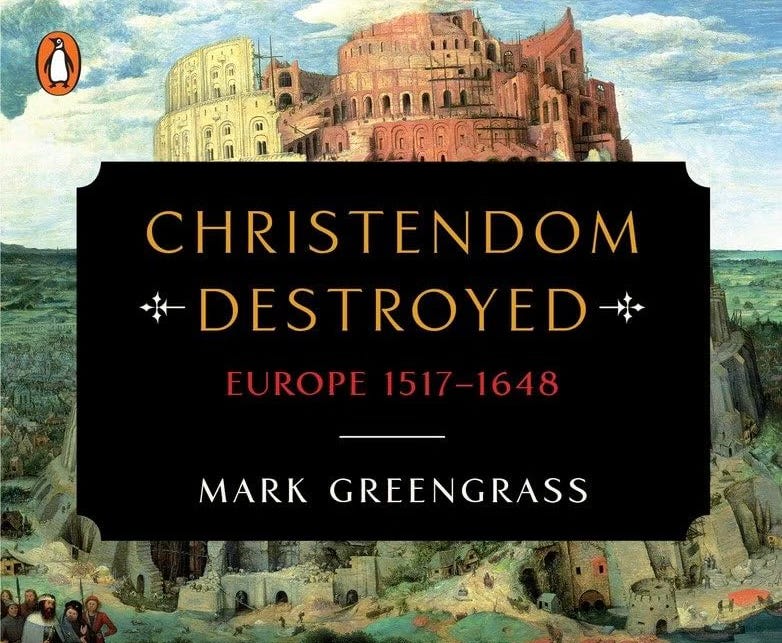
Welcome to Book Week! Last week I laid some groundwork for Christendom Reborn. This week I’m offering commentary on five different books, using them to illuminate the dimensions of my own project. I’m starting with Mark Greengrass’ Christendom Destroyed, which is possibly the least famous in this week’s line-up, but deserving of the honor because it inspired the title of this Substack.
Published in 2014 as part of the Penguin History of Europe series, it is a 700-page tome on the political upheavals of the sixteenth century. Greengrass covers plenty of ground. If only I were one of those people with a good memory for historical details, I could know a lot about early modern Europe right now. But despite the wealth of data, the book’s organizational principle is delightfully simple. In the period between Martin Luther’s 95 Theses and the Treaty of Westphalia (Greengrass’ boundary markers, as it were), people living in that chunk of land west of Asia stopped thinking of themselves as denizens of “Christendom” and instead began feeling like “Europeans.” Their dominant religious, geopolitical, and cultural paradigm was shattered in a surprisingly short period. The book is meant to explain why it happened.
Guess what? It wasn’t just one thing. Christendom was hit with a massive collision of forces in that period. Perhaps that sounds obvious, as indeed it really should be, but monocausal explanations of modernity are so remarkably common (whether that’s “science” or “philosophical nominalism” or “the breaking of the Church’s tyranny”) that it’s genuinely satisfying, and enlightening, to read a book that lays out a range of pressures that caused the medieval system to buckle.
One of Greengrass’ idiosyncratic (but oddly brilliant) quirks is an obsession with weather. He goes on at length about climates and biomes, considering their effects on building patterns, settlement patterns, agriculture, and trade. The major takeaway though is that immediately after a major population boom in the 15th century, the “Little Ice Age” (which was particularly brutal in the late 16th century) led to failed harvests and a gutted European economy. The result was famine, plague, political unrest, and a lot of soul-searching about why exactly God was so angry with the world. This, we should note, was an entirely external factor that destabilized standing cultural and political arrangements, fed into stronger and more centralized states, and intensified the Wars of Religion. (You might think of those as a kind of continent-wide witch hunt. Everyone was convinced that the other side’s heresy and corruption had precipitated the scourge.) I mentioned last week that the thriving Christendom of the High Middle Ages was in some respects a “hothouse flower.” That idea probably drew something from Greengrass, who showed how the world literally got colder in the early modern era, leading to a host of new problems for Christendom.
The Reformation was obviously a significant factor too, and Greengrass discusses it at length, in conjunction with the printing press. The pairing seems specially significant to him. The spread of ideas is good in many ways, but bad for maintaining a unified authority and shared worldview, and it’s widely recognized that Protestantism, with its love of personal Bible-reading, tended to raise literacy rates wherever it spread. Of course, scientific discovery and global exploration added still more new influences and ideas into the mix, putting further pressure on the old paradigms. Christians care about truth! Science and exploration pushed their horizons in some exciting ways. But when you’re flooded by too many new truths all at once, it can be a little disorienting, and cultural and political upheaval may be the result.
Eventually, of course, the Wars of Religion became so absolutely devastating that some sort of truce was clearly necessary. That happened at Westphalia. Affirming the principle of cuius regio, eius religio (”whose realm, his religion”), European nations largely accepted that Caesar would take the reins moving forward, leaving behind the complex balance of political and ecclesial forces that defined the Middle Ages. Political “Christendom” faded as people instead learned to think of themselves as Spaniards, Frenchmen, Swedes, or Danes.
It’s a complicated, messy picture, and yet for me the overarching narrative had a clear discernable shape. In the early modern era, the world just “got bigger” in lots of ways. The old “Christendom” couldn’t quite hold it. There really are many ways in which Medieval Christendom was sheltered; its climate, geographical location, geopolitical positioning, and ideological homogeneity all staved off certain pressures (for a time) and facilitated a remarkably cohesive social world. There’s a lot to love about that. But when those protective walls crumbled, that system was inevitably going to break down in some dramatic ways. We ended up with… nations-states. We still have those. Have you noticed that they’re under a lot of pressure nowadays? Hmm.
I’m not predicting the sudden demise of the nation state, but two things do seem true to me. 1) Nation states are not serving us as well as they used to, either in a practical sense or as a primary source of identity. 2) Unlike in the 16th century, Christianity seems reasonably well positioned to answer important questions and supply some foundational principles, supportive of civic peace and prosperity.
That does get me to wondering. Is it possible in the foreseeable future that even non-Christians might want Christianity to be a more visible unifying or identity-forming force, and even in some ways to have more political relevance?
We’ll pick up there tomorrow with Rod Dreher’s The Benedict Option.
Great job capturing key historical moments in a balanced way. It's funny how many people struggle to recognize that nation states are a modern phenomenon, largely downstream of the printing press. But print is obsolete! And that's one reason why the nation state as a form of polity is in crisis.
Christianity, meanwhile, has outlived its own putative irrelevance. There was a time, not that long ago, when it would kind of make sense, and capture a lot of people's feelings, to say: "Christian, Jew, secular, even Hindu or Muslim; it doesn't matter that much, the main thing is that we're all Americans." Wave some flags and watch the same TV shows and to go to the same conformist patriotic schools, and it really could start to seem like nationality was the essence and religion was the etcetera, No matter how thin the content of Americanism was compared to Christianity.
That's fading. Of the explanations you list in the post, I think media technology is more important than the others in explaining the shattering of Christendom. Now, for 30 years, the internet has been kaleidoscoping the discourse, at once globalizing it and nichefying it but decentralizing any kind of national conversation from people's consciousness. Expect AI to accelerate that. By contrast, Christianity isn't really losing market share globally, and it's definitely not losing relevance. I think there is a pattern whereby Christianity is gaining importance as a source of identity for a lot of very marginal believers, or outright unbelievers. What kind of future Christendom does that point to? All answers are speculative, but speculation is worthwhile on such an important topic.