


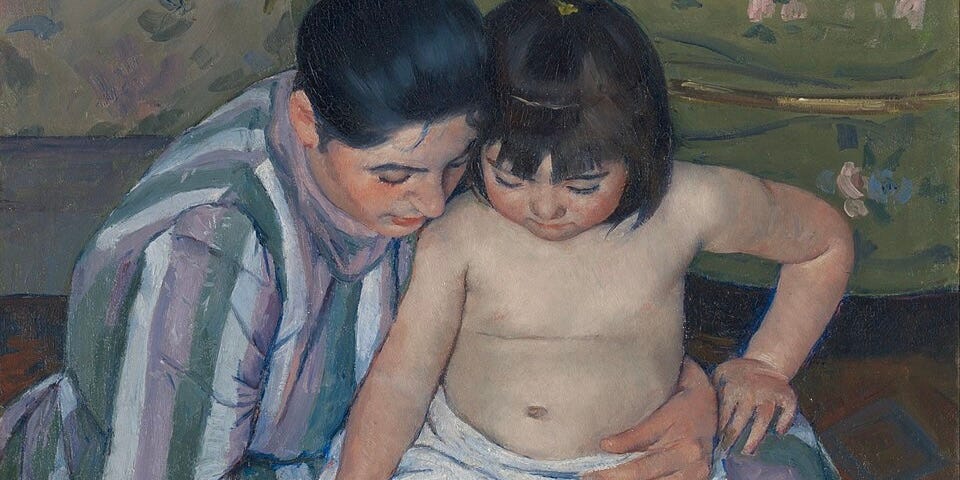
My plans for this week got a little derailed by my actual job (so unfair), two kids’ birthdays, and a family visit. So, I have another essay that I’ll probably end up posting as one of next week’s, inspired by this week’s discussion, on why there’s no such thing as “safe sex.” (It’s very unsafe. By nature. Welcome to life.)
But in the meantime, I’m posting the two “From the Archives” pieces I was planning to put up yesterday, pertinent to the subject of “vocation.” It was sort of fun, actually. I went through my files and found two pieces on maternity and vocation written a decade apart! Ha. You can see how my views on the matter evolved from early motherhood to middle motherhood.
I’ll be sending out my Weekly Wrap-Up either tonight or tomorrow. Right now I’m off on a birthday outing… I now officially have three teenagers under my roof! Rejoice?
From Aleteia, August 2014, my essay “Children Are a Burden and So Is Love”:
Given that love really is good for us, why should we dwell on the burdens? Because selflessness can be punishingly difficult in the shorter term, and modern people have trouble understanding this. In our modern parlance, “love” means little more than “a strong preference, the satisfaction of which is particularly important to one’s personal happiness.” We understand that love can be sweet, but we don’t want to accept the attendant burdens.
So obsessed are we with the language of rights that we allow love itself to be co-opted into that world. People of the same sex, we are told, have a right to love one another as spouses, in a way exactly equivalent to heterosexual love. Anyone who experiences maternal or paternal yearnings has a right to a child, which is why we must enable all interested parties to acquire children, through adoption, artificial insemination or surrogacy. The welfare of the children is very much a secondary concern. Anyone who desires parenthood (and has the resources to finance the physiological process) is entitled to offspring, regardless of their other personal circumstances.
Of course, all people want to love and be loved. This longing is fundamental to human nature. It’s hardly surprising, then, that people yearn for relationships that are not appropriate for them, given their personal circumstances. We should regard these kinds of frustrations with compassion, and where possible help to fill the breach. But we should never allow ourselves to forget that love cannot be an entitlement. It begins with the assumption of burdens, and only later yields its bountiful rewards.
Then from Word on Fire, November 2024, “Tradwives and Traditional Women,” in which I reflect on how a serious view of vocation makes the gender cosplay of the Tradwives feel pointless and unnecessary.
Here’s what I actually see among the traditional women I know. They’re practical. They’re hardworking. And they’re positively entrepreneurial about taking advantage of new technologies, tools, resources, or opportunities to meet their family’s needs. They have close, cooperative relationships with their husbands, working in tandem on a day-to-day basis to get it done. This is simply necessary, because traditional Catholic families are attempting something very difficult in a broader cultural climate that is often deeply unsupportive. We want our kids to thrive, just like everyone else, but we’re trying to raise many children into healthy, well-adjusted, marriageable and employable adults, with limited resources. When you’re climbing that crag, there’s no time for cosplay. There’s no money for period wardrobes. Who cares about such silly things? We’re focused on the task at hand: raising honorable men and women who are prepared to serve the Lord.
Naturally, the people who choose to put their lives on the internet will always be the most visible, so it’s not surprising that they form people’s assumptions about traditional women. But it is unfortunate in many ways, because it’s quite misleading. Here is an example. Reading tradwife debates on the internet, one would easily conclude that the old “mommy wars” are raging as hot as ever. Moms are absolutely tearing one another apart over the question of whether they should work. But the real Catholic moms I know, whether they have two children or twelve, don’t seem energized in the least by those tired old questions. They may have been of interest to us when we were seventeen. But now, we’re too busy worrying about the meal planning, the bills, the shower mildew, the games, concerts, and dances, and that funny sound the van has been making. We’re trying to hang on through the maelstrom of parenting. In the midst of that, who has time or energy for evaluating everyone else’s work-and-family arrangements?
As you see, the “rewards” I was anticipating were bountiful indeed. So much shower mildew! So many dirty socks!
Anyway, as we close out Love Week, here’s to embracing the actual, messy, exhausting, and bountiful burdens of love—starting with this weekend’s birthday chaos. Have a wonderful weekend!
Nothing wrong with being too busy to debate larger questions about the economic role of women in the household.
But in the grand scheme of things, it is worthwhile to discuss these things. People need advice. They need role models. And while people's situations are different, there's also quite a bit in common.
The "mommy wars" aren't a needless distraction.