


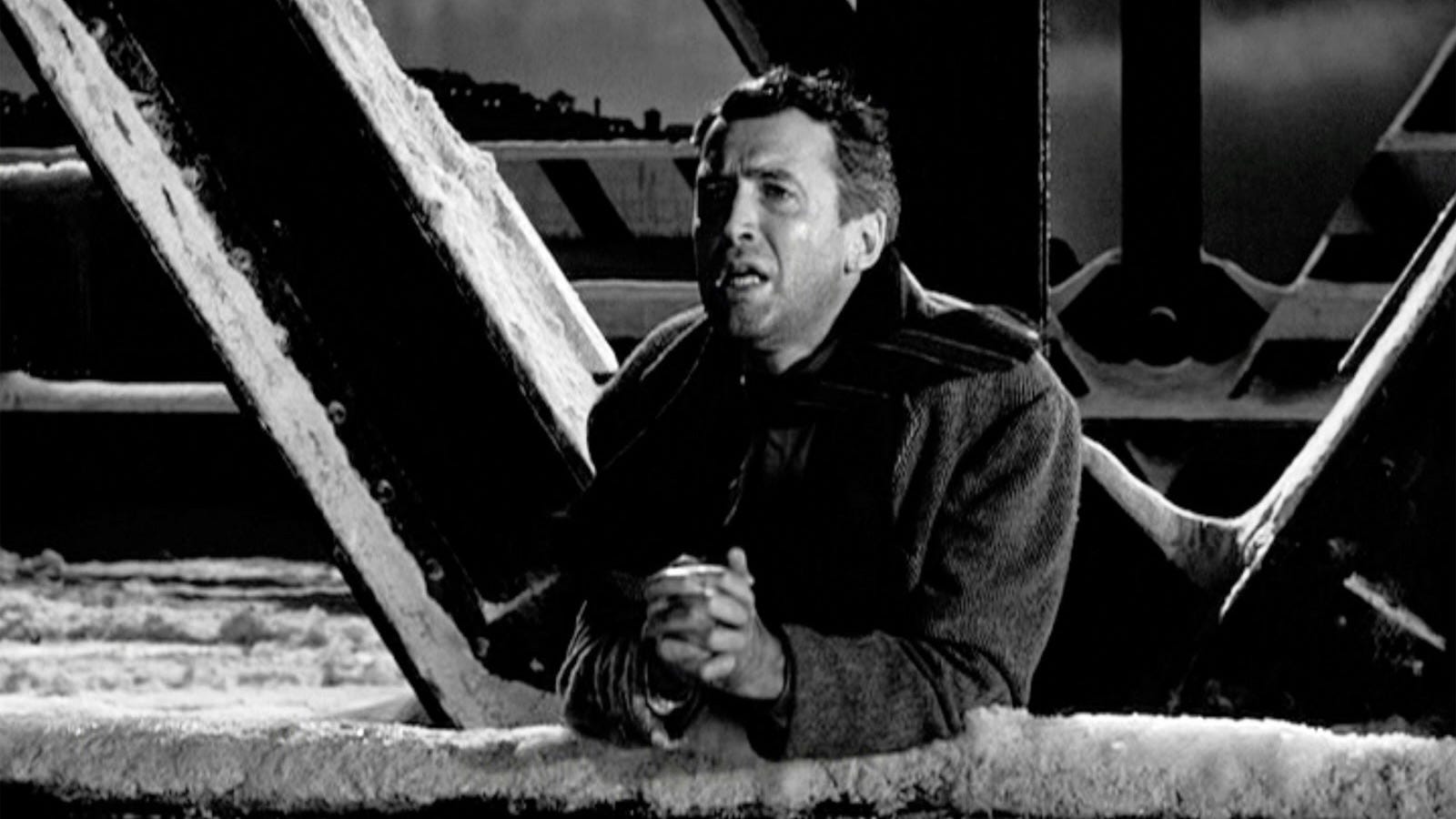
It’s nearly Halloween, which means of course that the stores are not full of candy, cobwebs, and creepy-crawlies. That stuff’s gone already, shelved to make way for the Christmas décor. Accordingly, I’m going to get into the obscenely premature Christmas spirit by giving you my take on It’s a Wonderful Life.
Everyone has one, right? Which makes sense, because that film touches all the cultural sore spots, raising questions about community, capitalism, and the decline of small-town American life. It’s the perfect proxy battleground for our “localism wars.” That makes it a reasonable place to go, following on my series of essays on marriage. Obviously, I believe that loving relationships are essential to human thriving. I’m into commitment. What about community, though?
I agree obviously that community matters. But I tend to think that human community is by nature an ever-shifting and many-hued thing. It should be built around shared loves, shared goals, and hard moral constraints. It’s not particularly great when community itself becomes the focus of a community. Here, I do really seem to be at the opposite end of the spectrum from Wendell Berry.
Let’s start with the film, though. Here I must begin by correcting a common mistake: George Bailey is emphatically not“an everyman.” George is an extraordinary man, the best man in town in fact, as everyone clearly sees. From his father (“You’ve got talent, son, I’ve seen it”), to Violet Binks (“I’m proud to know you, George Bailey”), to the shrewd and conniving Potter (who has no difficulty identifying his one true rival), George is easily recognized as the town’s most promising citizen. The board of the Building and Loan will accept no leadership but George’s. (“They’ll vote with Potter otherwise!”) And then of course, there’s Mary, the best woman in town, who “wants her baby to look like George.” More on her in a moment.
George wants to see and do great things. He dreams of skyscrapers and airfields, the chance to “shake the dust of this crummy little town from my feet and see the world.” What he does not want is to “play nurse-maid to a bunch of garlic eaters,” i.e., spending his life handling small mortgages for the citizens of a small town. But that, of course, is the life he gets.
Are we meant to blame him for wanting more? Many people do. Localists are deeply uncomfortable with this movie.They pen essays on George Bailey’s monstrous dark side, or, somewhat less preposterously, how Mary is the film’s true moral exemplar, as the clear-eyed localist, ever steadfast in her love of both husband and home. Mary is indeed a keeper! There’s some gender traditionalism in play here: the superlative man wants transcendence, while for the superlative woman Bedford Falls is “oh, everything.” But let’s not get sidetracked on that. Mary is a veritable miracle worker who picks George above “any man in town” (including Sam Wainwright) because only he can “lasso the moon.” Indeed, in Clarence’s dystopian alter-universe, this stunning woman becomes a lonely spinster quietly locking up her unvisited library, which is unrealistic but a clear signal that apart from George, no man is good enough for her.
They are properly paired. George handles the mortgages; Mary runs the town committees. George prevents Potter from suffocating the town under an exploitative monopoly, and Mary hosts the Christmas party. Together they save Bedford Falls. As the town’s First Couple, they naturally get to live in its grandest old home. Except they have to repair it first.Because it’s on the verge of being condemned.
This is not a movie about the emptiness of worldly ambition. It’s a movie about brain drain. Small towns need their most capable and driven citizens, but they rarely want to stay. As an immigrant with plenty of ambition, Capra well understood the hunger of talented men, and though he gives the film a happy ending, that adorable scene with Zuzu can’t truly bury the reality that Bedford Falls, for all its charm, drove its most illustrious citizen to the brink of suicide with its raw, relentless neediness.
A thousand sentimental Hallmark movies have painted small-town America in gauzy, Norman Rockwell colors, but those puff pieces are generally forgotten by the next morning’s breakfast. It’s a Wonderful Life is seared on the American psyche precisely because it doesn’t try to disguise the difficulty of the core problem. Bedford Falls needs George Bailey, but he’d probably be happier somewhere else.
Anyone who doubts this should note that George’s own ambitions are realized in the film by lesser men who were vaulted to worldly success by George himself. Even proximity to this man tends to produce greatness. Wainwright becomes a titan of business using a tip from George. Harry owes George for his very life, but also his college education and beautiful wife. These men seem rather happy! Nothing in their story arcs suggests that they’re meant to be cautionary tales. Wainwright is kind of a silly man, but then he always was. He seems to be living his best life now. It’s true that Harry, in the final scene, raises his glass to “My big brother George, the richest man in town.” It’s a joke, since they’re standing by a pile of money, but of course we’re meant to understand that his riches go beyond the cash. And yet. The town is still preparing a parade for Harry on the morrow. Their mom is all in a tizzy about it. No reason to think it’s been canceled.
When I think of my own happiest experiences of community, this is always the common thread. We took joy in each other, yes, but that friendship and mutual regard was shaped by what we shared or were trying to do. “We few, we happy few, we band of brothers.” Isn’t that the kind of community we really want?
Even Bedford Falls itself celebrates its military heroes more than the man who stayed and literally kept the rain off everyone’s heads. George’s life, we are told, is “wonderful.” But wonderful for whom? He reaps some real rewards.But he would surely have found great satisfaction in applying his talents to larger things.
The problem gets even harder than that, of course. Bedford Falls is at least a charming, pleasant sort of town, but small, insular communities aren’t always like that. They can be riddled with dysfunction and prejudice. Suffused in gossip and internal rivalries. Built around nutty religious cults or misguided political causes. Now obviously, as Wendell Berry’s novels repeatedly remind us, it can be morally salutary to be forced to live with people in all their flaws. If no one is willing to do that, we will all find ourselves alone. But sometimes we have to fall back on the word “wonderful” precisely because “happy” is a harder call. And in a free society that raises further questions. Don’t Americans believe in giving people the chance to “pursue happiness”?
Now, I want to give due credit to Berry here. His talents as a novelist were immense, and he clearly captured the beauty of the small community in very poignant ways. It can happen sometimes that a particular writer brings a lot of people to a true insight (“the modern world is super alienated!”) that you yourself reached long ago by other paths, and it then becomes hard not to be unduly dismissive when those people rave about him. Berry may be like that for me. In truth,I’ve read only a small fraction of his vast corpus, so in a way this isn’t even primarily about him, but more about what you might call his “secondary impact.”
He seems to have become a bit of a totem for the view that we must do absolutely everything to recover True Community. Quit our office jobs. Move to the countryside. Destroy our word processors. Religiously he seems to have been a kind of Christian, but quite heterodox, and very ready to throw the book at other Christians when they didn’t agree with him politically. He didn’t like divorce or abortion but was inclined to view those problems “structurally”; the real key is to fix our soulless economy, cease our wanton destruction of the environment, and obviously sever our soul-destroying attachment to our phones, computers, cars. Then we’ll be less alienated, our communities will flourish, and people will be far less inclined to kill their unborn children and abandon their spouses.
So I bring him up here simply because it’s helpful for illustrating my own position. I am the un-Berry. I contend that True Community, as such, is not the proper goal, for our politics, our culture, or ourselves. We cherish it when we find it, as well we should. But it’s properly found through our shared quests, our shared loves, “the things we do together.” When I think of my own happiest experiences of community, this is always the common thread. We took joy in each other, yes, but that friendship and mutual regard was shaped by what we shared or were trying to do. “We few, we happy few, we band of brothers.” Isn’t that the kind of community we really want?
This is not to deny that, like George Bailey, we are sometimes required to sacrifice personal happiness for something larger than ourselves. But I think those commitments need to be cashed out personally. There are things men and women of honor will not do, and things they must do. We confront those demands when they meet us. That might be in the form of a board saying “they’ll vote with Potter otherwise,” or an aged parent requiring attention, or two pink lines on a strip. But however it goes, we must live our lives as persons, not indentured servants of the communal collective.
I appreciate that this view has a built-in vulnerability: it demands purpose instead of supplying it. To the already-alienated it may seem like a counsel of despair. Community can’t heal what ails you! First you have to find purpose,then you can have community. Sounds like the view of an immensely privileged person!
In a sense, it is. But you already know what I’m going to say. In the Christian worldview, every human life isconsequential. Every person that breathes is on a kind of quest: a transcendent quest, imbued with noble purpose. Berry goes to church first and foremost to see his neighbors, and urges people not to fixate too much on dogma and creed. My own advice is to fixate on dogma and creed. Go to church to worship God, and you’ll find over time that the people who join you have become your community. And it will be a community built on something true, not just “we’re stuck with each other,” but Credo in Deum, Patrem Omnipotentem.
God bless the George Baileys of this world. We do truly need them. But if we want them to be happy, and not hostages, we need to think carefully about what community can and cannot do.
This was so interesting to read, and also challenging for me (in a good way), as someone who has found myself, quite devastatingly, without real community even though we recently moved back to my home city. I agree that individuals should always feel free to pursue ideas/goals/opportunities beyond their immediate context... but I also think that, when this becomes the norm, it starts to shape us in certain ways and may make us less able/willing to see the (legitimate) claims made on us by the more dependent - particularly the elderly. I live in South Africa, where many educated and upwardly mobile people move to bigger cities or emigrate, leaving their parents behind. I can't tell you the number of times I've been out in public with my toddler and had an elderly stranger tell me, unprompted, about their grandchild who is in Australia/ Canada/ Europe and who they never get to see - it's heartbreaking.
I keep wondering if maybe there's a "happy medium", something like what Lane Scott is doing by building culture in a home and community, while still encouraging exploration... but in my experience, that middle ground doesn't last long - especially if economic conditions are difficult - and you inevitably get a growing class of "Anywheres".
Just my rambling thoughts - thank you for a thought provoking essay!
What wonderful writing! Fascinating and perceptive. A joy to read.
if you ever have time, I'd be interested in your take on my "Twelve Days of Christmas" From the perspective of what it has to say about community. :)
https://lancelotfinn.substack.com/p/the-twelve-days-of-christmas