


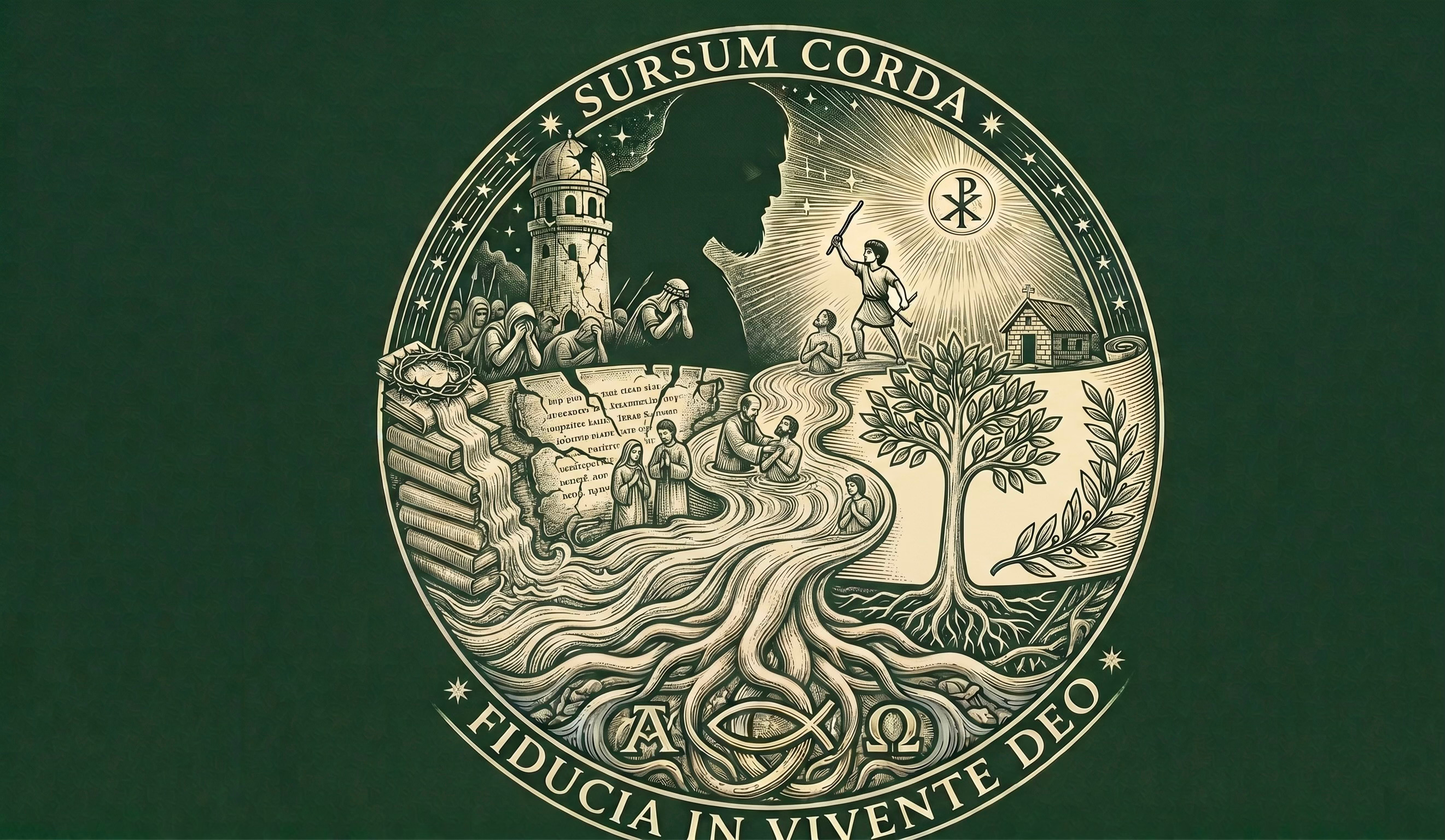
I think it’s time to say a little more about my motivations for starting this project. Actually the immediate spur was a crash-and-burn job interview. But I’m not telling that story today. Today’s theme is despair literature and how I got thoroughly fed up with it.
I’m thinking especially about anti-modern despair, built on the conviction that the contemporary world is so broken, so depraved, and so uncompromisingly hostile to tradition (particularly Christian faith) that we cannot really live in it. Dramatic action is absolutely required. We must retreat to catacombs, build bunkers, stage revolutions. Until modern errors are utterly vanquished, repression will always be just around the corner, cultural hostility will inevitably intensify, and Christianity will perpetually struggle to survive. Modernity and Christianity are implacable enemies whose differences cannot be resolved.
Now, truthfully, I myself am far from satisfied with modernity. I’ve been a religious conservative more or less my entire life, so the culture war ethos is quite familiar, and I certainly do believe that our culture has some deep problems. I’m reasonably well-versed in the conservative/traditionalist critiques of modernity, from Ideas Have Consequences to After Virtue. I accept, in fact, that conservatives and traditionalists have a time-honored duty to go on explaining What’s Wrong With the World, and that those explanations will typically be reiterations of the basic point, “We think we can jettison tradition without cost, but that’s not actually true.” I’m not scornful of that endeavor. It matters.
Nevertheless, over the last decade or so I became increasingly disillusioned with the wave of despair literature that seemed to wash over the Christian world. It was panicky and hyperbolic, heavy on alarmism but light on logic. Unoriginal, too, forever trumpeting familiar anti-modern critiques as though they were newly discovered. Alienation is a serious modern problem! Secular governments tend to be suspicious of established religious faiths! Bad things happen when liberty devolves into license! Yes, well done, modern political commentators. You’re killing it.
Bad and unoriginal books are hardly a new thing. The demoralizing part, though, was that people seemed to be reading them and, well, becoming demoralized. I could see in my own networks of friends and acquaintances, where everyone wanted to discuss the Benedict Option, whether liberalism was failing, how many more years until we were worshiping in the catacombs. Unbalanced books were creating unbalanced conversations and expectations. They weren’t harmless.
In the end, my real issue with the despair books wasn’t that they were hard on modernity but that they seemed soft on Christianity. They were tapping into, and even selling, the palpable fear that Christianity simply might not be able to survive under modern conditions, or at least that it was likely to be driven to the far margins for the foreseeable future. It all started to feel unseemly. Self-indulgent. Pusillanimous. Christianity historically has weathered many tectonic changes, adapting itself to all sorts of conditions. Should we maybe give it a bit more credit?
As a child I loved the story of David and Goliath. This is a perennial Sunday School favorite, of course, but to me the best part wasn’t actually the giant killing. It was earlier in the story. David is sent by his parents to bring food to his older brothers, who are soldiers in the Israelite army. He happens to arrive on the scene in time to see Goliath emerge and issue his challenge: “Who is brave enough to fight me?” The Israelites cower. David is furious and ashamed. “Who is this uncircumcised Philistine,” he thunders, “That he should defy the armies of the Living God?” I loved that line.
It haunted me as the despair books (and articles, and podcasts) piled ever higher. First they became tiresome, then they started to make me mad. Why are we cowering like this? Do we really think that our faith can be defeated so easily? Are we the ones who think that God is dead?
I appreciate that this criticism can be applied unfairly. I have already acknowledged that it is often necessary to critique modern errors; I have certainly done so in my own published work. No doubt I have myself been guilty of “cowering” at times. Past a certain point though, it just becomes lazy and self-indulgent. We’re past it. I’d say we’re miles past it.
I started thinking about Christianity’s long and complicated history, and the many lessons it could offer. Every day, the despair books felt more and more parochial. And in my mind, a new question began to formulate.
We’ve read a million explanations for why Christianity is declining. But let’s try asking a different question. Why is it still here?
It would have been startling to practically everyone in the first few centuries who had even heard of Jesus. To the Romans Christianity looked like a bizarre, marginal splinter sect of Judaism. Christians themselves, meanwhile, clearly expected in the early days that Christ would return quite soon. Two thousand years later, the world is still here, Rome has long since fallen, and two and a half billion Christians are walking the earth. What would the ancients have thought if you’d told them that?
The rise and fall of multiple empires. Scores of heresies and other philosophical errors. Plagues, famines, natural disasters, invasions, tyrants, revolutions, totalitarian repression. Christianity has come through all of this, and remains the world’s most global faith, but we think gender ideology may be the death of us?
I don’t mean to trivialize contemporary problems, but if you’re tempted by the doomer script, it’s worth spending some time thinking about Christian resilience. What explains it? If Christianity could survive all those things, maybe it’s better equipped for present challenges than we sometimes think.
So that’s where I’ll pick up tomorrow: the three keys of Christian dynamism. I will tell you, in very basic outline, what I see as the secrets of Christian survival.
engaging and persuasive, and helpful in motivating the argument. This is kind of low-hanging fruit. And if some may find it unnecessary because we always took the despair books and the doomscrolling dismissively without bothering to explain why, that actually underscores the value of the project. Somebody should explain why! We shouldn't all just assume that it's obvious why these bestsellers are wrong!
Christian resilience is a fascinating theme, in part because it's tied up with Christian apologetics. if you really wrap your head around the amazing way that Christianity has outlived nations, languages, civilizations, empires, philosophies, and every other normal product of human history (if there's a case to be made for any exceptions, they are very few), it's really hard not to see that as a reason to give Christianity more credence as a candidate for being true. if you're planning to explain Christian resilience without including truth among the best candidate reasons, I wonder whether that argument is possible without considerable distortion. The best explanation of Christianity's unparalleled resilience really is precisely that God is moving in history through the Church. That point has been made before, for example by GK Chesterton, but that's no reason not to make it again. On the contrary, it's convenient, in a way, that people have come along who are so naively despairing as to give you a pretext for re-engaging the pleasant task of marveling at Christianity is miraculous durability. :)