


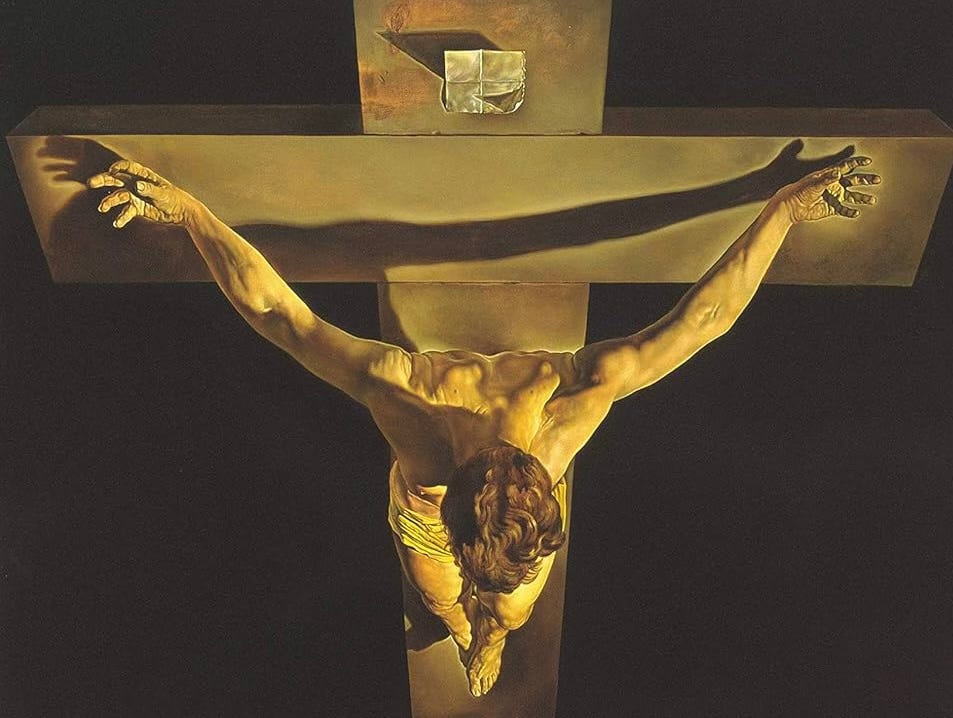
Yesterday I talked about Rod Dreher, a Christian who sees darkness and godlessness falling on the West. Tom Holland, by contrast, is a kind of noble pagan who thinks that Christ has already won the culture wars so decisively that it’s hard for us even to notice. Christianity is in the water we drink and the air we breathe.
It’s an odd pairing, perhaps. But this can happen. Holland was an unbeliever for many years; he now goes to church and refers to himself as a “cultural Christian,” but is still accustomed to looking on Christianity from the standpoint of an outsider who suddenly realized he might be a bit of an insider. He tells the story in the introduction of the book, explaining how his younger self was fascinated by ancient empires and bored by Christianity. Many years later, after writing several bestselling books about Rome, Persia, and the ancient world generally, he realized that he didn’t reallywish to live in a harsh, pitiless pagan world. And a second thing became clear to him too. It was Christianity that had saved him from that fate. Jesus’ message of mercy and love tamed the pagan monsters, and the free societies of the West grew from that soil.
Sometimes it takes an outsider to remind Christians how strong our position really is. Winston Churchill referred to these sorts of people (including himself) as “flying buttresses” supporting the Church from the outside. Holland plays a similar role, or at least he has in recent years.
He testifies to an important truth: Christ’s cross changed world history. As a pagan historian he looks at this-worldly impacts, not other-worldly, telling the story of Christianity as he understands it in his bestselling book, Dominion. The road Holland walks is well-trodden (at least to the intellectual historian’s eyes), but it’s none the worse for that, especially because he, as a popular historian of antiquity, is such a very credible witness. In the ancient world, strength was celebrated and weakness despised. Jesus, as a god who submitted himself to torture and death for the sake of contemptible sinners, flipped that value system entirely on its head. He moves through Christian history, watching each civilization struggle with the radical implications of this view, showing how our own assumptions about justice and goodness flow from that effort.
The book ends in the modern era with Holland arguing that even secularism and its various offspring are really in many ways the descendants of Christianity, perhaps best understood as “modern heresies.” Some people found that view daring and (possibly) offensive. It had been my basic paradigm for years before I read Dominion, so naturally I was very pleased to find it in a widely-discussed bestselling book.
Needless to say, my project is very harmonious with Holland’s view. He’s a historian and I’m a trained philosopher, so our perspectives are a bit different, and I think it will be possible here at Christendom Reborn to explore Christianity’s resilience and dynamism with a bit more clarity and precision than Holland typically offers. He “argues” mainly in narratives; sometimes it’s good to make arguments. I want to drill down a bit and consider more explicitly how Christianity facilitated a rich intellectual tradition, a new kind of political tradition, and the humanistic ethos that is most centrally important to Holland.
Nevertheless, it’s clear that he and I see similar things. When I wrote last week that “expansive human understanding, freedom, beauty, human dignity, virtue, love” are rightly seen as some of “Christendom’s most precious fruits,” that was a Holland-esque sort of claim. He also shares my interest in the question, “Can these exquisite flowers survive and flourish outside the hothouse of medieval Christendom?” Holland knows that Christianity is the rootstock. He sees that neo-paganism (think “cruelty of the revanchist right”) and postmodernism (think of the insane excesses of the woke left) are to some extent the result of that tradition eroding, and in other ways less-than-lovely mutations of it. He knows too that secular humanism is a thin, inadequate substitute.
However, as someone who has struggled with belief, he also struggles with the question of whether Christianity can recover. He knows of course that the roots run deep, and that Christianity’s dynamic power is immense. It seems possible to Holland nevertheless that Christianity’s resources could be spent down to the point of bankruptcy. This may be the point at which an actual believer’s view will be sunnier (or more naïve?). I have a lot more confidence that Christianity can still come out smiling, a point I plan to argue in this space. As much as I appreciate the value of the flying buttress, it is both fascinating and sometimes a bit frustrating to see a writer like Holland come as far as he does and not quite be able to persuade himself: Maybe this myth is so powerful because it’s true?
Come on in, Tom Holland. The water is warm!
At least, I’ve found it to be so. Not everyone agrees with that though, which will lead us to the next post. Come back tomorrow for a cold bucket of ice water from sociologist Christian Smith.
The pushback here is that maybe Christianity discovered important truths, but can't the truths endure without the Christianity? If we learned human dignity or moral equality or freedom of conscience from the Christians, can't we keep those things regardless of whether Christianity is accepted.
At a practical, yes, a lot of that is possible and has happened. That's much of what Holland writes about. But the theoretical underpinnings of liberal post-Christianity are remarkably thin, arbitrary, and/or confused. Much of modern moral and political philosophy seems to be struggling to reach Christian conclusions without Christian premises. Meanwhile, most of the time, Christians were still the majority and held enough high office to help the government on side. And when that was not the case, as in the Soviet Union, the results were monstrous.
Liberalism needs Christianity, in practice and in theory, much more than it likes to admit.