


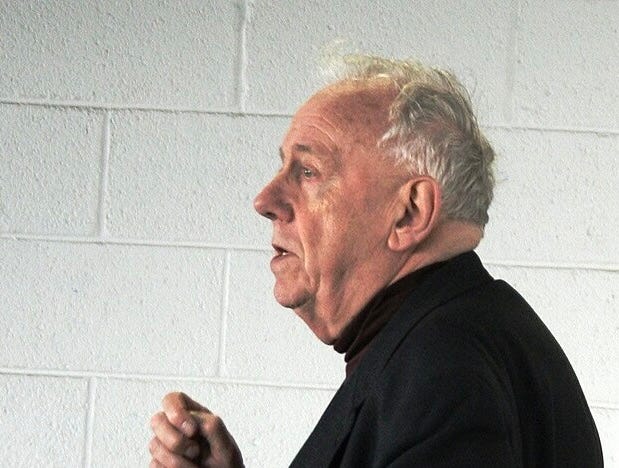
Since it’s hot off the presses today I’m just going to post this Law & Liberty piece from yours truly, on MacIntyre and “the common good.” We’re doing a full symposium on the subject this week, inspired (if that’s the word) by a right-wing dust-up a few weeks ago that, in our estimation, brought a lot more heat than light. It so happened I was reading this MacIntyre book anyway, which has a whole lot to say on “the common good,” so it made sense to focus my analysis on that. (Here’s John G. Grove’s essay, and you can read Michael Pakaluk’s at Law & Liberty tomorrow.)
It’s quite relevant to this week’s theme. Basically the core argument is that MacIntyre believed in organic order, but not really in emergent order, and that left him unable to say much about the common good. He was admirably frank about what he was able to explain. But it wasn’t much.
While I do genuinely appreciate MacIntyre’s honesty on this, it’s also true of course that in the meanwhile we have to go on living. To maintain order, stability, and civic peace, we thus end up depending on a lot of political apparatus that MacIntyre isn’t quite willing to endorse. For that, we owe a great deal to… the godless conservatives.
As I write in the piece:
One can understand why we see angry populists issuing dramatic, uncompromising condemnations of core features of modern life: liberalism, pluralism, the global economic order. But MacIntyre rejected that form of rejectionism. It’s hard to think of anyone with a keener appreciation of modernity’s deficiencies; nevertheless, he insisted it was necessary to find ways to live in the world as it was. He realized, in making that case, that he was working with a limited toolkit. He had no principled commitment to free markets, social contracts, or any understanding of civil, political, or human rights; to the contrary, he had a marked hostility to the entire classical liberal tradition and all its modern-state apparatus, which one can at least understand given his defining life project of charting the fragmentation of modern moral discourse. The downside to that view, however, was that he simply had no framework for securing order without falling prey to the power-hungry state. He believed deeply in organic order, but rejected all plausible accounts of emergent order, which left him with no practical account of how a functional political community could actually form under modern circumstances.
I don’t really go into recommended solutions in the piece. But if you’ve been reading Christendom Reborn, you probably have a reasonable sense of what I recommend. I’ve written enough about MacIntyre already that I don’t really need to stress that he was an immensely important influence, whom I view with deep respect. The book was all the more interesting for that reason. It’s MacInryre all right: clear, incisive, entirely frank. Which makes it all the more useful for delineating the limits of his Aristotelian project.
Godless conservatism has limits too! Looking forward to discussing those tomorrow.