


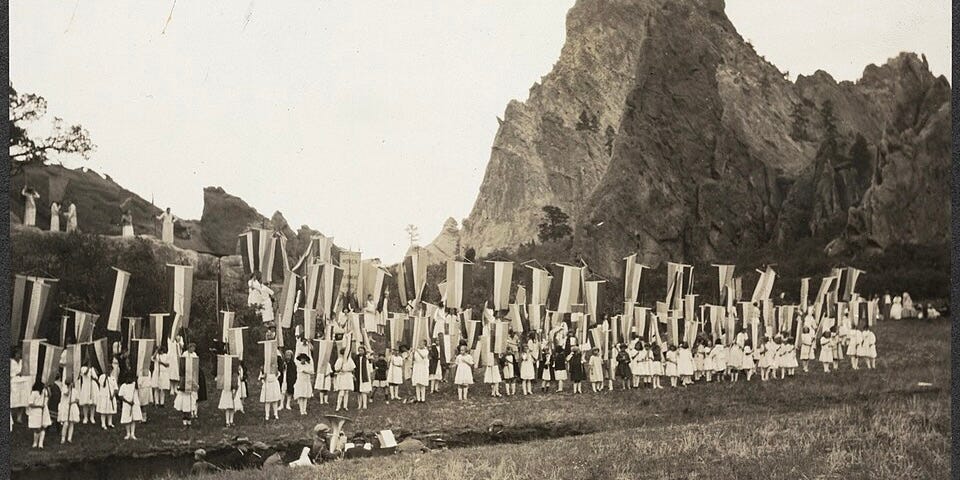
I’m used to being the only woman, or one of very few, at conferences full of men. That’s my conference-going normal. It felt quite strange, therefore, to attend a conference last weekend that was absolutely packed with women. It’s not a bad kind of strange! Actually, this was the best kind of conference, because I met many people in person who had been virtual friends for years. What a treat.
What was this rare event? Well. Hmm. It was labeled “The Women’s Convention 2026.” You might notice that that’s some remarkably nondescript branding. In an age when everything is supposed to be memed and tweeted, prepackaged for easy identification, the selection of such a non-revelatory title is itself somewhat revealing. This group is trying to have an intelligent, nuanced conversation about women, and they’re aware of the gravitational pull of our toxic culture wars. So they went with a simple title, and relied on their speaker line-up and advertising channels to attract the right sort of people. Don’t be fooled though. They are neither vapid nor directionless. “Women’s Convention 2026” had real goals, and I thought it was a real success.
That speaker line-up included me, by the way. I spoke on the concluding panel. I think those remarks are meant to be published in some form, so I won’t rehash them here, but I’ll make them available when I can. Here I’ll just give some general thoughts on the conference and its purpose (as I perceive it).
“So what is this group, Rachel? Stop dancing.” Fair enough. If you’re familiar with Fairer Disputations, it’s that crowd. If not, you could get in the ballpark by calling them “conservative feminists,” but you’ll need multiple asterisks there. Not everyone in the group self-identifies as conservative, and some people still bristle at “feminist.” Now, the conference ended with the reading of a Declaration of Principles on the site of the 1848 Seneca Falls Convention, and I personally consider that anyone willing to participate in that should probably make their peace with being labeled as some sort of feminist. I myself am fine with “conservative feminist.” But if some angry third-wavers bitterly assure me I’m not the real deal… fine, whatever. It’s perfectly true that I have never, at any point in life, undertaken to work within any defined “feminist tradition.”
If you’re just looking to stick a pin in the right spot on the map, I actually think the best label might be “anti-anti feminist.” That is 100% my own assessment, but I can explain. If there is one single stance that seems to unite every person in this space, “opposition to contemporary anti-feminism” would probably be it. They have a lot more shared ground than just that, of course: Most of these people are very pro-life; there is staunch opposition to pornography and surrogacy; they’re cool with women (including mothers) working but also with at-home homeschooling moms; they think that the suffragettes had at least some things right and that the second-wavers had at least some things wrong. But there can still be lively debate surrounding most of those topics. I doubt any of the 200-ish people at that conference would argue that Helen Andews’ “Great Feminization” thesis hit the target. Or that Carrie Gress’ The End of Woman was a worthy work of cultural criticism.
I’m not suggesting they should have labeled the conference “anti-anti feminist.” That would grossly distort the mood and directionality of the movement, giving the impression that we gathered in Rochester mainly to destroy antifeminist ideas with fire, when in reality I didn’t hear Gress or Andrews directly referenced in a single session. There’s a “build and explore” ethos to the Fairer Disputations space that I find very refreshing, and I think the central figures sincerely wish to advance the real thriving of women, in a way that is consonant with both nature and contemporary circumstances. They’re also pro-male, pro-family, pro-marriage, pro-community. These are not narrow partisans looking to settle their scores! I do nevertheless think the antifeminism has given a certain shape and focus to the group.
I think part of what happened here is just that segments of the populist right have grown so reflexively hostile to women that some have bounced out and gone looking for places where they don’t feel like objects of casual contempt. I talked to several people this weekend who clearly had that feeling, which depresses me, especially with the younger women. Like it’s not hard enough to put all these pieces (men, marriage, kids, work) in reasonable places without being pressured at DC happy hours to prove how “based” you are by railing against the 19th Amendment? For crying out loud.
I’m not the sort of person who normally races to “mentor” younger women. I don’t pretend to understand their circumstances with clarity, nor do I assume that they want my advice. Am I some great success story? Debatable. In that company though, you do start feeling the impulse. Look, I’m no J.K. Rowling but I am happily married with five kids. And I like my work! I get men edits, not coffee! People pay me for essays on subjects that I deem interesting! Don’t let the baby chauvinists of the New Right convince you this can’t happen, or that you’re somehow wrong to want it.
Paradoxically then, I admire the group’s constructive spirit but also feel that “destroying anti-feminist errors with fire” probably is one of the worthiest things it could accomplish. (I’m factoring attainability here. Ridding the world of smut would do far more good overall, but how would we do that?) But I also think that project, undertaken in the right way, has potential to bear other fruit. Antifeminism is out there, having its moment, but evaluated on a philosophical or scholarly level most antifeminist literature is just absolute trash. It exists because it sells, mostly to embittered, gender-resentful audiences. Nevertheless, explaining why it is trash, to an audience more closely aligned with the antifeminists, is a significant project requiring real intellectual work. There are multiple angles to the problem calling for different forms of expertise.
Getting perspective on womanhood is a non-trivial undertaking, after all. There are elements of biology and anthropology, but also history and political theory, moral philosophy, sociology, law. Art and literature are relevant at many points. Public policy matters. It’s helpful to have people who have engaged feminist literature in a sustained way (as I have not) so they know what Gloria Steinem and Simone de Beauvoir actually said. And of course, if one wishes to stay grounded in reality, it’s helpful to get perspectives from people with experience of different age groups, demographics, and life situations. There were people from a wide range of backgrounds and disciplines at Women’s Convention 2026, debating many points of real disagreement, and yet the mood was exceedingly friendly and upbeat. Maybe that’s Helen Andrews’ real gift to women?
We’re all pretty tired of vacuous “conversations about” social issues, and yet a serious, substantive conversation about women and gender could do some real good. Many people are sincerely confused about these topics, often for good and understandable reasons. So a movement like this should certainly be working to articulate better, more nuanced answers to sincere questions that many people have. I always work on assumption that most Americans actually want to have a free and basically “inclusive” society, which affords all people a chance to forge a good life. I believe that.
At the same time, I also think that our tumultuous political landscape, and right-wing populism especially, has given rise to a non-trivial group that is genuinely sexist in the fullest sense, meaning they want to believe that women are the inferior sex. And that it is appropriate to treat us as such. Relatively few would profess that view openly (though there are a few!), and I’m sure many people who are attracted to these views would nevertheless insist, even in their own minds, that they don’t really view women as inferior, merely “different” or “complementary” in ways that just happen to relegate us to a properly subordinate status in more or less every sphere of life. Because men and women are actually different, there are always wide avenues to “separate but equal” visions of the sexes that aren’t remotely equal in any measurable way. But of course, mystical and moral equality are largely unmeasurable. Healthy cultures do recognize that moral equality can hold across people in very different circumstances and conditions. So it’s hard to make charges of “sexism” stick, even if one is fairly confident in the diagnosis.
In the harsh environment of toxic online culture wars, that fig leaf may fall away. People reveal their real feelings about women. It gets ugly. We’ve seen quite a bit of that ugliness of late.
It can take real work to persuade people that they are in fact eager to see women as the morally inferior sex. (And often, by extension, wanting to conclude that marginalizing or exploiting us may therefore be somewhat acceptable.) Most people deny this, and one rarely moves the ball by flinging angry accusations, so you have to show people that the conclusion falls pretty naturally out of their own premises, then work backwards to the question of why they embraced the premises in the first place. It’s a fairly laborious process. But it’s the kind of process that calls for a dynamic and nuanced conversation, not just a spewing of memes. And it requires some measure of insulation from the polarized genderslop of social media, hence “Women’s Convention 2026.”
One can’t expect a single gathering to change the world, but I found it pretty uplifting. I was impressed by the concentration of intelligent people, the range of lively disagreements, the constructive and generous spirit, the juxtaposition of moral seriousness and winsomeness, and the very evident joy people took in being there together. I’ve been to a lot of thoroughly forgettable conferences; this was a memorable one.
I was also chuckling at myself this weekend, because I have to acknowledge that for years, I’ve shied away from anything that looked too much like a women’s movement, not because I don’t like gatherings of women (I do!) but more just for “typecasting” sorts of reasons. When you’re a Catholic mom of five, and a writer, people tend to want to slot you into one of the obvious categories: spirituality, feminism, parenting, work-life hacks, family policy, education. And yes, I do sometimes have takes on those topics, but I’m also a trained philosopher who works for classical liberals. My next two conferences are on conservative political theory and the Articles of Confederation. The stack of books on my desk right now includes one book on gender theory, but also books by Ratzinger, Adam Smith, Leo Strauss, Archbishop Fulton Sheen, and St. Justin Martyr. I’m a proud Catholic mama, sure, but my intellectual life doesn’t all emanate from that particular place, and anecdotally I’ve found that it is sometimes necessary to protect myself from being written off as a glorified mommy blogger. (Even though, yes, I have a Cornell PhD. In philosophy. Not women’s studies.)
There I was, though! Not just moonlighting, but addressing the closing session of Women’s Convention 2026. I’d like to say that I’m too established now to worry about typecasting, but eh, I doubt it. Other factors just outweighed, I suppose.
One of those factors is “Erika Bachiochi,” who, as I sometimes tell people, is a kind of a Bill Buckley or Richard John Neuhaus of Aristotelian feminism. She has a talent for friendship, and a way of drawing people into a space where they also discover each other and a host of common interests. It’s one thing to be leery of “women’s movements,” another to be leery of friends. Or making common cause with friends. I’m not planning to remake myself as a crusader for women’s rights, but I did feel grateful to be there, among friends. And I hope some of those women, the younger ones especially, do look back years hence on Women’s Convention 2026 and think, “Yeah, that mattered.”
Have I ever told you that my late maternal grandmother was friends with William F Buckley, Jr? He was also my uncle’s godfather. (Ironically, I’ve scarcely read a word he wrote.)
Like you, I’d like to call what we’re doing “Aristotelean feminism” but that may be even less evocative for most than 2026 Women’s Convention.
Thanks for this post, Rachel - really enjoyed reading your reflections and glad you thought it a success. Can’t wait to publish your remarks!
You summed it up really nicely, Rachel! And it was great hanging out with you.