


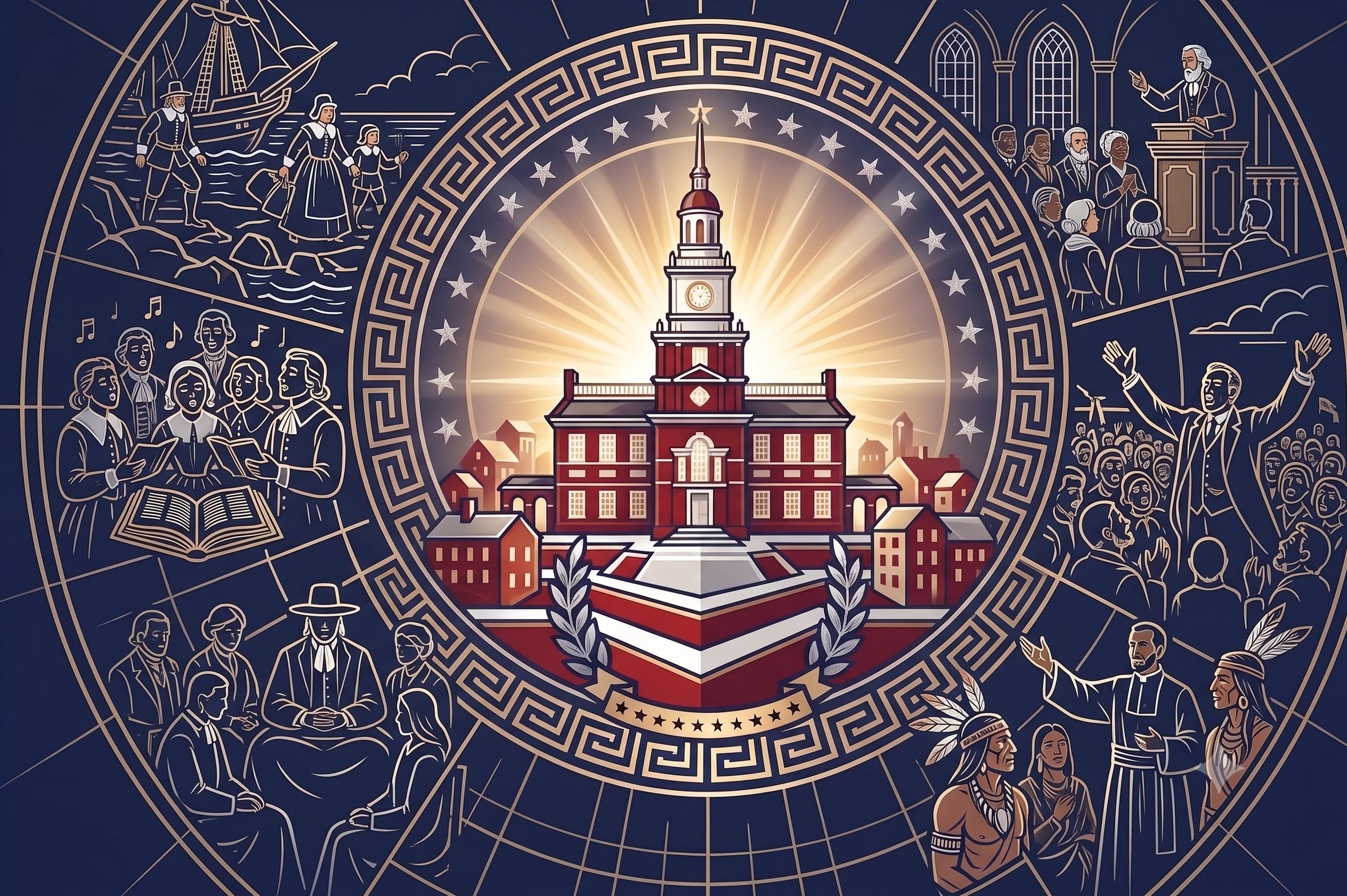
The United States represents the most successful, most extraordinary experiment in religious liberty the world has ever known. Religious freedom is a big part of America’s story, but for that reason, America is also part of Christendom’s long story. I’m proud to be an American for many reasons but this is certainly one: I genuinely believe that my nation played a transformative role in moving Christendom beyond Westphalia’s not-so-satisfactory compromises, to a place where we could explore the potential compatibility of faith and freedom.
It was a major step, which opened a lot of hard questions that we’re still working to answer. As we’ve already seen here at Christendom Reborn, this is basically true of all major pivot points in Christian political history (Constantine’s Milvian Bridge moment, King Henry IV standing in the snow at Canossa), so it shouldn’t surprise us if the legacy of the American Revolution is a bit complicated. But it mattered. And I myself believe that the step the Americans took in 1776 was a good one, which opened the way to greater Christian thriving in the modern era.
So how did it happen? Why the Americans?
America was the first modern nation to embrace religious disestablishment very intentionally, explicitly structuring it into our Constitution. But we emphatically did not do that for secularist reasons (e.g. because we wanted to write God out of our nation’s history). Even secular reasoning (of the more modest “wall of separation” variety) was really more of an accent note to colonial America’s culture and public conversation. We did it, first and foremost, for religious reasons.
This is really quite an extraordinary thing. People today, in their crushing ignorance, tend to be insufficiently impressed by our Revolution’s religious character. Weren’t all people highly religious in The Old Days? Actually, no! The modern era has been replete with philosophical fads and political religions, often intensely hostile to traditional faith. One such movement upended France at right around the same time as our own Revolution! So it wasn’t at all a given that the first intentionally nonsectarian nation, the one that would go on to stand astride the world, would have written a “godless Constitution” in large part for the sake of facilitating a thriving culture of faith. That’s a significant thing. There were reasons, of course! Early Americans understood in a profound, visceral way how important it was for people to be permitted to worship in accord with their own beliefs and conscience.
Yes, granted, there were also some Enlightenment ideas rolling around in that period. John Locke and Thomas Paine left their mark; Thomas Jefferson infamously undertook to rewrite the Gospels to remove the parts he personally found less-than-credible. Intermixed with that were several other significant influences. Colonial Americans loved the classical period; they studied Roman law, loved Cicero, and taught Greek and Latin in American schools. Their politics and judiciary were strongly marked by English common law and a keen valuing of “their rights as Englishmen.” There were many pieces to this puzzle. But it’s absurd, obtuse in the extreme, to ignore the very consequential fact that the colonial culture was deeply marked by Christian commitment. America was the place people came when the long, bitter aftershocks of the European wars of religion pushed them out. This was, in other words, a nation largely founded by people who cared so much about their faith that they were willing to cross an ocean, leaving everything behind, in order to practice it properly.
For the most part, this desire extended all the way up to the elite. Colonial America did have an educated elite of sorts (one might even say “aristocratic”), which is a good thing, because without that stock of highly intelligent and capable men, our fledgling nation would have stood very little chance. (Without dwelling too much on the point, I will note in passing that there were some very formidable women in the background also: Abigail Adams, Mercy Otis Warren, etc.) They provided badly needed leadership, and laid the foundations for effective governance. This was not, however, a country where decadent atheists condescendingly ruled over devout plebs. Yes, you had those few Enlightenment-happy people, but even Jefferson had no intention at all of leeching the faith out of America. And he was moderately unusual in his heterodox forays. Most of the Founders were sincere churchgoing men, often quite devout, with politics saturated in a strong sense of providential guidance. When they met in that small building in Philadelphia a quarter-millennium ago, and voted to declare Independence from Great Britain, many of them clearly believed they were doing the Lord’s work. As it happens, I rather think so too.
They understood the gravity of what they were doing. Indeed, at the time, it seemed like a fairly desperate move, to the point where a few (most notably John Dickinson) refused to sanction it even as the writing was clearly emerging on the wall, simply because it seemed too incredible to them that this wild little colony could successfully throw off Great Britain and survive. She did, though. We won our independence, flourished far beyond what even the rosier Founders likely anticipated, and did all this precisely as a society in which a thousand faith-hued flowers bloomed.
Atheism has never been a significant force in this country. Militant breeds of secularism have torn apart many other modern nations that were once steeped in faith: France, Spain, Mexico, Russia, etc. (This also happens to nations steeped in non-Christian faiths: Turkey, Mongolia, China etc.) It never happened here. Of course, pluralism hasn’t always been a cake walk; we’ve had our own tensions, and as a Catholic I am of course aware that we’ve had our own experiences of religious discrimination, and yet. Setting that against a broader historical backdrop of religious difference, I’d say this has been a spectacular success story. Catholics in particular, as a sizable religious minority in this country, should recognize how blessed we are to be Americans.
One feels a strong desire to go deeper and grasp how this happened, but naturally that’s always rather difficult. It seems clear now that the Founders made the right choice in 1776. Wisdom is justified of her children. But what wisdom did they have? I won’t pretend to explain it fully, but let’s set a few points on the table.
The Americans loved freedom. But they were particularly concerned about the freedom to worship. Their own experiences had shown them how easily authoritarian government can put people of faith in an impossible position by suppressing their religious practice. This truth, which they saw more keenly than most people of this historical period, has been resoundingly confirmed by later experiences of modern government. The state in the modern era has a terrifying capacity to exercise despotic, mechanistic control over millions. It can get much, much worse than anything colonial Boston experienced, but New Englanders glimpsed the fundamental problem and responded appropriately. The modern Caesar must be restrained, especially from the realm of faith. They grasped that important point.
They were also blessed with less baggage than their European brethren. A variety of different religious groups had come to America, so they were moderately accustomed to religious pluralism, and they were all newcomers here at least by European standards. No one in particular could declare that, “My fathers and forefathers tended this land for centuries, and I’ll die before I allow heretics to seize it.” Blood and soil attachments are of course natural to a large extent, but here, a diminishment was helpful. It created more good-faith willingness to negotiate a modus vivendi, and of course the threat of Great Britain (a common enemy!) solidified that further.
Add to all this one final, interesting fact. Colonial America had a very disproportionate number of brilliant political theory wonks. They would not of course have self-described in that way, but I think it’s only fair to say that this moment, on this soil, saw a kind of flourishing of subtle and mature political thinking, just as Renaissance Florence saw a flowering of high art, ancient Athens a golden age of philosophy, or nineteenth-century Russia an explosion of great literature. Eighteenth-century America was a political theory powerhouse, and later Americans reaped the benefits. Something about that intersection of influences (Christian, Enlightenment, classical, English), and that breed of men (appropriately elite but not yet too entitled) created a Momentous Moment.
One can never entirely understand such events; they exceed the sum of their parts. We can go on thinking about them, as indeed we should! It should also be remembered that colonial Americans had significant practical experience of self-government, owing to Britain’s years of benign neglect. That surely helped too. But from the standpoint of a believing Christian, I think it is entirely appropriate to see the hand of Divine Providence somewhere in this narrative arc. The Founders themselves certainly did.
I’ll pick this up on Thursday, musing especially on the question of how Catholics who love America should think about the very Protestant character of our Founding and origin story. For now, I’ll leave it here. America’s birth helped facilitate Christendom’s rebirth. American Christians should be proud of that. We shouldn’t lose sight of how extraordinary those events really were. No reasonable person denies that our love of freedom also leaves us vulnerable to certain challenges and pathologies, and it’s unclear at this point whether America’s greatest contributions to world history are behind her or whether there are more rosy chapters to come. But we should be eager, on this momentous anniversary, to honor the achievements of our forebears, and reflect on how we can continue that legacy.
To be fair, Catholic Maryland’s 1648 Act of Toleration is an important, if often neglected, step on the road to full religious liberty. (And although it only encompassed Christians, the only Jew ever arrested for blasphemy [having been tricked into doing so] was amnestied out the back door without ever having been tried and lived the rest of his life in Maryland.)