


Happy Halloween! These next few days are known within the Lu household as “the Death Triad,” our annual memento mori. After the sugar-saturated antics of Halloween, we move on to All Saints, singing our Alleluias with the Church Triumphant. Those festivities then come to a softer close on Monday, with the gently somber Feast of All Souls.
I love this sequence of days. I look forward to the Death Triad every year. I do genuinely love Halloween, with its impish, pagan spirit, which to my mind is a fitting opener for a death sequence. We remember that life is sweet (sometimes literally), and reflect a little on the monsters and myths that various cultures have put forward to try to make sense of the awfulness of death. Also, Halloween has shown some remarkable staying power as a neighborhood-oriented civic holiday, and that’s very heartening too. Go see your neighbors! Or give them treats when they come to see you!
All Saints makes the obvious point about death, which nevertheless does need to be made, lest our death sequence devolve into a despair sequence. “Don’t be too afraid! Stay the course like all these people did, and you’ll end up rejoicing in Heaven with them.” That’s a nice little shot of hope, and I always find the litany of saints particularly moving, because it feels on that feast like those great men and women are genuinely present with us as we invoke them, casting a benevolent glance on the still-toiling Church Militant. It’s a nice feast.
And yet, spiritually speaking, this all feels to me like preparation for All Souls. Monday is the day when it “gets real,” from the standpoint of a mortal being. We ate the candy, sang the triumphant hymns, and now are ready to fix our minds on death as fallen humans experience it. As a source of loss. A yawning, dark doorway. A painful separation. Salvation sounds great, but for us death is still very hard, and on All Souls, we try to stop hiding and look that reality in the face.
It’s clearly the least fun day of the Triad, but to me the mood is not so much mournful as tender. We visit the cemetery. We remember and pray for our own departed loved ones. Monday night I will spend a few hours at my parish’s Requiem Mass, complete with Mozart, black vestments, and my sons serving at the altar. I really do cherish these occasions when the men handle all the liturgical preparations, and I just get to rest in a quiet pew, restoring tranquility to my own soul. Contemplating the mysteries. Reflecting on eternity.
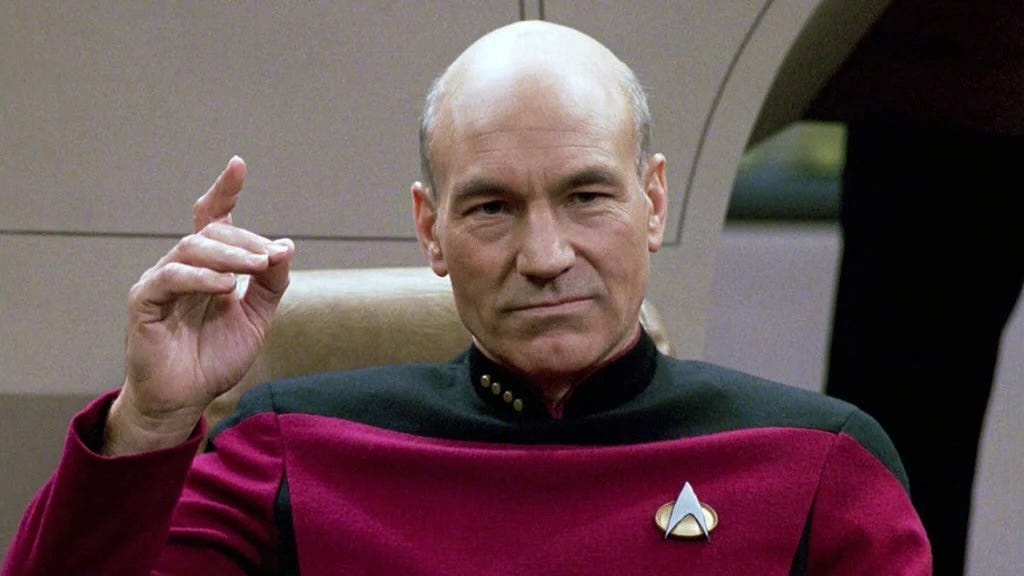
That brings us to the subject of Patrick Stewart, and Jean-Luc Picard, the gentleman-scholar who took Shakespeare to the stars.
It felt oddly fitting that his death should be announced just before the start of the Death Triad. I loved Star Trek: The Next Generation as a teenager. Every new episode was anticipated, and I have also have fond memories of staying up with my sister on Friday nights to watch the 10pm rerun. Then there was that time in college when I hit a rough patch and started comfort-watching Star Trek for an emotional boost. Worked great! It was an odd confluence of circumstances that brought a Shakespearean onto a sci fi show, but it turns out that was exactly the medicine some of us needed.
Gene Roddenberry was a secular humanist, looking to use space as a backdrop for illustrating his utopian political ideals. He wanted to fantasize about how super-cool technology could usher in a peaceful paradise where hunger, prejudice, and war were no more. Stewart strode right onto that stage and turned it into a production of Henry V. Where Kirk charged around the galaxy getting in brawls, Picard engaged alien civilizations with prudence and reason, showing all the sensibilities of a trained humanist. I have nothing against the “cowboy captain”: Han Solo, Malcolm Reynolds, and Kirk are great characters in their own ways. But in Picard, we got a bona fide old-world aristocrat, projecting the authority of a medieval lord. And people loved it.
It’s said that Roddenberry was vehemently opposed to the casting. He made the right call! Eventually, with immense effort, his producers wore him down, being generally of the view that you should find a way to say ‘yes’ to an actor of that caliber. Here’s the problem, though, with actors of that caliber: You cannot control them. They will make the role their own. Stewart did that, and effectively hijacked the whole Star Trek universe.
Everything about him projected classical excellence: his voice, his bearing, his hobbies, his expressions. The man grew up on his family’s French vineyard! And every beloved Picard episode raises deep questions about the human condition. I’ve been going back through the classics, reminding myself how amazing they were, and noting how certain questions thread their way through the entire series, with Picard offering different angles on them in different episodes. I’ll restrain myself and mention just a few.
In The Inner Light, Picard is mentally “taken captive” by an alien probe that allows him to live an entire lifetime as a citizen of a now-vanished civilization. Seeing that they were unable to save themselves from a crushing drought, the aliens created this probe as a kind of legacy, to show the universe who they were. Picard steps into the life of a young, married man, and ends up raising a family, cherishing grandchildren, and watching his loved ones prepare themselves for their anticipated end. The episode is masterful, especially because its most poignant message goes unstated: the life of a normal man, raising his family and loving his home, is the experience this civilization chooses to transmit. They didn’t make a montage of heroic deeds and technological discoveries. A civilization’s legacy is its people.
Heroic deeds do matter though! That point is made in Darmok, when Picard is again taken captive, this time in person, forced to fight a mysterious beast together with an alien who speaks to him exclusively in metaphor. When he recognizes that this civilization is obsessed with legend and story, Picard tells the alien the story of Gilgamesh, and thus they come to understand one another.
His single most famous episode is of course The Best of Both Worlds, which to me is an exquisitely sweet example of a humanist triumphing, not only over the Borg, but over Roddenberry’s Borg-like vision of humanity’s future. The Borg are technocratic imperialists who consume civilizations and convert their people into mindless automatons. When they integrate Picard, this becomes the ultimate test, both for him and for the Borg. Can the technocrats triumph over the Shakespearean? Is the mind mightier than the cybernetic implant? It is. Picard beats them, in a very human way. Resistance is not futile.
Could he have turned that ship any more masterfully? I normally roll my eyes at the notion of “actors making a difference,” but I think Stewart did.
A few years ago, my family rewatched the entire Next Generation series, which my husband and I had both loved as kids. It was his idea, actually, and I was game, but also prepared to find that my middle-aged self was a little less enamored of Star Trek.
It held up. I still loved it. Actually, I was genuinely surprised just how much I enjoyed it, and how grateful I was for a show that didn’t have some massive budget to blow on endless explosions and bells and whistles. When you think about it, they really didn’t have much going for them, apart from a great team of writers and a superb Shakespearean actor. What’s a show to do at that juncture but write some great dialogue and develop its characters?
The first couple of seasons of Next Gen are infamously not-great, and yet one must note that the show was bookended by two episodes in which the all-powerful Q collective puts humanity on trial, with Picard standing as its advocate. From the very start, then, it raised fundamental questions: What are human beings? Are they good? Despite our many sins and weaknesses, are there things worth preserving from humanity’s benighted past? It was the perfect opening for a humanist, and Stewart took that ball and ran very far with it.
Now he has passed on, boldly going where many have gone before. But in an age quaking in terror at yet another technological revolution, Star Trek: The Next Generation will outlive him.
Requiescat in pace, Patrick Stewart. And dear readers, enjoy your memento mori.