


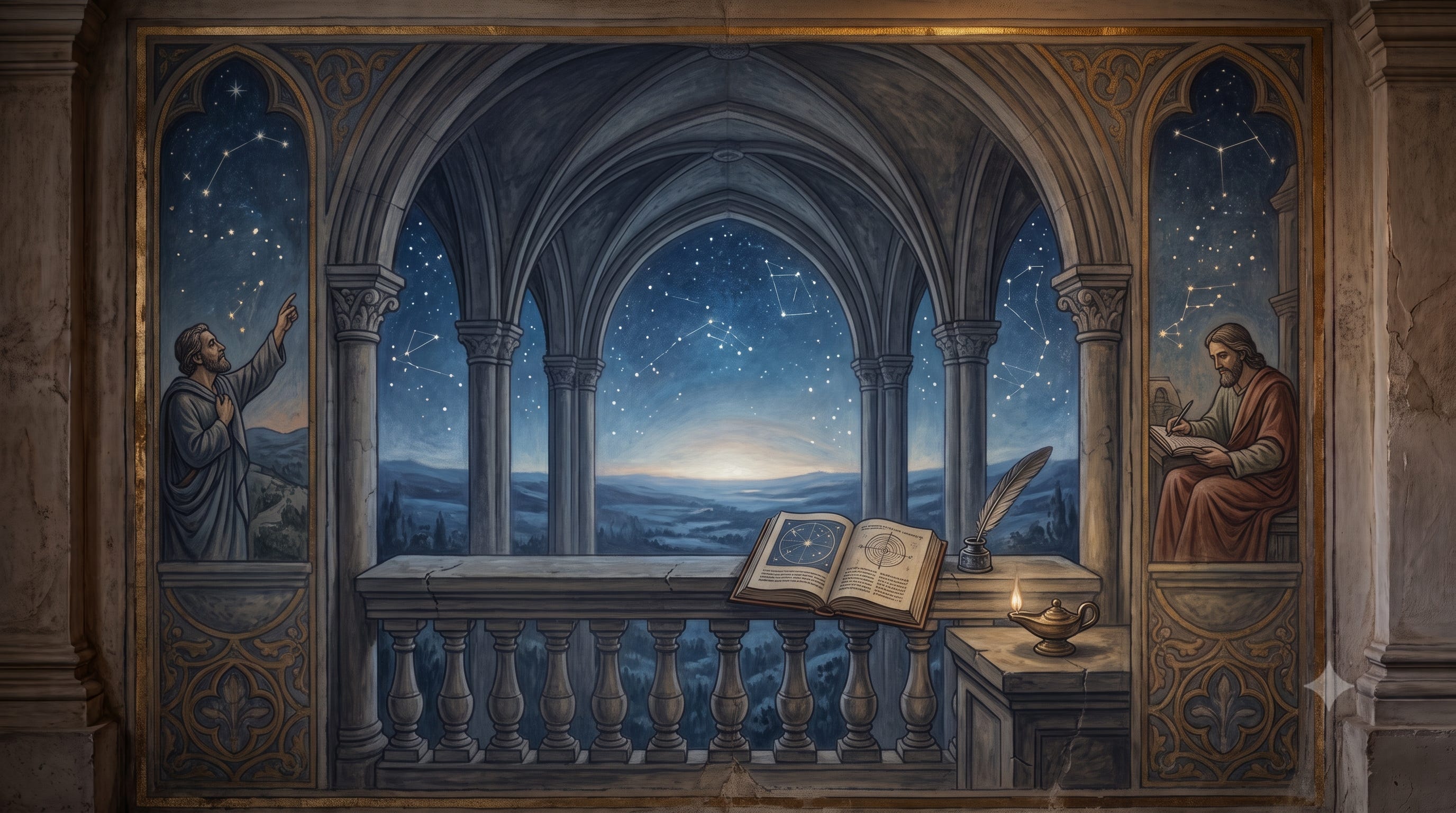
I’m embarking now on a 2-week series on “Why Christian Philosophy?” We’ll dive in tomorrow with an essay on philosophy more generally: Why should we do it, and what should one look for in a comprehensive philosophy? Then I’ll go on to explore some reasons why, in my evaluation, Christian philosophy holds up well.
Thursday’s essay will examine what I call “the two work horses of Christian philosophy.” These are two big-picture concepts that (I argue) serve as engines of Christian thought, making it particularly broad, deep, and also satisfying. Christianity can explain things in ways that really capture the tenor of human experience, the flavor of the world as we find it. It can help us dig into hard questions with real hope of finding worthwhile answers. It enables us to “seek understanding” without fear that what we find will render life empty, flat, or meaningless. I think identifying these two “work horses” is helpful for explaining how it can do that.
Next week I’m planning to talk more about “the competition.” What’s going on with modern philosophy? Against what rival worldviews must Christianity prove itself?
That brings us to the issue of other faiths, which I realize has been something of a hole in my discussion up to this point. I’ve been meaning for some time to have a week (or more?) on other ancient faiths, to give just a glimpse of how I think about them, though it’s a little tricky insofar as I don’t wish to present myself as an expert on any non-Christian religion. I’m aware that the slightly triumphalist premise of Christendom Reborn might be taken as a challenge, or even as disparagement of other world faiths. I really don’t intend that at all, and in general I view other ancient faiths with lively curiosity but also great respect. Clearly it is possible for different religions to become competitors; religious (or ethno-religious) conflict is certainly a real thing, and I don’t take it lightly. But in our own time, the threats that most deeply concern me don’t spring primarily from other ancient faiths. I worry about the collapse of social structures, the loss of meaning and connection to tradition, political polarization, atomization. Not Hinduism or Islam.
In the end of course, I choose Jesus. I do ultimately believe that Christ will win. But I also consider that any faith that’s existed for a millennium or more must surely contain a lot of wisdom. I realize obviously that faith and politics often fuse in complex ways, which complicates the picture, and it’s possible we’ll end up discussing those sorts of scenarios at some point. Islamic wars of religion. Hindu nationalism. Those Russian Buddhist communities that are pumping for Putin in his war on Ukraine. That’s all fascinating stuff, but it’s fairly tangential to Christendom Reborn. In general, I don’t tend to view other faiths as a major threat to Christianity. They’re much likelier to be “fellow travelers” working to combat the same problems that concern me.
Even insofar as they are a threat, I’m firmly committed to “winning those battles” through persuasion, answering questions, and solving problems, particularly by building institutions and healthy communities that meet people’s actual needs. Not through repressive laws and certainly not through violence. Other religious communities are welcome to pursue those same strategies. In fact, I encourage it! I like freedom, especially religious freedom. It’s the most important kind.
At some point I will say a little more about particular world faiths and how I think about them. I’ve lived in Israel and the Islamic world; I went through a period of being fascinated by Hinduism and Buddhism. Without making any claim to expertise, I can at least say a little about what I find most attractive and fascinating in each tradition, and what questions they illuminate in my own Christian mind. Maybe someday I’ll get a chance to learn more about other faiths, and engage in more interfaith dialogue. I’d love that! But one thing at a time.
For now, let’s go back to the beginning. What can philosophy do for us? What can faith do? Perhaps they could do some things together?
The traditional role of philosophy has been cast as being the handmaiden of theology (ancilla theologiae) insofar it anchors and enlightens the dogmas of religion in a foundation of reasoning and logic. Immanuel Kant famously quipped that such a perspective does not establish if philosophy "bears the torch before its gracious mistress or merely trails behind her train". I am looking forward to a resolution in the coming articles!