


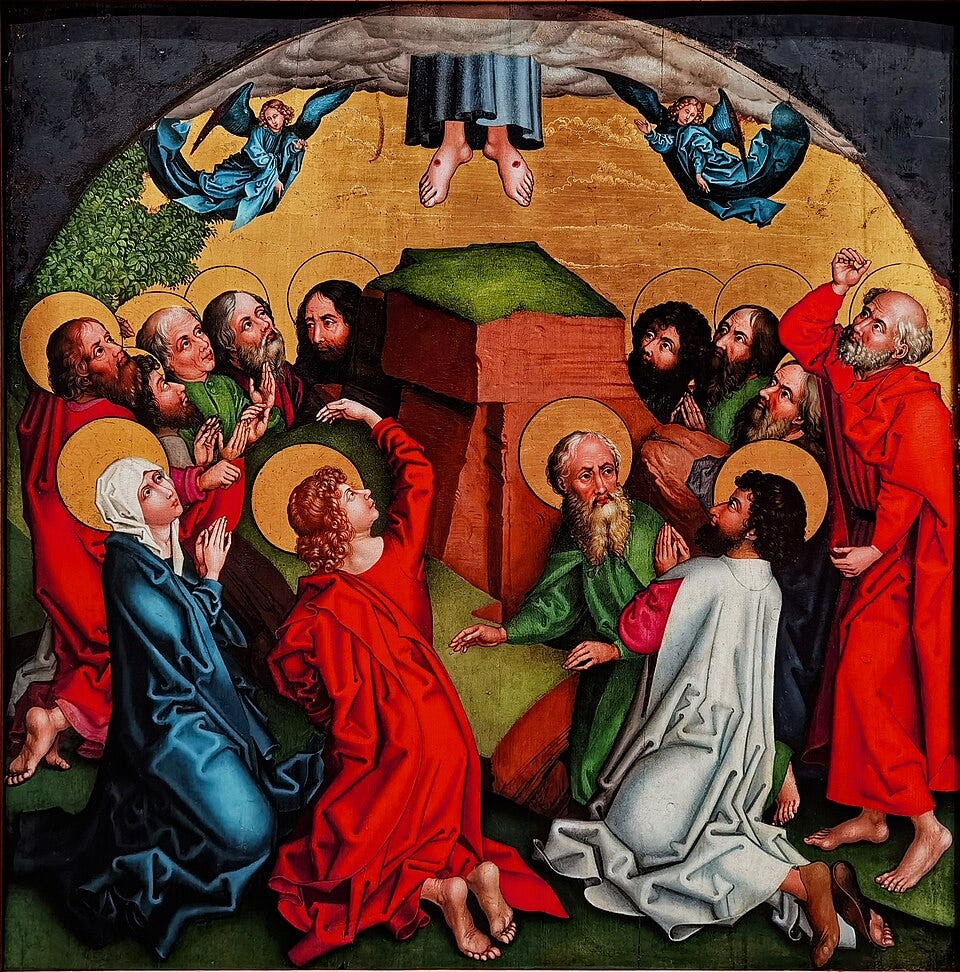
Men of Galilee, why are you standing there looking at the sky? This Jesus who has been taken up from you into heaven will return in the same way as you have seen him going into heaven.
I’ve always found this passage (from Acts 1:11) very stirring. It clearly marks an important turning point for the Apostles, a “launching point” as it were. From a certain perspective it’s actually quite harsh! They don’t even get to finish watching our Lord ascend into Heaven before getting on with further business? But the message is important, as is the urgency. Sometimes God does allow (or even want) us to be absorbed in contemplation, eyes on Heaven and minds on the next world. But when there’s a job at hand, he expects prompt action.
It’s important to realize that even though this is an exciting moment, there’s also some heartbreak. I’ve reflected many times on how frightened and forlorn the Apostles must have felt, suddenly expected to make their way, without Jesus. Today at Mass our priest made another interesting point that had not occurred to me: Quite soon, the Apostles would set off on their earthly missions, heading to all different corners of the world, and many of them surely would never see each other again. Even insofar as some of them did rub shoulders in this or that place, the unity and solidarity they enjoyed in Jesus’ company would be taken from them. They had come to the Big Goodbye, not only saying farewell to Jesus but also to one another.
I’m a little ashamed of myself, never having thought of that. Perhaps just because this is such an exciting and hopeful moment for the Church that it’s hard to think about small, human concerns like personal friendships among the Apostles, and yet I know from experience (as most of us probably do) how hard it is to be set a hard task, and to come to come to grips with the reality that, “This is my assignment, and it seems that I’m supposed to do it without a lot of cheerleading or warm, sympathetic ears.” It can happen, but it’s hard.
None of the examples I can summon from my own life, however, are anything like as hard as converting the whole world. I mean sure, in some sense all Christians should hear “the Great Commission” as applying to us, but those first Apostles were a tiny little cadre of people, holding onto (what must have sounded to almost everyone like) a very, very tall tale, and they were supposed to charge off and preach it to all corners of the earth. Jesus wasn’t planning to stay on Earth to help them – and why not? Nor did they necessarily get to rely on the regular help and support of the handful of other people who could understand and relate to them. (Again, why?) Note too that these were Jews, presumably raised with a strong sense of their unique identity over and against the domination of the Romans, but their own people were soon going to reject them. (Well, many of them. Though let’s not get too grim; they converted a lot of their own people, too.)
The importance of Pentecost really comes into focus here. They needed a lift.
It bears some thinking about, when our own path feels arduous, or when the goodbyes are hard, the losses painful, the world unbearably broken. We definitely aren’t asked to do anything harder than the things that mere mortals have already done. Jesus ends the Great Commission, and the Gospel of Matthew, by assuring the Apostles,
Behold, I am with you always, until the end of the age.
I always liked those words, but as a child they felt exciting and hopeful, like the “Play ball!” at the start of a baseball game. Now those words can occasionally make my eyes prickle. They often don’t feel true. On Ascension Sunday, I try to find inspiration in the firm belief that they are, in fact, true.
I’ll probably do these “Sunday Faith Reflections” at least some weeks. Don’t plan to send them to the email list, because I don’t like to bombard people with content, especially on the weekends. This felt like a good time for such, since I’m transitioning from “Autopsy Week” to some essays focused on the rebuilding of Christendom! Come back later in the week for more substantive essays on this theme!