


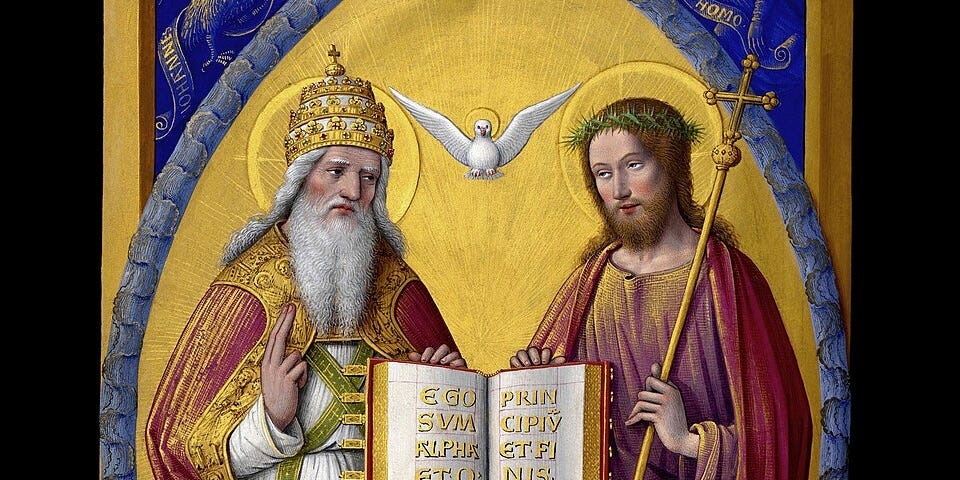
As a former Mormon, I think of Trinity Sunday as “Dogma Day.” It is a solemnity dedicated to a dogmatic principle. Isn’t that exactly what you would expect from the Catholic Church? A critic might snarkily ask: When is Patriarchy Day? Guilt Day? Tacky Candle Day?
I’m not sure, but it’s clear that The Patriarchs have got their hooks in me, because I love dogma. With a deep and genuine gratitude. I love it as someone who wandered around without it for a considerable period, and experienced the discovery, not as a stifling constraint, but as a kind of fertile oasis in the desert. Or, to switch metaphors, perhaps it was more like the headlamp that transformed the same landscape from an oppressive thicket to a romantic moon-drenched woodland.
Dogma is a great gift. It supplies order and direction to the searching mind, enabling it to work productively on pressing questions, instead of meandering around fruitlessly with mounting frustration. My own (genuinely transformative) first experience of this related to the dogma of the Creation and the Fall, not the Trinity, but the point stands for all dogma. It is the scaffold that enables philosophy (and all other disciplines) to build with confidence.
It’s interesting to note that the Church Fathers, in hammering out Christian dogma through the early Ecumenical Councils, had a habit of rejecting the most obvious or natural resolution of pressing philosophical questions, instead embracing the harder or more confounding view. Over the long run, those choices proved justified.
The Trinity is an excellent example of this. I was taught, in Mormon Sunday School, that the Father, Son, and Holy Spirit were just separate persons, full stop. Now and again a teacher would scoff a little at the metaphysical mumbo-jumbo of mainstream Christian dogma: One in Being? What in the world does that mean? I was told that they were one in purpose, not Being, which does of course seem far more reasonable to ordinary human intuition. They’re like three guys who share common goals and agree about all the important things. Makes sense, got it. (To be clear, scoffing at mainstream Christian dogma wasn’t a major fixation of my Mormon youth. Mostly people ignored it. But now and again we did get little compare-and-contrasts.)
I disputed a lot of things with my Sunday School teachers, but felt no inclination to make the case for “One in Being.” I didn’t understand it either. Sounded like empty philosopher-speak.
It turns out, this dogma bridges Christian metaphysics and ethics in a spectacular way, enabling a particular, embodied-in-time story (first of a unique people and their relationship to God, then of a single man and his life in Palestine in the first century) to amplify into The Story of the Universe. It’s rather an extraordinary thing! And it turns out that the metaphysical mumbo-jumbo is key to making it possible, but unsurprisingly, my adolescent mind did not grasp that. I’m not the smartest person in the world, but it’s much too much for anyone to work out on their own.
Working through those mental knots is not just a matter of mental hygiene or personal intellectual satisfaction. It is salvific. The Gospel (the one you see painted on people’s cheeks at football games!) richly underscores that point, not only urging people to believe, but also showing how belief and love are intimately connected within the inner life of the Trinity, and how the Incarnation also flows from that tight connection:
God so loved the world that he gave his only Son,
so that everyone who believes in him might not perish
but might have eternal life.
For God did not send his Son into the world to condemn the world,
but that the world might be saved through him.
Whoever believes in him will not be condemned,
but whoever does not believe has already been condemned,
because he has not believed in the name of the only Son of God.John 3 16-18
Believe! And Happy Dogma Day.