


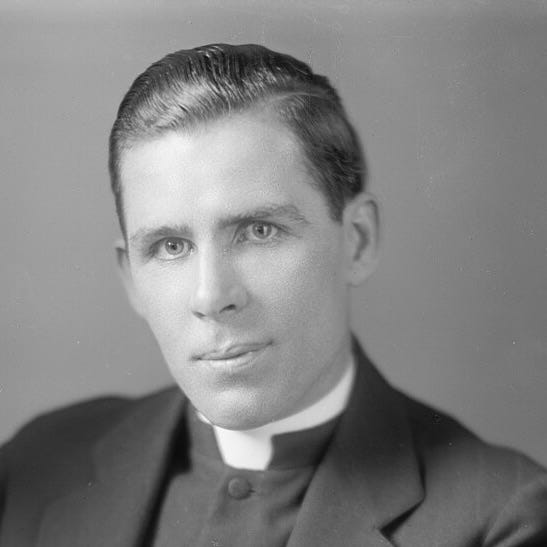
Today is a joyful day for the Church in America. We celebrate the beatification of Archbishop Fulton J. Sheen. Even if you are not Catholic, or American, I invite you to raise a glass today for this remarkable man. But if you are an American Catholic, it is only fitting to celebrate this as a momentous and long-awaited day. A coming of age. An arrival.
By beatifying Sheen, Rome implicitly affirms the American Catholic story as a hopeful and positive subplot in the larger drama of the Universal Church. It swings open a door for the American Church. We’ve waited a long time for that gesture.
Not everyone knows who Sheen was, though, or why he mattered. Let’s rectify that right now.
Most Americans do know that Catholics were, for much of this country’s history, a somewhat-disliked minority. It’s good to keep this in perspective: Catholics were certainly never subject to genocidal pogroms here, like the Jews of Europe or Christians of Asia Minor, and our institutions were generally left standing. That is no small blessing. But if extreme persecution was rare, lower-level discrimination was not. Those institutions are numerous precisely because Catholics were often excluded from mainstream institutions, or mistreated by them, which is why this country developed such a vast network of Catholic universities, schools, hospitals, and charities.
Here’s another, less-familiar reality: American Catholics were in a sense doubly marginalized. They occupied a second tier not only among their compatriots, but also in the eyes of their own religious authorities. Rome didn’t exactly hate the United States, but she viewed it all the way into the twentieth century as “mission territory,” a heathen land where the unfortunates of the mother country were sometimes forced to decamp. American Catholics, in Rome’s eyes, were like permanent refugees. They were encouraged to remain attached to their original ethno-religious communities, not because the Church cared particularly about ethnic purity, but because it was assumed that the loss of the “ethno” would in most cases mean a loss of religious faith. The nineteenth-century Church hierarchy was still widely convinced that robust national churches, with a relatively tight church-state integration, were the way to go. America didn’t seem anywhere close to attaining that, so the recommended strategy was to bunker.
There were some dissenters from this view, even in the 19th century. Archbishop John Ireland, native son of my own Minnesota, firmly believed that America was a great nation on the rise, that its spirit was fundamentally harmonious with Catholicism’s beating heart, and that American Catholicism thus deserved to be recognized as a distinct but fundamentally healthy phenomenon. He pitched this view, rather aggressively, to Rome in the 1890s. And he was personally slapped down by the pope! Kind of. In a way.
It’s rather a strange story, actually. Pope Leo did issue an Apostolic Letter in 1899 condemning “the heresy of Americanism,” and it was understood that Ireland was in some sense the target. But Leo never mentioned Ireland by name, never removed him from office, and carefully framed his letter so as to leave open the question of whether anyone on Earth is in fact guilty of this heresy. “If anyone out there is preaching these false things, stop it,” is basically the upshot. I think Leo, a rather forward-looking pontiff, was really quite sympathetic to the Americans’ case, but diplomacy was not Ireland’s strong suit and he created a kerfuffle that Leo then felt obliged to calm. The United States would have to stay on the back burner a bit longer.
Sheen anticipates the work of Eric Voegelin a decade later. He really was a theorist in his own right, though he clothed his ideas in theological language and pitched them to normies more than to scholars.
In his late years, semi-exiled from elite ecclesial circles, Ireland refocused on the home front, building the spectacular St. Paul Cathedral (which stands just a few miles from my house) and also founding a major seminary here. Guess who matriculated in 1917, one year before Ireland’s death? That’s right. It was a young Fulton J. Sheen.
The Illinois native would go on to preach Ireland’s message with an eloquence the old soldier himself, though renowned for his oratory, could hardly have matched. Sheen fully grasped Ireland’s vision of America, and after leaving St. Paul Seminary he carried it with him to Europe, studying first at the University of Louvain in Belgium, and then at the Angelicum in Rome. At Louvain he proved his philosophical acumen by becoming the first American ever to win the prestigious Cardinal Mercier Prize for philosophy. At the Angelicum he completed his doctorate, then returned home for a short pastoral stint before taking up a post as a theologian at the Catholic University of America. Through it all, he was clearly thinking about what he’d seen and learned in Europe, and it would soon become clear that those experiences had shaped him in ways that went beyond Thomistic philosophy.
Sheen was attentive to the political currents swirling all around him, first in Europe as it radicalized in the 1920s, and then back at home as the world careened towards war. Far from scorning his native land as a heathen backwater, Sheen saw, with Ireland, that America’s Constitutional tradition contained real wisdom, affording citizens some protection from the poisonous ideologies that were consuming the continent. He understood that we were blessed to have a political tradition rooted in both liberty and justice.
Back on home soil, Sheen was so popular at CUA that he was soon tapped to do a national radio show. The Catholic Hour grew in popularity across the 1930s, eventually reaching 4 million listeners. In some ways, this was really the period when Sheen came into his own as a thinker. I discovered this last spring, when I was researching a piece on Sheen for America magazine; looking back on the ideas from his radio days was honestly something of a revelation. I was astonished at their depth and sophistication. I had already known that Sheen was an incredible evangelist, and a worthy theologian, but I didn’t know that he was such an interesting and fertile political thinker. I think it’s fair to say that he anticipates the work of Eric Voegelin a decade later. He really was a theorist in his own right, though he clothed his ideas in theological language and pitched them to normies more than to scholars.
Sheen argued on his radio show (and in his books) that both communism and fascism should properly be seen as religions, rivaling Christianity as totalizing worldviews that are meant to replace God. He urged his listeners to reject these, embracing both freedom and a faith grounded in holiness and the energetic labors of virtuous men and women. The American tradition, in Sheen’s view, supplied a strong framework for facilitating that effort. It’s worth noting that he was airing these ideas opposite Charles Coughlin, another priestly radio host, whose corporatism and agrarian populism eventually matured into a full-fledged clerical fascism. By the late 1930s, Coughlin was railing against World Jewry, raving about Mussolini, and forming a paramilitary-style “Christian Front” that terrorized Jews. Sheen told his listeners to love their country, their Constitution, and their faith. And he fiercely condemned anti-Semitism, writing statements of solidarity with Jews.
He’s best remembered today for his television show, Life is Worth Living. Though it ran for only a few years in the 1950s, the show really was a bit of a miracle in its own right. Originally slated for a “graveyard” slot opposite NBC’s Milton Berle (a ratings blockbuster), Sheen was basically set up to fail. His network, DuMont Television, picked him up because he was cheap. They were in bad financial shape and couldn’t afford anyone with a real chance of competing with the top stars. Everyone was shocked therefore when Sheen, armed with nothing but a chalkboard, a Marian statue, and his iconic cape, began scaling the ratings in leaps and bounds, to the point where he was soon beating Berle. Who knew that America was so hungry for lectures in Thomistic philosophy? Well, apparently one man did.
The show didn’t just reach Catholics. Everyone warmed to the wit and wisdom of America’s most famous prelate. Sheen reminded them of truths that transcended the brokenness of the post-war world. He gave them a glimpse of a worldview that was comprehensive but not totalitarian. He showed them how philosophy could be medicine for the soul. It was the most successful religious television program in history, but when Sheen beat out Lucille Ball and Arthur Godfrey for the Emmy in 1952, he cheerfully stepped up to the microphone and thanked his four ghostwriters: Matthew, Mark, Luke, and John.
What a moment it must have been for American Catholics. They’d been mainstreamed, not by hiding or self-marginalizing, but through the work of a bishop, standing on national television with his Marian statue, demonstrating the beauty and richness of a joyfully-lived Catholicism.
Sheen wanted American Catholics to work harder to cultivate holiness. They were remarkable institution-builders, and he admired that. But he thought they needed deeper spiritual roots, and more interior discipline.
If you’re inclined to hate popular media, at least note this: Sheen wasn’t canned by anti-Catholic executives or envious entertainers. They all seemed to love him. He was squelched by his own superior, Cardinal Spellman. I won’t tell the whole story, but it basically seems like Spellman couldn’t handle the envy. He wanted to be the biggest prelate in New York City, and so, as so often happens, he became the smallest. I don’t claim any capacity to read souls, but I will just say that I wouldn’t like to explain to St. Peter why I thought it was a good idea to spike a program that was catechizing millions every Tuesday night.
Sheen did a rather unsuccessful tour as the Bishop of Rochester, but his final years were passed in relative seclusion, battling health issues and spending hours each day in prayer. He never tried to retaliate against Spellman, and wrote beautiful things in his autobiography about the pitfalls that star power (we might today say “influencer power”) lays for the soul. He died in front of the Blessed Sacrament in his apartment, on December 9, 1979. (I was in utero at the time. But I existed! I like that.) It appears he was in the midst of his daily “Holy Hour,” a practice he had maintained since his days back at the Saint Paul Seminary.
The United States has an embarrassing shortage of saints. Italy’s literally got thousands! We’ve got 13! Even among those we have, only three were born here. Now, don’t get me wrong. I love St. John Neumann and St. Damien of Molokai, but wouldn’t it be nice to think that we have some capacity to grow saints here on US soil? In fact, this was a favorite theme of Sheen’s too: he wanted American Catholics to work harder to cultivate holiness. They were remarkable institution-builders, and he admired that. But he thought they needed deeper spiritual roots, and more interior discipline. Peace and plenty are a blessing, but they can breed decadence and vice.
For now, he’s only a Blessed. But we can pray to him! And he’s on his way.
My America piece was titled: “Fulton Sheen Bet on America. Some Catholics Want to Call It Off.” It’s a good title. It came from the editors, not me, and the spotlight is mainly on Sheen himself, but they didn’t miss my point.
It is a source of real grief and shame to me that Catholic intellectuals have lately been leading the charge to persuade young Americans that our own political tradition is fatally flawed. That the Founders should be viewed as the mischievous agents of malevolent modernity, and that the right course is some sort of return to a blood-soil-crown-altar something-or-other. That makes even less sense today than in the 19th century, when Rome already saw that it wasn’t on the table. And in the meanwhile... how hard did we work to persuade our compatriots that yes, we too can be loyal Americans? We built the institutions, won the football games, worked through the theory, and now some people just want to turn right around and show the haters they were right all along? We finally persuaded our own Church that American-style republicanism can work for us, and suddenly our own intellectuals are racing to re-up Carl Schmitt and Charles Maurras? Excruciating.
But you know what? I’m not worrying about that today. Today is a day for joy. It’s a day for celebrating the man who recognized America as a good country where Catholicism could thrive. Who saw through the political religions of his own day, and led millions down a different path, where spiritual renewal and freedom could flourish together. Today the Church formally celebrates him as an exemplar worthy of imitation. That means something, for the world but especially for American Catholics.
Bye now, and God love you.