


“When did you change your position on marriage?”
It’s not a question I get asked all the time, but I suspect more have wondered than asked. That’s understandable, because I hang with the libertarians now, but in the lead-up to Obergefell I was a pretty staunch marriage traditionalist. Those were the novice years, when words flowed freely and sloppily, and since marriage happened to be the burning issue in America at the time (and one on which I had well-defined views), I wrote quite a bit on the subject. I warmly invite you to not go looking for those pieces.
Not because I was hateful and homophobic. (I really don’t think so, but more on that soon.) There are other reasons a writer cringes when revisiting her maiden efforts. What I’m saying here is that my first experience of politics really did begin on the culture-warring right. And the topic of the hour was marriage.
In those days, marriage traditionalists were the scum of the earth. We were right over there with the white nationalists, the antisemites, the raging sexists. Actually we were raging sexists, dontcha know, and every bit as bad as the racists and skinheads to whom we were regularly compared. In my graduate days (at Cornell! Go Big Red?), I remember hearing peers discuss the subject, reflecting on whether it was reasonable to allow marriage traditionalists to teach in a mainstream university. (Would gay kids feel safe in that classroom?) No comment, friends. By the time I started freelancing, I had basically accepted that people like me had no future in academia, but even as a two-bit opinion writer I assumed that the culture-warring right was my only refuge. Who else would tolerate a one-man-one-woman bigot like me?
So, that was then. Looking back with the benefit of age, wisdom, an experienced editorial eye… I can see that Younger Me was naïve. Caught up in the excitement of the moment. Gosh, I’d like to go back and edit some of her stuff. I had some bruising lessons still to learn about politics, populism, religious conservatives. And I’ve “evolved” on many subjects over the years, but... not really on marriage. I never stopped being a marriage traditionalist; the world just moved on and stopped caring.
Now, I will say that my younger, culture-warring self probably attached too much significance to that particular cultural battle. The early 2010s felt to us like a clutch, civilization-defining moment (which is always the mood of the dewy-eyed culture warrior) but it wasn’t as true as we supposed. I’m not too deeply ashamed of that though, because I remember why it felt that way. Partly, of course, it’s just that young people are young, and it was my first full-bore experience of the ugliness of politics, which can easily inspire some panic. Aging leftist culture warriors like Frank Bruni, who once led the charge for “marriage equality,” like to remember their own younger selves as civil, high-minded cultural reformers, entirely unlike today’s unruly young ideologues, but that… is not how I remember it.
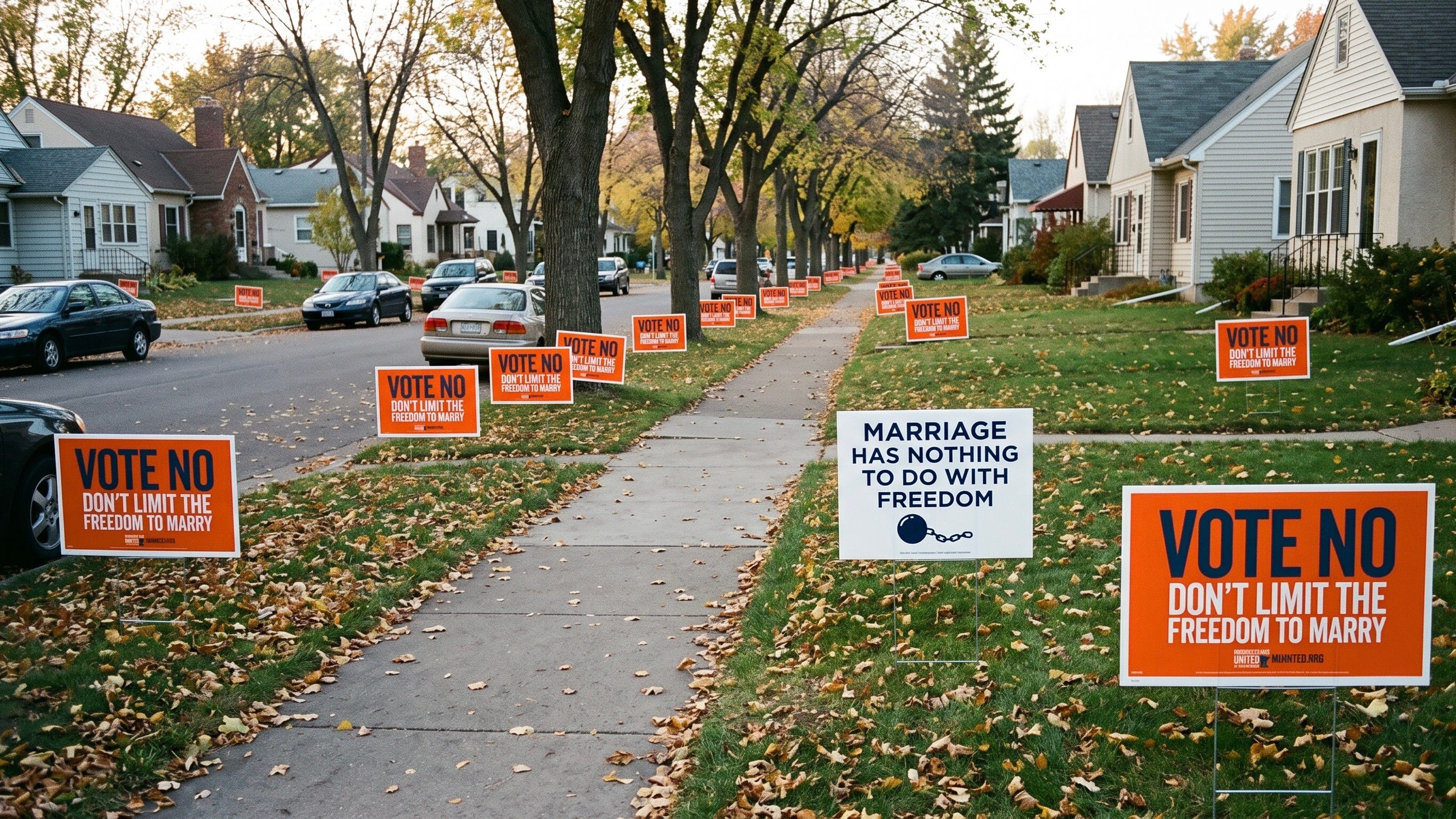
But this wasn’t just about the nastiness of politics. Marriage is absolutely one of the central pillars of civilization; we were right about that. It requires significant legal and cultural support to flourish. We were right about that too. Making marriage into a testing ground for exploring questions about personal identity is completely bonkers, as we clearly and correctly saw. I still remember when Minnesota put the issue on the ballot, and almost every yard on my street was marked with an ugly orange sign reading: “Don’t Limit the Freedom to Marry.” I joked to everyone (except the neighbors) that I wanted to have one printed depicting a ball and chain, and the message: “Marriage Has Nothing To Do with Freedom.” (It’s not quite true, but like a Buddhist koan, might have produced a salutary kind of puzzlement.)
The problem, in short, was that our social fabric was clearly eroding, and we apparently weren’t allowed to do anything about it. We weren’t even allowed to have an intelligent conversation about why it was happening! That was, to put it mildly, concerning.
Let me be clear here: the question of how gays and lesbians can flourish in modern society is genuinely important. Like nearly everyone, I’ve had many gay and lesbian friends across my life, and I want them to be happy and thrive. I could, if asked, discuss how my own views on sexual ethics should be applied to the case of a person who is attracted exclusively to their own sex. But no one needs to ask, nor take my advice if they do. As a Humanae Vitae-embracing Catholic, I am myself in a very small minority in my views on sexual ethics. Hardly anyone wants my advice! I don’t take that personally. We are fallen beings. We spend a lot of our lives muddling through as best we can. I can generally feel sympathy for most anyone who is trying to handle their commitments and relationships honorably, and as I have written before on this Substack, I always remember that sex is not safe, no matter how you handle it. My own experience of marriage and maternity amply confirms this.
I absolutely believe there is a causal relationship (albeit diffuse) between the destructive zeal of the marriage reformers, and the many young people who are unhappily alone today. Love did not win that round. But marriage is still very much a thing, and it’s not going anywhere.
The sense of urgency I felt in the Marriage Moment had nothing to do with distress over same-sex couples building lives together. I had no interest in shunning, shaming, or re-instituting sodomy laws. It just seemed like we were taking marriage, the strongest and most enduring of social glues, and tossing it casually over our shoulders in homage to “identity” or “personal expression.” This seemed unconscionable. How can our civilization survive without marriage? But how can we preserve it when we don’t seem to know what it is?
Now, the truth is, people deal regularly with things they don’t fully understand. (What is time, gentle reader?) But there was at that moment a kind of aggressive, willful nihilism surrounding the subject of marriage, to the point where it became impermissible to ask or honestly discuss questions like: What is this thing we call marriage? Why do we have it? What does it require of us? What does it do for us? What counts as success or failure in this sphere? How should law and culture work together to preserve this vital institution?
Would even Bruni claim that marriage reformers were open to broad-minded, civil discussions of those questions? I’m not sure, but take it from me: they were not. I reiterate once again that I did not worry, but rather assumed, that being “outed” as a marriage traditionalist would scuttle the ambitious career I was at the time attempting to pursue. Civil conversation was clearly not on the table. But hey! All they were doing was tearing down a millennia-old assumption of practically the entire human race. Why bother to think that through?
Before I ride too far on my high horse though, let’s get to the points where I was wrong. I think I did, at least in my most zealous moments, view that fight as some sort of Last Battle for Marriage, which in retrospect was fairly silly. I was primed for it, having been raised in socially conservative spheres where it was a commonplace that marriage, within mainstream culture at least, was just sort of disintegrating. That’s true in certain demographics, but marriage has not vanished, nor will it. It’s too necessary to go away.
On an empirical level, marriage clearly has not vanished, or even substantially changed. Fewer people are doing it, but for those that do the “rules” haven’t shifted all that much: fidelity and permanence are still the mainstays. Adultery still ranks as the least socially acceptable (legal) behavior in American life. We are perpetually teased with the possibility that polygamy is about to take the nation by storm (or perhaps it’s “open marriage,” or free love communes) and publications run titillating feature stories on those phenomena, but they read the same today as they did ten years ago (or twenty, or thirty). I suspect these will always be fringe, for the same reason that the “Tide Pod Challenge” was short-lived. It’s dumb and self-destructive, and the truth is that traditional, heterosexual marriage is the arrangement best suited to the freedom and individualism that Western people value. (So, fine. Marriage does have something to do with freedom.)
I really believe that there’s a kind of Marital Darwinism in play here: individuals, sub-cultures, or societies that figure out how to sustain marriage as a viable institution will ultimately dominate those that don’t. It’s not just about “the hand that rocks the cradle.” That’s a factor, but it’s also just true that marriage functions as a kind of core social infrastructure for a healthy society. If you jettison it, or allow it to disintegrate, your “hot mess to productive citizen” ratio tilts in an unfavorable direction. It will survive because it works. I absolutely believe there is a causal relationship (albeit diffuse) between the destructive zeal of the marriage reformers, and the many young people who are unhappily alone today. Love did not win that round. But marriage is still very much a thing, and it’s not going anywhere.
I was wrong about another thing. Completely wrong. I figured, based on my youthful experiences, that marriage traditionalists would be permanently consigned to the margins, either skulking along incognito, or else cloistering themselves away in Ben-Op bunkers. It was astonishing to me how quickly that page turned after Obergefell. Two years later the political right had gone to pieces, I was persona non grata among many of my old friends (because Trump), but The Week was willing to run me, and nobody cared that I had spent several years publicly crusading as a marriage traditionalist. That was some serious whiplash. And it was dramatically underscored every time I wrote something that angered The Week’s leftist readers. They’d go back into the archives of The Federalist, hunting for things that could be used to publicly humiliate me, and they’d trot out stuff on climate change, policing, critiques of Critical Race Theory. No discussion of my (many) columns defending traditional marriage. That chapter was over, apparently. Finis.
I’ve reflected many times on what it all means. There are lessons about cultural mania and groupthink. There are lessons about buying into lazy, monocausal social narratives. I suppose in the end, my key takeaway is just that marriage is simultaneously a very dynamic thing, and also astonishingly stable. The details need to be adjusted constantly, and when we fail to do that the price is simply… a lot of ruined lives. For individuals or communities, this is an enormously consequential thing. Whole societies can be destroyed or severely weakened by the decline of marriage and family.
But marriage, the thing itself, is too bedrock to be destroyed by a court case or activist movement. It will adapt and thrive again. And those who figure out how to adapt it will likely own the future.
In that sense, we marriage traditionalists were well ahead of the curve. We didn’t have fully-fleshed answers, but at least we grasped the problems, far better than the Mark Tushnets or Frank Brunis of the world. And the future can still be ours.
This will probably be my only post for this week, because my parents are visiting, my kids are on their fall break, and I’m picking up some slack for colleagues at Law & Liberty who are helping Liberty Fund host the esteemed Mont Pelerin Society. Next week though, I’ll say a little more about why marriage is such a vital institution, how I see it evolving, and whether anything can be done about the infamous “birth dearth.”
Meanwhile, picture me tearing through corn mazes with my parents and five children. We can still have nice things, people. Dare to dream.