


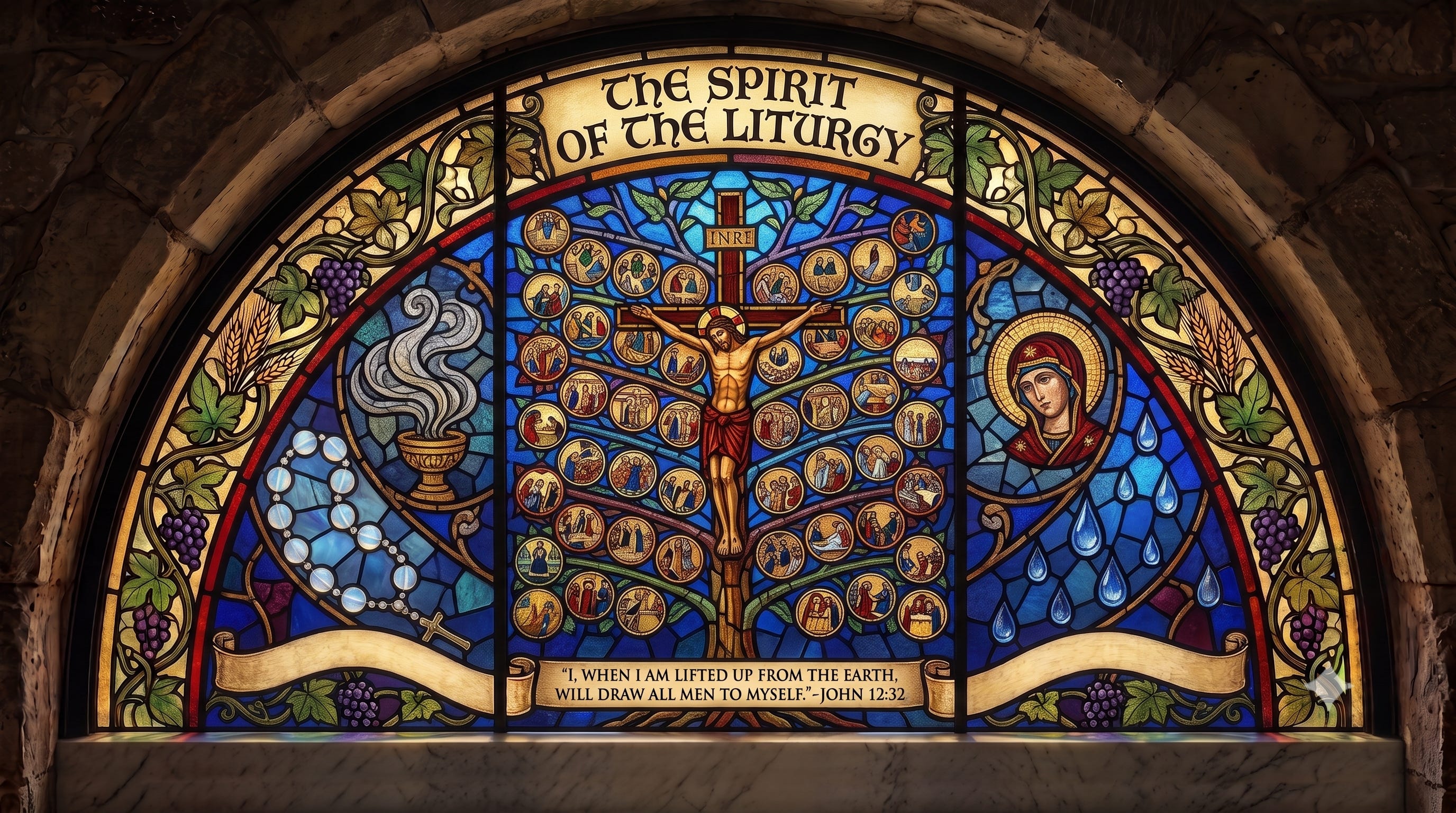
It’s an easy choice. If you can make time for only one book on this subject, you should get Joseph Cardinal Ratzinger’s The Spirit of the Liturgy. (For those who don’t know, he later became Pope Benedict XVI.) This book is simultaneously wise and very practical, in the sense of giving the reader a clearer sense of both how and why we should worship God through liturgical action. He was a great man, both brilliant and very holy, and this is one of those books that I still like to keep close at hand, so I can browse a few pages when I need a quick lift.
Ratzinger took the name from an earlier work by Romano Guardini, and it’s clear he was deeply influenced by Guardini. Their historical moments were quite different, though, and the books certainly reflect that. Guardini was interested in drawing the people into Mass in a more holistic way, but to Ratzinger it seemed clear that concerns about “community experience” were swamping any sense of liturgy as worship. He helped me make sense of my attraction to the beautiful and the physical (beads, water, incense, icons, crucifixes, and so on), so that I could continue to love those things without devolving into superstitious or magical ways of thinking. Liturgy should bridge the gap between things that our bounded, corporeal, and temporal existence, and the things that are eternal, universal, and infinite. I truly believe that all human beings on some level want to worship. But it’s not just obvious and intuitive; it’s not something we can simply make up on a whim. We have to begin where the Apostles did: “Lord, teach us to pray.”
The book has the feeling of a long, meditative prayer, so it’s difficult to pull out a single quotation and still appreciate its full meaning. But let’s try.
After the tearing of the Temple curtain and the opening up of the heart of God in the pierced heart of the Crucified, do we still need sacred space, sacred time, mediating symbols? Yes, we do need them, precisely so that, through the “image,” through the sign, we learn to see the openness of heaven. We need them to give us the capacity to know the mystery of God in the pierced heart of the Crucified. Christian liturgy is no longer replacement worship but the coming of the representative Redeemer to us, an entry into his representation that is an entry into reality itself. We do indeed participate in the heavenly liturgy, but this participation is mediated to us through earthly signs, which the Redeemer has shown to us as the place where his reality is to be found. In liturgical celebration there is a kind of turning around of exitus to reditus, of departure to return, of God’s descent to our ascent. The liturgy is the means by which earthly time is inserted into the time of Jesus Christ and into its present. It is the turning point in the process of redemption. The Shepherd takes the lost sheep onto his shoulders and carries him home.