


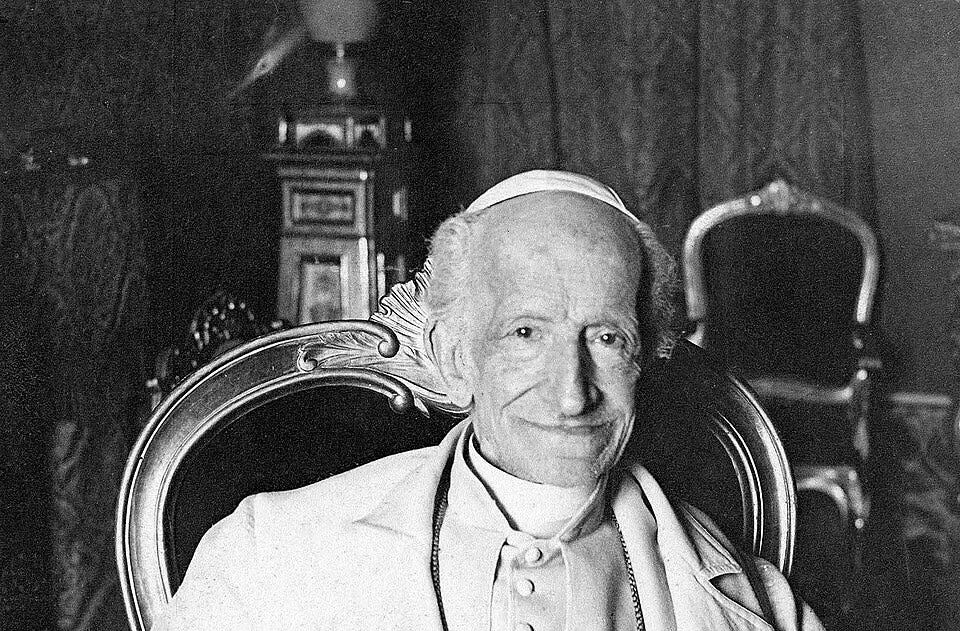
Today I’m reading papal encyclicals on the subject of philosophy. What a treat! I’ve been reading Aeterni Patris (1879) and Fides et Ratio (1998), and it’s beautiful to reflect on the deep and profound harmony between them.
Naturally, they have their differences too. Pope Leo XIII essentially recommends Thomism as the Catholic philosophy, while Pope John Paul II, the phenomenologist, stresses the Church’s openness to many sources of truth. Leo is especially concerned about modern rationalism, JP II about nihilism. But both are eager to stress that faith divorced from reason, as JPII says, “runs the grave risk of withering into myth or superstition(48),” and as Leo says, using philosophy to defend the truth is “a great and noble work.”
Christianity is a rational faith. Not of course in the sense of being the product of human reason, but in the sense that Christians celebrate and embrace the capacity of our God-given intellect to grasp truth. We believe that God wants human beings (All of us! To the best of our ability!) to immerse ourselves in truth and grow in understanding.
My essay on Christian philosophy will be posted tomorrow, but for today, a couple of choice quotes. From Fides et Ratio an explanation of how philosophy enabled Christians to learn from ancient pagans while purifying their teachings of superstition and error. This seems very relevant for the question of greatest concern at Christendom Reborn: How philosophy can help address the challenges of today:
One of the major concerns of classical philosophy was to purify human notions of God of mythological elements. We know that Greek religion, like most cosmic religions, was polytheistic, even to the point of divinizing natural things and phenomena. Human attempts to understand the origin of the gods and hence the origin of the universe find their earliest expression in poetry; and the theogonies remain the first evidence of this human search. But it was the task of the fathers of philosophy to bring to light the link between reason and religion. As they broadened their view to include universal principles, they no longer rested content with the ancient myths, but wanted to provide a rational foundation for their belief in the divinity. This opened a path which took its rise from ancient traditions but allowed a development satisfying the demands of universal reason. This development sought to acquire a critical awareness of what they believed in, and the concept of divinity was the prime beneficiary of this. Superstitions were recognized for what they were and religion was, at least in part, purified by rational analysis. It was on this basis that the Fathers of the Church entered into fruitful dialogue with ancient philosophy, which offered new ways of proclaiming and understanding the God of Jesus Christ.
Pope St. John Paul II, Fides et Ratio, para. 36
And a short one from Aeterni Patris, reiterating the nobility of the effort:
For, not in vain did God set the light of reason in the human mind; and so far is the super-added light of faith from extinguishing or lessening the power of the intelligence that it completes it rather, and by adding to its strength renders it capable of greater things.
Pope Leo XIII, Aeterni Patris, para. 2