


In the fall of 2004, I got an email out of the blue from a guy I’d communicated with exactly once. He asked if I’d like to go to Mass that coming Sunday with him and some friends. The Mass was two hours away in Scranton, Pennsylvania. (Both of us lived in Ithaca, NY.) If I wanted to come, he’d get someone to pick me up, and we’d all drive down in the morning, go to Mass, eat out, and return in the early evening.
It was a Traditional Latin Mass, by the way. If that meant anything to me?
Mostly, it did not. I was vaguely aware that there existed people in this world who were still cranky about Vatican II, but I’d had no real contact with liturgical traditionalism. I was savvy enough to recognize that my correspondent must be a bit of an oddball, likely speaking on behalf of fellow oddballs. We were going to spend the whole day driving to Pennsylvania for a Mass? They have those in Ithaca, right?
So naturally, I immediately told him I’d come. He said I would be picked up at my apartment by a fellow named Mathew Lu. Astute readers can likely piece together one part of this story, at least.
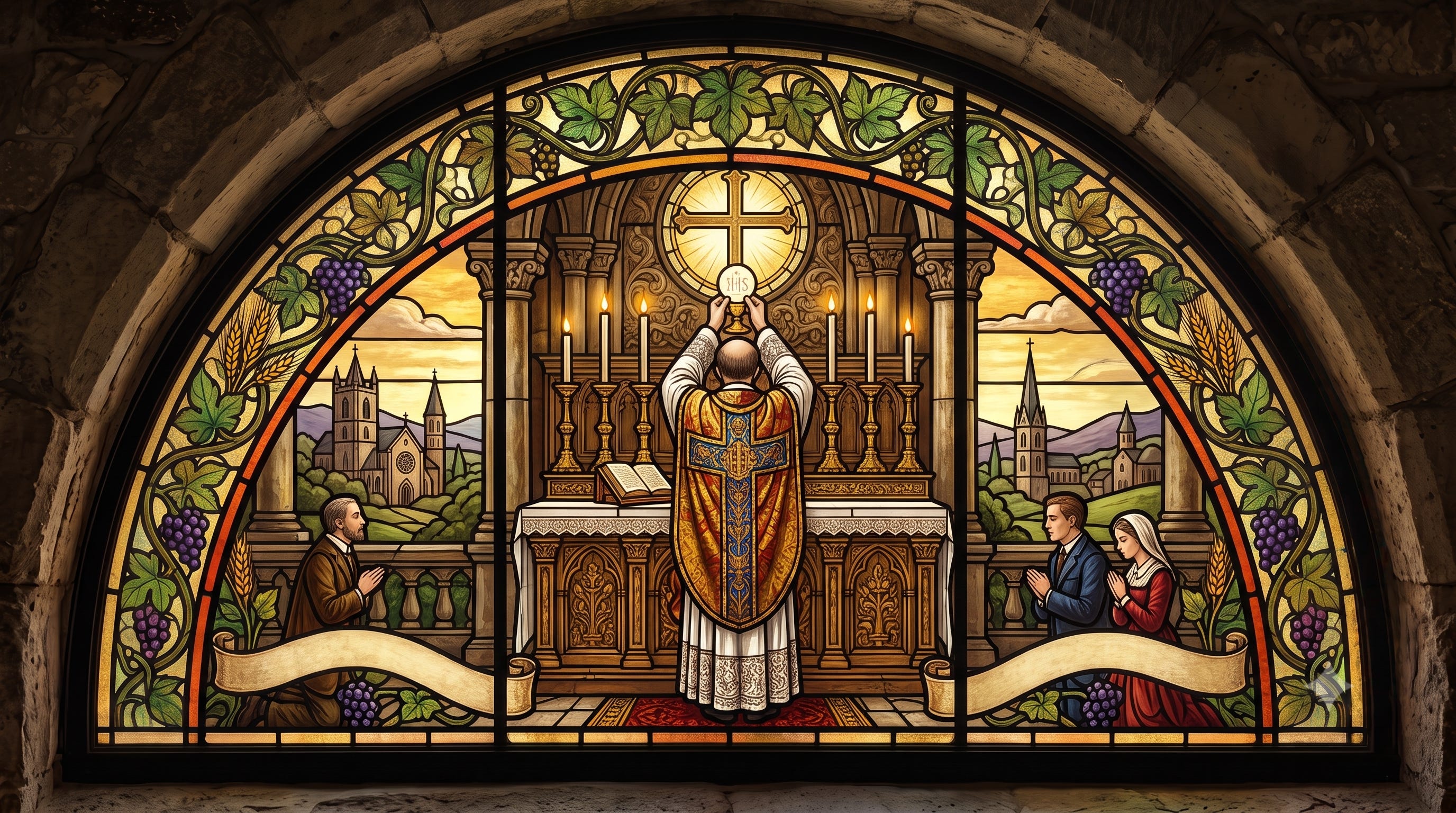
I noticed all the usual things in that first FSSP Mass. The women in veils. The large number of shockingly well-behaved children. The host of very serious, very upright altar boys. It was a stifling day, and the church was jam-packed, so we were all sweating a great deal. But all of that has now receded into a haze. The only moment that comes back with piercing clarity is the elevation. (This is the moment when the priest elevates the host, now the Body of Christ, for all to adore.) The altar boys rang the bells. The noise cut jarringly through the otherwise-silent church. I looked, and suddenly my mind seemed to clear. That’s why you do it. That’s why you become Catholic. It hit me with devastating force that these people were all drinking from a river of grace, and I was not.
I was not at this point a newcomer to Catholicism. I’d been to scores of Novus Ordo Masses. I held Notre Dame degrees in both philosophy and theology. I’d seen great cathedrals, admired magnificent sacred art, and read numerous books on Sacraments and liturgy. Clearly, I was powerfully attracted to Catholicism. But like many people of an intellectual bent, I was lingering indecisively on the threshold. There were real upsides to being a “fan” instead of a full-fledged member, and between my Mormon family, and my ambitions in the secular Academy, I was aware that real Catholic commitment would come at a cost. I needed a reason to cross that line, something important enough to make the sacrifices worth it. Suddenly, in that little parish in Scranton, PA, I felt like a fool. “Rachel, seriously. Do you want these graces or not?”
After Mass, my mind still whirling, my new friends took me to meet the pastor. He was an unassuming, genial man who immediately asked if I’d like to be invested in the Confraternity of the Brown Scapular. (The what?) Reading the wariness on my face, he quickly changed tacks. “Okay. Could I bless your Jerusalem cross for you?”
That was the right card. The cross, which I nearly always wore, had a lot of meaning for me. I had bought it in Bethlehem five years before, when I was studying abroad as a college student. At the time, I had been a fairly confused and disillusioned Mormon, chewing on a lot of big questions. The purchase represented a kind of desire to live a Christian life (whatever that meant), and I had gone on wearing it in that same spirit. That day in Scranton, still overwhelmed by all the sensory input, I suddenly found that I did very much want that priest to bless my Jerusalem cross. I unclasped it.
The following spring, he baptized me in the font at the back of the church. Two years later he officiated at our wedding.
That’s one woman’s story. Conversions can involve all sorts of funny quirks. Still, there it is. I spent years around Catholics, observing the fasts, attending the Masses, and reading all the books. I’d visited the Church of the Holy Sepulchre and St. Peter’s Basilica. It was only in that tiny, hot, overstuffed church in Pennsylvania that I realized I needed a Sacramental life.
I had a funny, Jekyll-and-Hyde-like existence in that period: I was learning how to be an Ivy League philosophy graduate student, and also moving deeper into networks of liturgical traditionalists. (Which was Jekyll though, and which Hyde?) I realized immediately, of course, that Latin Mass communities were a magnet for misfits. That wasn’t everyone of course, but I suspect the concentration was higher back then (pre-Pope Benedict XVI) than today. So many conspiracy theories and extreme reactionary opinions. The Young Earth Creationists! The Jefferson Davis enthusiasts! People still genuinely worried about the Freemasons! And of course the multiple people who sent me SSPX Bishop Richard Williamson’s essay on “Women in Universities.” (They shouldn’t be there. Rational activity is unfeminine. You’ve got the gist now.)
That was never a draw for me. As I mentioned yesterday, that dynamic persuaded me from the start that a Latin Mass community likely wasn’t where I wanted to raise my kids. I wasn’t as bothered as many people would surely have been, though. I have kind of a soft spot for eclectic subcultures. I don’t really mind being an outlier in many of my views. And anyway I’d spent much of my life around religious conservatives, so I wasn’t entirely unfamiliar with the sort of person who’s less-than-thrilled about female careerism. I’ll get into that stuff more in my Thursday essay.
There were reasons to keep coming back, even if some people did openly judge me for studying academic philosophy and (gasp) wearing pants. The biggest reason was the liturgy, of course. It’s what sucked me in in the first place, and I wanted more. I had always believed in God, and tried my best to love and obey God, but I felt like I was learning for the first time what it meant to worship God. It really was a whole new world for me in that sense.
Beyond that though, I came to see that there was really a sense in which traditionalists were living in the past… but it didn’t necessarily seem like a bad thing. Most of Christian history happened in the past! But to these people, it didn’t necessarily feel like history. They walked in the Christian landscape as though in an eternal present. They talked about centuries-old saints like personal friends; Latin prayers seemed to pour from them spontaneously as though they were medieval peasants; they filled their lives with Rosaries, icons, holy water, medals, scapulars. Once again, the contrast with my life at Notre Dame was noteworthy; I’d spent years living among Catholics and hardly been aware those things existed. In the traditionalist world they were everywhere, part of the furniture of faith. Some people might have found that creepy or superstitious. I loved it. We are corporeal beings. Why shouldn’t grace be given to us sometimes in physically embodied ways?
In C.S. Lewis’ Prince Caspian, the young Telmar prince grows up in a castle as the heir apparent, and eventually has to flee for his life, discovering along the way that the “Old Narnia” of his childhood fairy tales is not just a myth. A real-life community of dwarves, fauns, and talking animals truly exists, living in hiding in the shadowy corners of his own realm. For me, the discovery of liturgical traditionalism felt a bit like that. It was a weird little corner of society in which magic and mystery were suddenly very tangible, saints real-world people, grace pouring down at every turn. And it was all anchored in the Mass of course, where I finally understood in a new way that God was with us. The Mass, supremely and above all else, was a true Eternal Present in which the distance between us and the hosts of Heaven fell away and we could all be one Church.
Old Narnia was in hiding for a reason. It was weak, not fully able to stand up for itself. Over time, I began to see traditionalists in a similar light. They had a lot of baggage, unquestionably. But that wasn’t exclusively because they were weird and unwilling to adapt. Traditionalist communities were their safe zones, which they understandably felt a need for, because a lot of them (the older ones especially) had heartbreaking stories about all the times they’d been mocked, ridiculed, even denied Sacraments simply for their attachment to older liturgies and devotions. Yes, they loathed Vatican II, and yes, there are some problems with that, but the truth is that lot of people did treat Vatican II as a “let’s junk everything good and beautiful about our faith and Be More Modern” sort of moment. I still feel incredibly sad sometimes thinking about some of the stories I heard back then, from older Catholics especially, for whom Vatican II was experienced as “the moment when the sun turned black.” They had once lived joyfully on the plane of All of Christendom, and suddenly a huge iron door was slammed in their faces. They just couldn’t understand why it had happened. The pain was appalling; seeing it, I too found myself completely at a loss trying to explain why these things happened.
Traditionalists have shortcomings. Many, in fact! These communities, as I’ve already said, are magnets for misfits, the sorts of people who just aren’t ever going to feel at home in a modern office, or apartment building, or marriage. Maybe they would have been socially awkward in any era, or perhaps they were constitutionally built for the medieval village. But there are such people in the world. People who do not thrive in the rhythms of modern life. So here’s the question. Where else would you want them to go?
There are so many much-worse options out there for the somewhat-embittered-and-alienated modern man. And I honestly can’t think of many better possibilities than falling in love with Latin liturgy. Would we rather such people immersed themselves in white nationalism or the misogyny and racialism of the dark web, or would we rather they found liturgical traditionalism, and drank from that river of grace?
For the Church, too, it just seems obvious to me that the care of such people is a duty. Old Uncle Bob might be a little weird too, but do you evict him from your Thanksgiving table? If the kind of people who love old things are drawn to the faith, and we can’t make necessary arrangements to spiritually nourish them? That’s to our shame.
As I noted yesterday though, I am not in any way criticizing Pope Leo XIV’s excommunication of the SSPX, which was really just a recognition of their own choices. Traditionalists do have particular temptations to schism; it’s their “signature temptation” (where for others heresy or apostasy have more pull), and sometimes it needs to be curbed. One of the best ways of keeping that in check, however, is by ensuring that people don’t have to go to the SSPX to find beautiful liturgy.
But this isn’t just about what traditionalists need. The Church needs them too. They remember things that others have forgotten, and live truths that for others are mere trivia. If you can get past the prickly exterior, you start to see ways in which they’re keeping that Old Narnia magic alive, marching to an ancient drum and thus remembering some of its rhythms. We need people like that. In the traditionalists, we will find many of the heirloom seeds from which Christendom can be reborn.
This essay made me think of traditionalists in a new way!
What if all living religious traditions produce traditionalists in the way the Freud thought civilization creates its discontents?
Das Unbehagen der Religion!
Thank you very much for this wonderful article and series that made me look at traditionalism in a new light! Traditionalism can be seen as a custodian of many treasures that yearn to be discovered by a broader audience.
But as you point out there is also a dark side associated with the movement. I would add to your comments that traditionalists do not only have a temptation towards schism but also seem to have a latent inclination towards antisemitism. The most egregious representatives would naturally be Bishop Williamson and the Gibson family (Hutton along with his son Mel). But as far as I can tell they are only the tip of the iceberg.
Would you say this is a fair characterisation? Have you ever encountered any manifestations of antisemitism or is this something you never experienced personally? Maybe the long memories that you mention do not only include the gems of catholicism but also some of the defects it accumulated over the centuries?