


St. Thomas Aquinas is known as “the Angelic Doctor,” a title he well deserves. To the freshman college student, however, his angelic qualities may not be evident. It’s not just that his writings are dense and perhaps obscure, though some may find them so. Even when comprehensible, there isn’t much razzle-dazzle to St. Thomas. He may feel plodding and pedantic. Some of his pronouncements seem fairly obvious, while others address questions that nobody anywhere seems to have. What’s the point of this exercise?
I can understand that perplexity. Particularly if they’ve been prepped with assurances that he’s the most brilliant man who ever lived (plausible!), students may find his actual writings a little drab. He may seem like the epitome of the Ivory Tower academic, talking to himself in a corner about things of interest to no one but himself.
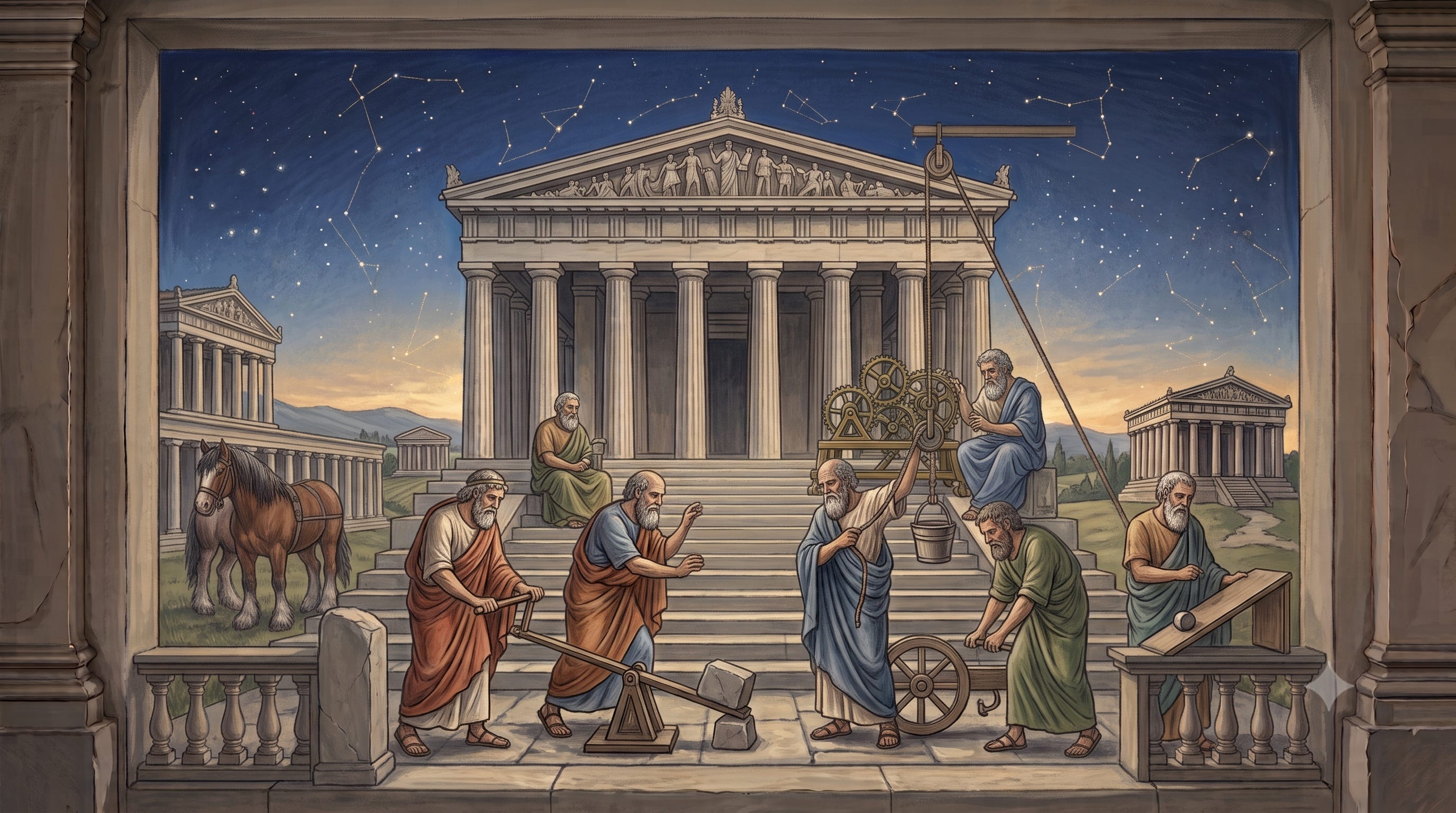
He isn’t that. If it feels that way, it’s because he isn’t giving you a pyrotechnic display. He’s building the simple machines that make philosophy work.
If you’ve ever spent time around a STEM-minded kid (I have!), you’ve heard a bit about the elegant beauty of the simple machines. Classical physics has six: the lever, the inclined plane, the wedge, the screw, the pulley, the wheel and axle. On their own, none of them look particularly cool. Who wants to play with a lever resting on a fulcrum? A drug-store remote-control car is way more fun. But that lever can allow a single person to lift loads that ten strong men wouldn’t be able to budge.
The “two workhorses of Christian philosophy” correspond to these question sets. Both give massive “intellectual advantage” to the Christian thinker. Best of all, they pull together as a graceful team, drawing the world behind them.
The simple machines are, well, simple. But these are the devices that built our world. By giving humans mechanical advantage, they enable us to do remarkable things with very modest physical strength.
Philosophy has its own “simple machines” which convey a kind of intellectual advantage. On their own they may look fairly humdrum. But they enable the philosopher to explain the world. If you look at the magisterial edifice of Christian philosophy, it’s easy to be overawed by the sweeping archways and intricate stained glass. But if you strip the structure down to its core mechanics, you’ll find two central concepts doing the heavy lifting: hylomorphism and natural law.
They cover a lot of ground between them. Professional philosophy departments tend to separate out into two different camps of people: the M&E folks (metaphysics and epistemology) and the ethics people. They might talk to each other, and some people cross lines, but that divide tends to be visible, presumably because these are in a sense the universe-defining questions that philosophy needs to answer. We’ve got the existence question set: What exists, why, and how do we know about it? And then we’ve got the morality question set: What is goodness, where does it come from, and what are the consequences of doing right or wrong?
The “two workhorses of Christian philosophy” correspond to these question sets. Both give massive “intellectual advantage” to the Christian thinker. Best of all, they pull together as a graceful team, drawing the world behind them.
“Hylomorphism” is a fancy and forbidding word. In fact, it’s quite commonsensical. It’s a metaphysical theory that treats things as an inseparable unity of matter (hyle) and form (morphe). The things we interact with every day are made of raw material (“prime matter” is the Aristotelian term), but they also have an essence, an identity, a structural blueprint that makes them what they are. The matter and form can’t simply be separated; the thing itself is a composite. Hylomorphism stands in contrast on one side to materialism, which treats matter as “the real thing.” (Humans may be strongly inclined to assign names to particular lumps of atoms or cells, but “the stuff itself” is all that truly exists.) On the other side it repels theories like idealism or dualism, which either treat matter as illusory (only ideas really exist!), or else draw wide separation between matter and soul. (Cartesian dualism, for instance, treats the human body like a kind of ship which the soul can fly like a pilot. Hylomorphism rejects that. You are your body, but not just a body. You are, in a sense, a soul made flesh.)
Because hylomorphism takes form to be real, not something imposed from the outside by the human mind, it can also hold that things have an essence or nature. There’s a way they’re supposed to be; things that go charging off-script are defective. Sunflowers should turn to face the sun. Apple trees should have little blossoms in spring and delicious fruit in fall. Dogs should romp around, chase sticks, and be loyal and affectionate to their owners. It’s in their natures to be like that, and it’s good to fulfill our nature. The lilac bush isn’t defective for failing to grow fruit, but the apple tree is. The parakeet that refuses to fetch sticks is simply normal, but the dog that refuses is “bad.” We can see this intuitively, and that’s not just a case of humans projecting their wishes onto the world. The things themselves have natures which they might, or might not, fulfill. As rational beings we can see this. Sometimes it’s appropriate for us to help other creatures fulfill their natures, which is a proper fulfillment of our nature as rational beings.
Enter natural law. Because things have natures, we can build a moral philosophy out of the fulfillment or non-fulfillment of those natures. The core of this view is that it’s good for things to “be what they are.” We should want them to be the best version of themselves, exemplifying their type in an excellent way. This is the foundation of moral goodness (or badness). On this view, we assume that the best roses will be the rosiest, and best ears of corn supremely corny, and the best human beings the most humane. Be what you are, but in a good way.
Naturally, the human case is the one that interests us the most. But it turns out that human nature is quite complicated. Figuring out what humans are, and how they can best exemplify their nature, is an arduous undertaking, more a centuries-long endeavor than the project of a single person. It’s the sort of project good philosophers should want to undertake though, and working from that solid foundation, we can approach it with real confidence. Our God-given rational powers equip us for the task, and we have something to work with, because after all, we’re looking into our own souls. Homo sum, humani nil a me alienum puto.
There are no secretive, arcane truths here. No shadowy society of priests and prophets holding the key to everything. This is the philosophy of the wedge and the pulley, not of the lightning bolt or mystical incantation.
Hylomorphism and natural law are both deeply intuitive. Your dog really is physically embodied; it’s not an illusion when you hug and pet it; but at the same time he really is a dog, not just a dog-shaped clump of matter. Also, he remains the same dog even if he gets in a fight one day and comes home with a chunk missing from his ear. (You’re now hugging a slightly different clump of cells from what you stroked in the morning, but it’s the same dog. The morphe hasn’t changed.)
Natural law, far from concealing vital truths in some esoteric Book of Masters, suggests that “right” and “wrong” are well within the realm of ordinary understanding. If a thing has been perceived by nearly every culture, in every place, to be shameful, unseemly, or unjust, that’s excellent evidence that it is in fact wrong. Likewise with intuitions about what is admirable, meritorious, and honorable. Natural law shows its face at every turn, in our innate faculties for perceiving right and wrong. The philosopher can still play a role in collecting, ordering, and synthesizing all those intuitions, and connecting them to an ongoing conversation about human nature and the human condition. But there are no secretive, arcane truths here. No shadowy society of priests and prophets holding the key to everything. This is the philosophy of the wedge and the pulley, not of the lightning bolt or mystical incantation.
Like the pulley though, it has immense power. Its simplicity is deceptive. This team can pull loads of astonishing weight and immense complexity, making it look easy. Each horse on its own is a Clydesdale, impressively muscular and sturdy, but in conjunction they truly move mountains. They make it possible to apply natural reason to every kind of question a person might ask, fitting it somewhere into this broader, intuitive picture. That’s what makes the greatest Scholastic Doctor “Angelic.”
Many years ago, as a rookie philosophy instructor, I assigned my Introductory Ethics students a massive reading from the Summa Theologica, maybe a hundred pages in all. That went over very badly and I never tried it again. I was of course ridiculously naïve, but still, there was a method to that madness. I was tired of students griping how they were bored by Scholasticism. It rankled when they read those bits of text (ruthlessly curated from a vast trove of Angelic wisdom, in deference to their apathy and laziness) and judged them tedious and arcane. It rankled even more when I could see that my impassioned pleas mainly had the effect of convincing them that I was the esoteric, Ivory Tower effete from Tuesday’s essay, with St. Thomas’ picture on my wall instead of Rasputin’s.
The super-long reading was not meant to be punitive. It seemed to me that my students were like people standing on a desert plain insisting that the world could not possibly be round, because, look! Look all around us! Do you have eyes, woman?
I do have eyes, but it turns out that by elevating yourself a bit above the ground, you can actually see the curve of the earth. Even with the naked human eye. I was hoping that a few arduous hours with St. Thomas might give my students that sort of glimpse. I wanted them to behold for themselves the magnitude, the breadth, the magisterial reach of that Christian vision. After a lifetime of meandering around, just doing this and that, it could be quite remarkable to look, if only for a moment, through those angelic eyes.
Maybe somebody did. One never knows for sure what seeds might have been planted in a classroom. But even if my students didn’t, all of us still can. Harnessing the power of the workhorses of Christian philosophy, we can build a platform high enough to put the world at our feet.
Re: "On the other side it repels theories like idealism or dualism, which either treat matter as illusory (only ideas really exist!), or else draw wide separation between matter and soul. (Cartesian dualism, for instance, treats the human body like a kind of ship which the soul can fly like a pilot. Hylomorphism rejects that. You are your body, but not just a body. You are, in a sense, a soul made flesh.)"
So it seems like you're positioning hylomorphism as the "Christian" philosophy here, and Cartesian dualism as... not.
I don't see how you can regard Cartesian dualism as less Christian-compatible than Aristotelian-style hylomorphism. "You are your body?" Then how can we say that the soul is immortal when the body dies? I assume the Aristotelians have some answer to that; far from pre-condemning it, I assume it's a bona fide faithful Christian opinion and all that, though I don't understand it. But it seems like a lot of things become problematic when you adopt this form of hylomorphism that have never seemed problematic for me, because I've always been more of a Cartesian dualist since that's always what the word "soul" seemed to mean. And it always seemed obvious to me that the real you is the part of you that thinks, the mind, the soul, and yes, your body is more like a vehicle than like your *self.* It's inconceivable to exist without your mind or soul; it's very conceivable to exist without your body.
Were the ancient Church fathers really "hylomorphist" in any articulate way?
So this is fascinating, but the big question I have to ask is: what does this have to do with Christianity?
Christian compatible, yes. But "Christian philosophy?" It happened that these ideas were worked out by certain Christians, particularly Thomas Aquinas. But why should we think that's anything more than historical accident? Why not speak of Christian physics because Newton was a Christian, or Christian chemistry?
What would clarify that this is actually *Christian* philosophy, in some more or less essential way, would be a rigorous derivation of these ideas from scripture or from early church councils that nearly all modern Christians accept as authoritative. I wouldn't even know where to begin to argue this from scripture.
That said, I think there is a roundabout way of arguing for something like hylomorphism (though it's a term I've never heard before this chat) as being especially Christian, by negation. If you're seeking a coherent worldview, you have to somehow unify a lot of disparate things. Christianity offers one way to do that, which doesn't pin down a lot of philosophical pre-commitments. Without Christianity, the search for coherence tends to drill down into ontology and epistemology end in reductionism. Let that stand as a placeholder for a longer argument.
As it is, though, I think the weakness of this piece is that you assert that you're describing Christian philosophy, but the philosophical arguments you put forward, while plausible, seem crazily disconnected from anything that any normal person recognizes as specially Christian.
And the dog example makes the problem sharpest, by going out on an uncomfortable limb. Some dogs don't fetch sticks. That's not actually bad. We could quibble over the specific traits of a "good" dog, but that seems rather silly, gratuitously arbitrary, and symptomatic of a philosophical error that makes a high stakes philosophical question out of something that should be subjective and innocuous. The apple tree example works better, but only because hylomorphism is clearly standing in for sociobiology. An apple tree that doesn't bear fruit is defective because its kind could not persist in the world. There's no union of form and matter that needs to be postulated to explain this, or to give a warrant for its extension beyond life.
I think there is a need for something like hylomorphism in order to address the problem of induction. Aristotelian telos conflates a philosophical move that is ultimately needed to skepticism with a broad generalization taken from biology that modern evolution fully supplants.
Of course, that's a much larger topic. But my critique here, again, is the total lack of any justification for the claim that these philosophical moves are specifically Christian.