


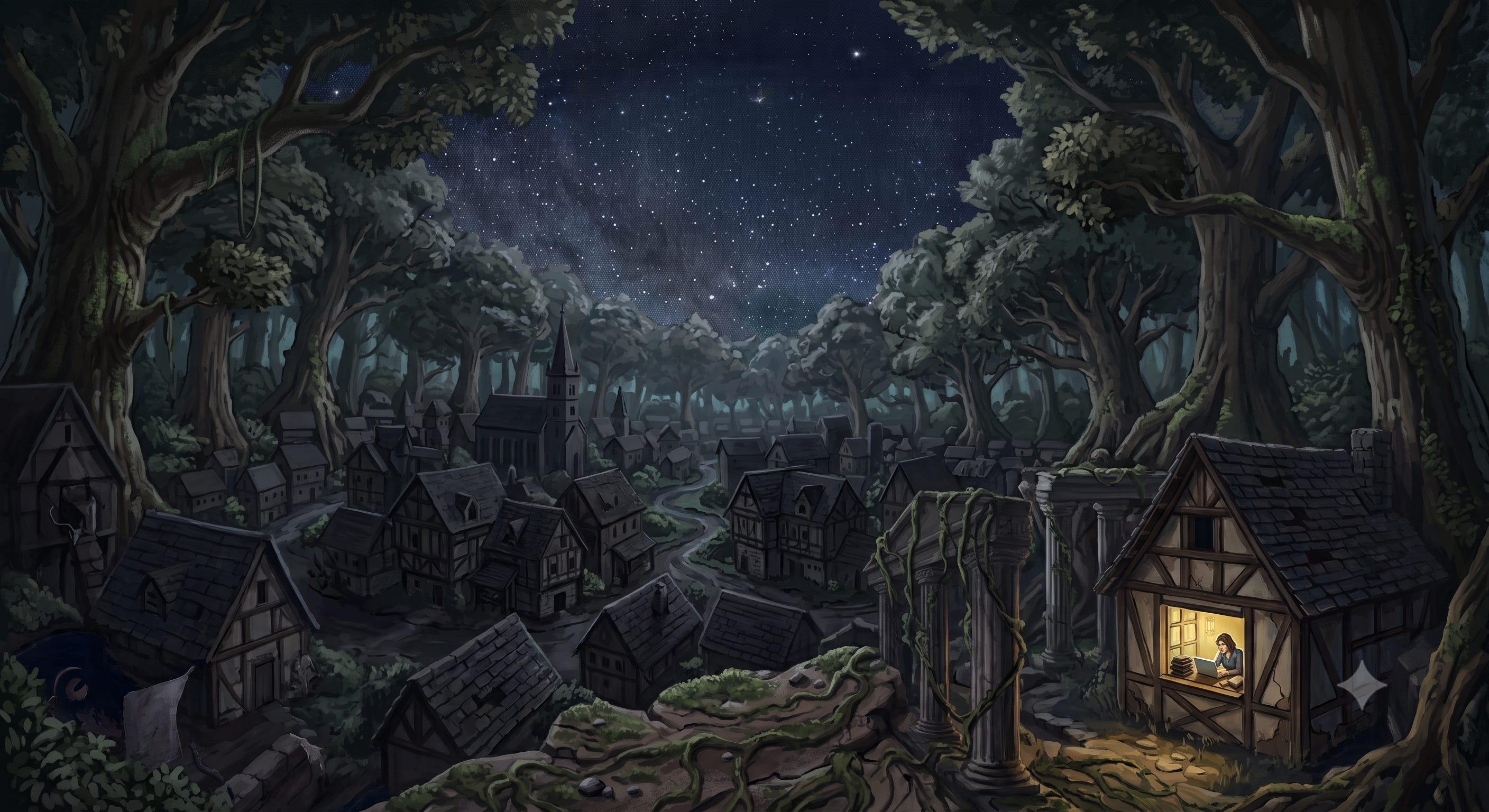
Is it a misfortune to be modern? It’s the perennial question for reflective traditionalists, and always hard to put in perspective. Of course, the question itself is so very modern. We just can’t stop navel-gazing.
The modern world has remedied many serious evils, especially in the realm of material want. Often those benefits literally enable us to snatch life from the jaws of death. I myself contracted pneumonia in my first few days of life, which would also have been my last without the aid of modern medicine. At least one of my sons was likewise saved in his earliest weeks from an illness that two centuries previously would probably have been fatal. I quite like being alive, and I’m grateful my son is too! And I do think it important to reflect soberly on the great blessings modernity has yielded to us, which are in fact quite numerous. (I expanded on this point when I discussed Paul Kingsnorth’s book a few months ago. As a funny aside, one of my sons asked me a few weeks after writing that post about the ideology of the Unabomber, and as we researched the question I realized, “Oh, so he’s Paul Kingsnorth, with bombs.” So that’s not disturbing at all.)
Nevertheless, it would be wrong to end the discussion there. The modern world has given rise to a lot of new problems, and unfortunately we can’t necessarily choose to shuck off the existential angst and “just live.” We live within networks of people: families, communities, states. We are affected by the state of our culture, our politics, our economy. Even just thinking about ourselves as individuals, we carry some fairly heavy burdens that might be labeled “the necessity of choice.” The modern world doesn’t lay out a brick road for us to follow from childhood; we have to do that ourselves. If we fail to set the bricks properly, we probably won’t come careening to a premature end, but we may well drift through decades of broken relationships, lost jobs, hours frittered away on vapid entertainments, a crushing sense of underachievement and failure. That’s not a good fate. And a lot of people do seem to end up there.
If you succeed in filling your life with meaningful activity, that burden can be heavy in a different way. As a writer, editor, practicing Catholic, wife and mother of five, I have no shortage of worthwhile things to do. Many of them are very good and enjoyable! I love spending time with my family, but actually, my job is pretty interesting too. My life is full of beauty, joy, and intellectual stimulation! However, arranging and prioritizing can be a major source of angst. In any given hour I could read submissions to Law & Liberty, exercise, pray my Rosary, engage my children in Meaningful Conversation, wash the dishes, call a friend or relative I haven’t spoken to in ages, or apply myself to what I simply call “the crapple.” (Making appointments, registering people for things, submitting invoices, filling out forms. There’s always so much crapple, which of course is my least favorite thing.) No matter which you do, there will be a lingering sense of guilt over the ones you didn’t do. Welcome to Middle Motherhood as a Modern.
So they’re First World Problems. They’re still problems! Handled improperly (but maybe even if we handle them well?) they make it harder for us to be happy and thrive. And now we cast our minds back to the medieval Hamlet and think. Yes, they buried more babies and plucked more chickens. Hunger and cold loomed much more forcefully. If a loved one emigrated to foreign shores, you might never see them again, and were lucky to get the occasional letter. However, they probably experienced less betrayal and loneliness. They spent lots of time enjoying the company of immediate loved ones. Lots of physical labor, but hardly any crapple. People probably didn’t wrestle much with questions like “is it a good idea to get married” or “are kids worth it” or even “do I believe in God?”.
In a nutshell, they were less alienated. Less fragmented and lonely. And that’s also a real gift.
In the end, it doesn’t matter if the medievals were more or less fortunate than we. Our job is to work the fields in front of us. The question is worthwhile mainly just as a way of helping us appreciate what that work involves. That will be a central question of next week’s essays.
On that note, a brief wrap-up.
On Sunday I reflected a little on King Solomon. (Was he really the wisest man ever?)
Monday set up the questions of Modernity Week. (If the Christian synthesis was so great, why was it rejected in the modern era?)
My Tuesday essay then dug into “The Muddle of Materialism,” explaining how materialism took hold in the West and how it created a serious crisis of meaning.
Wednesday I stayed in that vein by recommending Spencer Klavan’s Light of the Mind, Light of the World, which explores many of those questions in more depth. (He then informed me that the book is presently on sale at 30% off. So many reasons to pick it up!)
Thursday I shifted gears and delved into postmodernism, which I present as a kind of “philosophical cope” for a meaning-starved world. It supplies a kind of simulacrum of meaning, which people desperately want. Unfortunately, by severing itself from both rationality and truth, it ultimately makes the meaning crisis even worse.
I finished out that train of thought on Friday with a re-up of a review of Yascha Mounk’s The Identity Trap, which gives a diagnosis of wokism (“the identity synthesis” in his terminology) that’s genuinely helpful on a fairly granular level, but, I argue, not sufficiently attentive to some the deeper problems of postmodernism more broadly. We’re going to need a little more than “be reasonable and play nice” to bring our culture back together.
And what would that be? We’ll get there next week! Thanks for reading. Have a great weekend.
Whenever I feel my circumstances are limiting, including my historical circumstances, I always ask myself if that is really what is stopping me from doing what I want to do or being who I want to be.
Most of the time, after a little introspection, I conclude the source of the limitation is a combination of not really believing I'll do it or become it and/or not really caring. Then I make peace with that or try to change it.
Whenever you go, there you are.
I'm a big fan of philo-medievalism. It's very reasonable to admire the past and yearn for it, even if the past wasn't objectively, comprehensively better than the present, because it's usually, if not always, the case that the past was better than the present in some ways, and you can try to take the good and leave the bad, which often works perfectly well. European elites obsessively admired the Greco-Roman classical era for almost a thousand years, and profited immensely, even though taken holistically, Western Christendom was arguably a better civilization for most of that time, and definitely by the end of it. They admired it for very different reasons, and borrowed diverse and often opposite things from it, but all in all, they did quite a good job of taking the good and leaving the bad.
So definitely-- admire the medieval hamlet! The past is usually a better source of dreams and ideals than abstract ideology, because even if there's a good deal of imaginative projection, they're more grounded, more empirical.
https://lancelotfinn.substack.com/p/philhellenism-the-european-gentlemen