


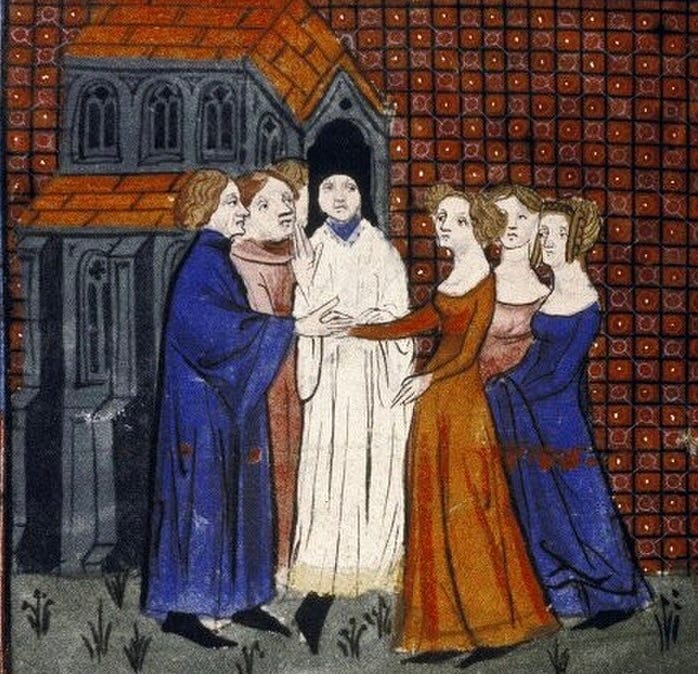
How can one instill order in a Christian society? That’s today’s question. I realize that many people will see it as somewhat strange and irrelevant.
Why worry about the needs of “a Christian society” when what we actually have is a post-Christian society? Or perhaps we have a pagan society, a consumerist society, a society of godless materialists. If we had a Christian society, surely things would be far more orderly. (That opinion, interestingly, would probably be shared by many people who view it as both a good and a bad thing.)
In the end of course I agree that Christian society is better than all those alternatives. But, as I argued in my last essay, the “Pandora’s Box” of Christian universalism has unleashed some genuinely difficult problems on modern society. Ordering a Christian society really is quite hard! Christians combined a lofty, Greek-like appreciation for human excellence with an uncompromising universalism, and seasoned it with the view that any person, from any walk of life, might potentially receive a divine calling to some other liminal life, transcending normal civic and familial obligations. That’s a hard starting-point from which to build an orderly civil society! And yet, Christians historically have managed to do this with some success, and a look at the strategies they employed may give us some good ideas for how to move forward today.
In the early years, there was a certain amount of chaos. Those were the years of the desert hermits, the stylites, and a fair number of people spontaneously giving up all their earthly possessions to live in poverty. Over time and as Christianity became mainstream, some baseline of normalcy had to be established, so Christian societies developed some tools to help instill that order, without jettisoning the radical Christian ethic of love. On a philosophical level (the “ethics of love”), the key concept was the ordo amoris, the order of love. I’ll leave that topic for another time. Practically speaking, the most important ordering principle was vocation. It was understood that different people were called to different sorts of work, and subject to certain rules and expectations connected with that calling.
Now, in Catholic circles at least, this subject tends to stir furious debate about the true number of vocations. Some argue that only priests and religious (that is, members of religious orders) can truly be said to “have a vocation,” the idea being that they are called out of the normal pattern of life while the married are merely “doing the done thing.” Others stick firmly to two primary vocations (the priesthood/religious life and marriage) while still others want us to multiply categories expansively to cover a whole range of other things people might feel called to do their lives. This can get complicated, and I don’t plan to settle it here.
For present purposes I’m going with the two-track model, setting aside edge cases like hermits and married priests. I’m not really going to say much about the secular priesthood generally, in fact. I’m looking primarily here at marriage and religious life, because those cases best illustrate the point at hand, though I will also note at the end that the concept of “vocation” does naturally expand outwards, in ways that can be read as variations on the theme.
The theme is this. For healthy adaptation to occur, something has to stay fixed. Then other things can move.
People can do all sorts of valuable things in this life, and it’s often quite good to be creative, entrepreneurial, driven. But a healthy creativity has to be bounded and restrained in various ways. It must be disciplined. If there are no rules, no forms, nothing fixed or required, the result is simply chaos.
This general principle applies to many things. In a sport or a board game chaos it means “confusing and not fun”; in music or art it likely means “a meaningless mess of color or sound.” In social terms, “chaos” probably means betrayal, loneliness, violence, predation on the innocent, anarchy. It also generally means poverty, because a certain level of order and stability is generally necessary for the generation of wealth.
Something has to be fixed if we want other things to move in purposeful ways. People need some expectations and limits to be their best selves.
As already mentioned, the early Church, had a good number of radicals: hermits, stylites, and the like. There are some great success stories here, like St. Anthony, St. Evagrius, or St. Gerasimus; they left us deep spiritual wisdom as well as a stock of excellent folk stories that Christian children still love. However, there were many others who sought the liminal life and came to grief. Total isolation led some would-be holy men (or women) to psychosis, despair, or raging megalomania; some rapidly starved or died of exposure, bringing tremendous grief of their families; some alienated their families by giving up all their property, only to realize a short while later that they lacked the fortitude to embrace the life of a beggar. Eventually, some wise people realized that a less radical path was needed for those who wanted to give themselves to God. And the monastery was born.
Monastic communities had rules, disciplines, and hierarchical structures. They began springing up in the 4th century, first in Egypt, then in Turkey and Palestine, and finally in the West. By the time St. Benedict wrote his famous Rule in the 6th century, the monastic experiment had been running awhile. But the Rule is justly famous, for its brevity and simplicity, its prudent balance of discipline and compassion, and its applicability to people of all classes and backgrounds. It’s just 13,000 words, easily fit into a sweet little 75-page volume, and yet it lasted centuries and grounded one of history’s greatest and longest-surviving institutions. St. Benedict created a discipline that ordinary people could live, rooted in work and prayer, which nevertheless enabled them to grow, build and discover in all sorts of extraordinary ways. They pushed the boundaries of science, engineering, agriculture, viticulture, medicine. As the Rule ordered life in the monastery, so the Benedictine Order became a pillar of order in the West.
See how this works? Something stays fixed. Then other things move, not randomly and chaotically but purposefully, adaptively, fruitfully. Religious orders, by providing that order and discipline, channeled spiritual zeal in ways that were transformative for society at large.
Christianity’s impact on marriage was no less dramatic. They didn’t invent it of course, but from the very beginning they startled the pagan world with their inflexible rules and high expectations. Christians appeared to the Romans as “monogamy fanatics.” It was truly strange to many pagans how they were relatively relaxed about food, but extremely strict in their sexual morals, demanding marital fidelity from wives and husbands and forbidding fornication. This makes perfect sense when one understands that Christianity is a religion of love. Sex can very easily be exploitative, in particular enabling men to exploit women. By placing a very high bar on “licit sex” (permissible only with lifelong commitment and an ordering towards parenthood), Christians recognized the interpersonal significance of sex, while strongly discouraging sexual exploitation. It’s really quite extraordinary that so many modern people still think of Christianity as a major engine of female oppression.
Over time, the Christian discipline associated with matrimony gave rise to its own entire body of legal theory. Canon law, in turn, also left a deep mark on Western society. A rather surprising witness to this truth is secular scholar Joseph Henrich, in his fascinating book The WEIRDest People in the World. Henrich explains how the Church, by forbidding cousin marriage and discouraging arranged marriages, broke up tribal networks and made it far more difficult to consolidate wealth and power within a family line. Ultimately he sees this as an important catalyst for Western morality, individualism, and also institutionalism: deprived of close kinship networks, people had to learn how to work together with strangers, and they ended up building universities, guilds, eventually joint-stock corporations.
Henrich, with a background in anthropology, evolutionary biology, and economics, views the matter from a strictly secular, naturalistic angle. He isn’t interested in defending the Church on theological grounds. Sometimes his explanations are awfully crass. For instance, he doesn’t give Christian authorities a huge amount of credit for spiritual or moral motives in launching the “Marriage and Family Program” (as he calls it); he mostly sees it as a self-interested attempt to motivate more people to leave their worldly goods to the Church. But in some ways that only makes it more interesting that he sees Christian marriage as a catalyst to innovation and social transformation.
Once again, we see it. Something stays fixed. Then other things can move.
Importantly, people entered into these life states voluntarily. They may have had constrained choices of course, but vocations still require an adult decision. Instead of simply being assigned a social role, one accepts the mission. As the Middle Ages advanced, there was a profusion of organizations, guilds, chivalric orders and the like, which also offered “missions” along with rules, disciplines, obligations. These were not exclusive of other vocations, but they still had some of the character of vocation, a voluntary embrace of that proved enormously fruitful across many Christian centuries.
In a vocation-based social framework, people do make choices, but life isn’t a whimsical choose-your-own-adventure. The choices are ordered, bounded, and defined. Sometimes, depending on one’s circumstances, the demands can be very, very hard. And yet, the rules of each vocation are not exhaustive, nor tyrannical. There’s still room to move, develop, and innovate within the supplied framework. This is the genius of Christian vocation.
To my eyes, the modern world is screaming for this kind of order. People are directionless, lonely, and longing for purpose. Vocation enables everyone to be Harry Potter or Bilbo Baggins, called to some genuinely important life work. How, without this concept, can we possibly cope with the chaos of the Pandora’s Box of Christian Love? The strategy is time-tested. The need is obvious. Let’s rediscover the magic of rules and promises.
The centrifugal effect of Christian society which you noted was actually planted as far back as the Hebrew era. The Law of jubilee, putting rural land back into the conquest title holder's hands every so often, coupled with the Law of double portion inheritance of the oldest son, was engineered by God to bring tremendous diaspora pressure on Israel. Land allotment would become so small and impractical for most sons that urban vocations and eventually international travel and trade would become preferable. Israel's societal design was meant to make them cosmopolitan from the get go. Of course, this design could only be unlocked via obedience, as the blessings for obedience described in Deuteronomy 28 would have manifested in a population explosion which would have seemed Malthusian. Israel instead chose the oath of disobedience and depopulation. It took the incarnation to finally unlock that original plan.
I love this argument, but it actually underscores why I'm so hostile to the concept of "stereotypes," with its gratuitous and misguided pejorative connotation.
Part of the benefit of a vocation is that you can choose how you will be seen. You can take monastic vows and be treated as a monk: trusted in some ways, exempted from some duties but denied some pleasures. Society is recruited as an accomplice in your vocation through its knowledge of certain patterns of life. Become a knight, and you create different social expectations, which facilitate a different kind of adventures and duties.
For your reintroduction of vocation to have its full effect, I think it will need to be supplemented by a radical revaluation of "stereotyping," if the word will serve. It's good to know things about different types of people!!! If society *stereotypes,* so to speak, monks, knights, economists, judges, or whatever in a certain way, those vocations become far more meaningful and impactful. Stereotypes, in this positive sense, make the social landscape more legible, and make people more free to make effective life choices.
We need to unlearn the mental habits we have been taught with respect to "stereotypes."