


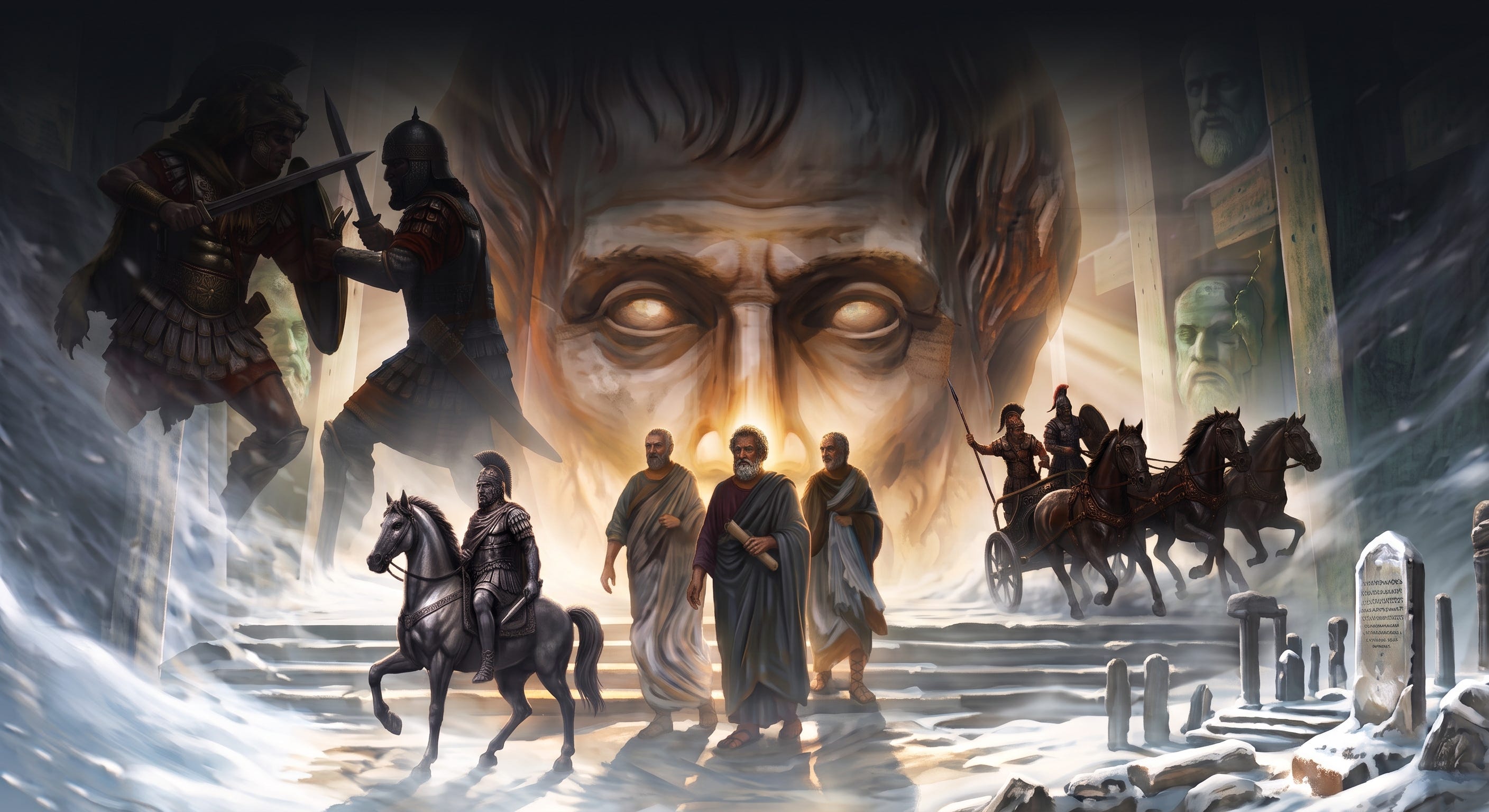
In the early days of this Substack, I wrote about “despair books” and how they spurred me to start Christendom Reborn. It’s time to put that point in sharper focus. I don’t think we’re living through some uniquely bad period for Christianity, in the world or even the West. Our politics is fairly dysfunctional right now, and the culture isn’t in good shape. The global order is feeling a little precarious. Christianity, though? I think we’re watching it pull back to its feet again after some pretty hard hits. Admittedly, it’s a slow process.
I dislike despair books because I consider relentless doomerism unfitting for a Christian. It is a pusillanimous posture. That’s true just in general, but it’s especially aggravating when Catholic intellectuals, my own set, ride the crest of the doomer wave, advancing the cause of despair with pseudo-intellectual explanations for why modernity is irredeemably broken.
It’s hard for me not to see this as a kind of scholarly malpractice. Training in the Catholic intellectual tradition does indeed position one to offer some trenchant and compelling critiques of modernity, an advantage some influencers have used to great effect. But it also positions one to appreciate some real, and genuinely hopeful, sources of remedy. The despair sells more briskly in today’s public square, which helps explain why some have traded so heavily in that commodity. But that’s an explanation, not an excuse. We should know better. We do know better.
For readers who’ve read all about the cancer of individualism, liberalism’s rebellion against nature, the rise of militant secularism and so forth, but not about neo-Thomism, Christian personalism, or the rebirth of Aristotelian realism, it’s time you heard the rest of the story. This really is not just about the Catholic-philosophy world, though that’s the piece most familiar to me. It cuts across many disciplines, denominations, and cultures, a complex network of ideas and movements that have for a considerable time been working to rebuild something humane, ennobling, and true in a landscape marred by reductive materialism and the flight from reality. Many people, viewing the picture from various angles, have come to see how those errors tend to empty the world of order, purpose, and love.
“Why then,” skeptical interlocutors sometimes ask, “haven’t they done anything about it?” Well, they have. Actually they’ve done quite a lot.
Looking back over the past 150 years, one finds many self-conscious efforts at reform which at this point can be helpfully viewed, in a very broad sense, as constituting a neo-traditional or neo-Aristotelian tradition. (If you like the word “conservatism,” that is fine, because I think these overlap very substantially. I’ll delve into that in another essay.) Many of these efforts have borne real fruit. I think that harvest will increase manyfold over time. Given the depth and extent of the challenges, one can’t expect cultural and spiritual renewal to sweep the globe effortlessly in just a few years, but if you think there’s nothing to build on, that “conservatism hasn’t conserved anything,” that we are sitting right at the nadir of liberal modernity… you are probably the victim of way too much rage bait.
Intellectual history rarely admits of discrete beginnings, but to me, Pope Leo XIII’s Aeterni Patris is something of a watershed moment, which dovetailed with the work of great intellectuals like St. John Henry Newman. This is a little bit funny, because Aeterni Patris was a ringing call for a rediscovery of the work of St. Thomas Aquinas, and Newman wasn’t all that keen on Neo-Thomism. One often finds sharp disagreements among would-be reformers. To my eyes though, these men were all clearly swimming the same way, all recognizing the urgent need for a revitalized Christian synthesis and a recovery of its intellectual tradition. Across the next century and more, quite a lot of people would come to appreciate that adequate responses to modernity, though rooted in tradition, had to move beyond a desperate effort to suffocate modernity in its cradle. They had to supply answers to new questions. We needed living traditions, not fossils.
Twentieth century Thomism turned into a fairly wild ride. It was riven with factions, which in many ways undercut its effectiveness. Certainly, the movement never cohered into the kind of transformative global movement that Pope Leo presumably hoped to see. At the same time the factionalism inspired rigorous scholarship, innovation, and furious intellectual ferment. I like to think of this as a kind of intellectual pressure cooker, which ultimately blew up but sent spores in many directions, cross-pollinating other movements and leaving its mark in all sorts of unlikely places. Its influence extends far beyond the places where most people actually know what “Thomism” is. It didn’t quite go as planned, but it certainly mattered.
To be clear, I’m not advancing a thesis that Neo-Thomism was the sole or definitive catalyst of cultural renewal; the broader phenomenon I have in mind—neo-traditionalism, political conservatism, the re-embrace of organic order—had many intersecting tributaries. But Neo-Thomism was a crucial riverbed in that landscape, and highly illustrative of how deep ideas work. And, as I noted yesterday, the fact that it happened at all would be astonishing to the early modern mind.
So Pope Leo hoisted a flag, and some fairly brilliant people gravitated to it. They all pretty clearly grasped that what was needed in this moment was a comprehensive Christian synthesis capable of bridging the spaces between different truths, as Scholasticism once did. Modernity had issued its existential challenge. In this moment of crisis, it was essential that faith and reason join hands once more. That intensity of purpose makes the Thomism Wars pretty arresting, but the ask was big, and the early decades of the twentieth century were hard ones. Granted, the world is always troubled, but between two World Wars, the fall of multiple empires, state-sponsored atrocities on a horrifying scale… it was a confusing time.
Working against that backdrop, the Neo-Thomists had a lot of things to settle. So they fought. They fought about the relationship of grace and nature. They fought about authority and the modern state. They had deep disagreements about the extent to which Christian philosophy could intersect fruitfully with modern philosophers, such as Immanuel Kant. Ultimately they were unable to get in sync, and not a single one is a household name even among Catholics. (Alright, maybe one or two. If you count Pope John Paul II and Pope Benedict XVI.) Nevertheless, ideas from these intense philosophical controversies flowed outwards into all sorts of other areas: Christian personalism, International Law, phenomenology, Catholic Social Teaching, and an analytic Thomist tradition that ran through Elizabeth Anscombe and Alasdair MacIntyre.
Political conflict, out-of-touch elites, creative destruction, mass migration, factionalism, and propagandistic “fake news” are all old problems that have impacted the world many times. Truth has more staying power.
The further impacts of that are, to my eyes, quite extensive, but that’s a long conversation. I’ll just mention a few things. The contemporary Catholic’s “open-to-life” ideal is deeply shaped by Thomist architecture and ideas explored by those thinkers, and that’s been relevant to the Catholic understanding of marriage and family (which model has also surely influenced many Protestant denominations) but also to the pro-life movement, and to Catholic advocacy across the world for the unborn, the elderly, and other vulnerable people. The Church’s embrace of religious freedom, and political freedom more generally, has also been very significant, and owes much to Thomists like Jacques Maritain and John Courtney Murray.
Another relevant thought. Over the past few years, there’s been considerable discussion on the American right of Catholics’ disproportionate influence within intellectual conservatism. We represent a minority in this country. And for ages Catholics were mostly Democrats. Why are they always punching above their weight among conservative intellectuals? Various answers have been debated but to me this is kind of a no-brainer: because Neo-Thomism. It doesn’t matter whether those thinkers were household names. That kind of intellectual work creates a framework, which in turn facilitates further intellectual projects, which in turn attracts brilliant people looking for firmer foundations. Things tend to happen at the point where faith and reason meet.
Synthesis is powerful. It’s especially powerful in a world where people are fragmented and ravenous for meaning. I appreciate that it won’t be immediately evident to everyone how the world can be transformed by a bunch of neo-Scholastics scholars shouting at each other about grace and nature. How will that defeat gender theory or the new socialism or raging nationalist movements trending into fascism? How do philosophy books that hardly anyone reads address the very real problem of falling marriage and birth rates, or European countries where regular church attendance rates are in the single digits?
Well, there’s always a lot of sturm und drang in the world at large. Periods of transition are particularly anxious. But, as Richard Weaver once told us, ideas have consequences, and that doesn’t just hold for intellectual errors. Actually I think it’s far truer of, well, truths. There have been other periods of history when very few people went to church. Unhinged ideas and destructive cultural fads have ravaged whole cultures on many occasions. Political conflict, out-of-touch elites, creative destruction, mass migration, factionalism, and propagandistic “fake news” are all old problems that have impacted the world many times. Truth has more staying power. If we’re talking about carefully crafted philosophical paradigms that successfully draw together many different types of truth, synthesizing them into meaning-rich worldviews that can explain and order human life? Those can endure for a very, very long time.
I’m not saying we’re quite there yet. There are a lot of new (known) truths today that need synthesizing, vastly more than in St. Thomas’ day or even Pope Leo XIII’s. All I’m saying is: Keep your eye on the ball. There are in fact many movements and developments parallel to the ones discussed here that are breaking out of too-limited modern paradigms, seeking something broader or more integrated. Some of these can be found within Protestantism or Orthodoxy, or other world religions. There are also intriguing developments in certain secular disciplines, as for instance in medicine and the biological sciences, where theorists have discovered that life, mysterious as it is, must be recognized as a thing in its own right: You can’t really understand the workings of the human body by breaking it down into component parts, treating a living person as “a vivified corpse.” I have mentioned already how breakthroughs in physics, especially relativity and quantum mechanics, have put real pressure on materialists to break out of their narrow, dated metaphysical worldviews and search for a synthesis that can accommodate new truths.
The nice thing about terrible ideas is that it’s comparatively easy to improve on them. If you view the matter in that light, it suddenly appears that the world is our oyster! Modernity tried to build a world on gears, bits of matter, and existential noise–and it exhausted itself. What we’re seeing right now, in philosophy, theology, and even many of the sciences, is the gradual return of order, purpose, and form. The Aristotelians have come surging back, bringing with them some time-tested tools that can help us rebuild. The lights aren’t going out for the Christian intellectual tradition. They’re coming back on.
So this makes me fascinated and impatient.
That mingled fascination and impatience is partly because this post is an advertisement for neo-Thomism but doesn't satisfy the appetite that it encourages by supplying the actual substantive arguments. That might be just what you're aiming for and what your project needs!
But also, how does CS Lewis fit into this? Unlike the philosophers that you're citing, he *is* a household name. I've had a bit of intermittent exposure to Anscombe and Maritain, and I wasn't convinced. I got the impression that they don't doubt deep enough to earn the warrant to be believed. CS Lewis does. He answers Descartes' challenge and brings Christianity through the test with flying colors. And as far as I can tell, he's by far the most famous and influential Christian apologist of the 20th century. How does he fit into your story?
I also get worried when you mention developments in medicine that might cast doubt on the conception of life life as explicable from molecular machinery as if they're load-bearing for the Christian worldview. I'm certainly open to the possibility that some kind of Aristotelian mystical telos is a needed explanatory factor in biology. I'd be a bit surprised, if anything, but I'm open to it. But: the Christian worldview definitely doesn't need that. The soul can be real without teleology pervading physical nature.
I'm quite open to being educated about Aristotle's contribution, and perhaps finding that it's larger than I realized. But I'm worried that this argument is trying to checkmate Christians into acknowledging a debt to Aristotle that isn't actually there.