


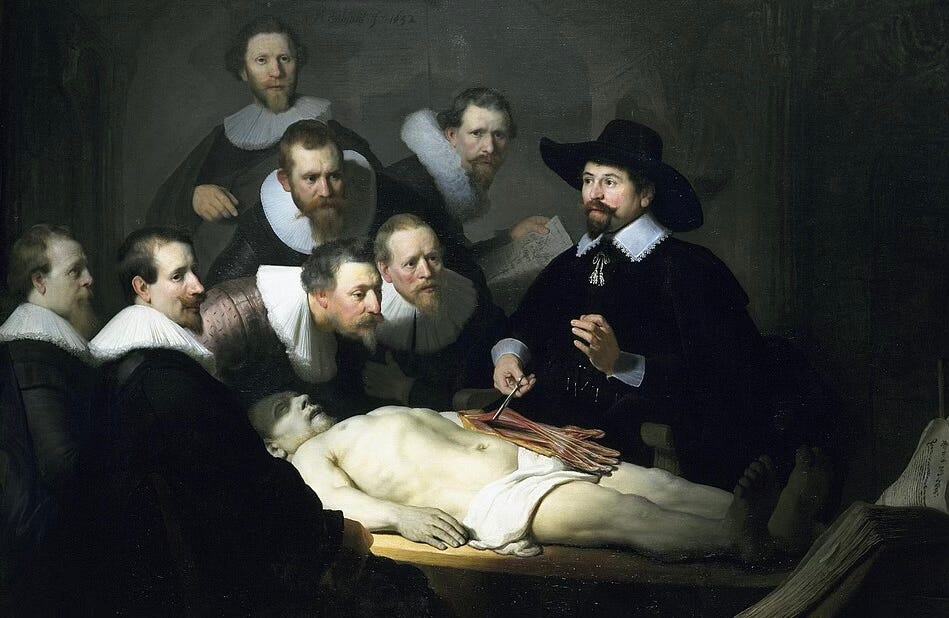
Over the first couple of weeks of Christendom Reborn, I’ve taken a couple of stabs at answering the question: What is Christendom? I’m a philosopher by training, so I love those definitional questions. However, anecdotal experience suggests that they aren’t always great for generating discussion. The best conversation-starter is not “what is Christendom?” but “What destroyed Christendom”? It’s a commonplace that it’s dead, or very nearly so. But people can still get very energized by the question of why and how that happened.
That is interesting in itself, no? By most operative political definitions, Christendom is pretty cold in the grave. Last week I discussed the historian Mark Greengrass, who marks Westphalia as the end point. That was in 1648. Why are we still so eager to autopsy something that bit the dust in 1648? Other endpoints could be defended of course, but if you’re looking for a time when the Church’s political relevance was robustly and uncontroversially recognized across much of the planet, you’ll be going back several centuries no matter how you slice it.
Admittedly, there’s a certain sort of egghead who just loves to debate sweeping civilizational questions, from the rise of Persia to the fall of Rome. But that’s kind of a niche thing. “What happened to Christendom?” is still an open, painful question for more than just History Channel addicts. People still feel that loss.
There are understandable reasons for that, which can’t be reduced to mere nostalgia, nor to some intemperate Christian desire to control and dominate. We perceive, correctly, that Christianity demands some form of political expression. We see that there is a relationship between the ground-level struggles of our churches (loss of members and cultural space, internal loss of cohesion) and the struggle to find an appropriate cultural and political identity for Christianity in a pluralistic and increasingly globalized world. Those reflections naturally lead the mind back towards “Christendom.”
Once a person begins thinking in those terms, it quickly becomes apparent how our raging culture wars can be understood as part of an ongoing struggle between Christianity and rival worldviews (among them, its own “bastardized” offspring). When that battle becomes heated, and particularly if it seems to be turning against us, we again don sackcloth and mourn the death of Christendom.
I’m not mocking anyone here. It’s not always bad for people to think in epic-narrative terms. There is a real sense in which we, as Christians but also as human beings, must fight perpetually for the very survival of our civilization. Anarchy and barbarism are never quite as far away as we like to think, and sometimes it’s good to recapture that sense of urgency. But there are also real hazards to the despair narrative (as I’ve mentioned already) and yearning moodily for the spires of Christendom is a great way to set off along that despondent path. (We’re not sure what Christendom actually is, nor what it would mean to recover it. All we clearly know is that we’ve lost it and it’s probably never coming back.)
One of the major goals of Christendom Reborn is to pull people out of that unhappy space. Therefore, I will dedicate this week to analyzing the autopsy reports. If Christendom is dead, who killed it?
Tomorrow I will consider the answer with the most street-level retail value among religious conservatives: the sexual revolution. Our civilizational chaos springs from moral chaos, at the heart of which is sex. Of course it’s really not all about sex, because once we start plumbing those waters we find ourselves grappling with all sorts of thick moral concepts: love, dignity, social cohesion, moral responsibility, family, fidelity, the care of the weak and innocent. Here I’ll talk about Louise Perry, an atheist-turned-Christian who certainly appreciates the deeper moral and social implications of the sexual revolution. In addition to being an insightful social critic, she also (conveniently!) just wrote a piece titled, “Christendom Is No More.” I’ll talk about that.
Wednesday I will turn to expressive individualism and the collapse of authority in the West. This is clearly a real problem for churches, and no one understands the point better than Carl Trueman, whose Rise and Triumph of the Modern Self is a perfect expression of this particular “autopsy report.” The concerns he raises are certainly real and serious, and yet, his prognosis is too bleak. I’ll explain why.
Thursday is about liberalism, illiberalism, and Patrick Deneen’s histrionic thesis. That should be a fun day.
I’ll end the week on a more poetic note, thinking about our “disenchanted” modern world and why so many people are confident they don’t want to live in it. Paul Kingsnorth is a particularly dramatic example, so I’ll dip into his Against the Machine and explain why I prefer Gerard Manley Hopkins.
As a final reminder, I now have a Weekly Digest option, perfect for anyone who feels overwhelmed by the Substack Era with its constant flood of emails. If you flip over to that, you will only receive one weekend update on our activity here at Christendom Reborn, though naturally we’d love to see you here at the site anytime.
This is an interesting framing, because "Who killed Christendom?" would seem to be downstream of "What is Christendom?"
My priors are that a semantic history of the *word* "Christendom" would not indicate any particular coherence, such as could ground a philosophically rigorous definition. That leaves it fair game for an author to invest it with their favorite meaning. An author who thinks the Sexual Revolution killed "Christendom" presumably just means something different by the word compared to an author who thinks the piece of Westphalia killed "Christendom."
It makes me think about an author who tries to write a book about banks, in a manner inclusive enough to apply to both both the financial and riparian forms, and to seamlessly interweave discussions of mortgage lending and fluvial hydrology. :)
Of course, it's not the same thing. But you've set yourself quite the task framing a meaningful concept of Christendom that can serve as the flip side of these very diverse complaints!
Yes, it heightens the interest in what this reborn Christendom might look like. There might be a new form of it that will answer a lot of different needs.