


I’ve been in the clouds a bit these past three weeks, thinking about philosophy, modernity, the well-lived life, the Christian tradition, hylomorphism, virtue. Heady topics! I think I’ll come off the mountain for a bit now, and explore some topics closer to earth. First though, I’m taking a recharge week, doing The Fun Things with my boys a few more times before school returns. I may post next week, or not, but if I do I promise fluff and levity! Then I think we’ll do some politics. Stay tuned.
Before moving on though, I need to cap the present series with an important From the Stacks. This piece, originally written for Law & Liberty, recounts my experiences as MacIntyre’s student, reflecting on what he did for me as a mentor. I touched on this topic in Friday’s post, but this is the fuller story, written as a tribute just after his passing. It was a very uplifting essay to write. It’s extremely humbling to look back and remember his generosity and integrity, especially now, when greater life experience has taught me that those qualities aren’t as ubiquitous as we might like.
I have told my children that MacIntyre “was my Socrates,” which sounds kind of melodramatic but I think it’s just true. As I relate:
MacIntyre had a quasi-prophetic aura, surely helped by the fact that he was brilliant and immensely erudite. But it was more than that. He had passed through a gauntlet of bruising professional and political encounters, but still somehow radiated conviction and an undiminished hunger for truth. His ideas were thick and complex, but his manner was disarmingly artless. He treated philosophy more like a vocation than a discipline or profession. And despite his reputation for cutting remarks, he could be extremely generous towards anyone who seemed to be trying, however clumsily, to do it.
It may have been a paper assignment that supplied an official excuse for my first visit to his office. The debate that occasioned it was so exhilarating, however, that the next time I dropped the pretext. I simply worked out a position I wished to argue (over and against something he had said in class), and showed up to his regularly scheduled office hour. Over time, this became a regular occurrence, with the format basically the same each time. I knocked, and MacIntyre offered me a chair. He asked genially, “What can I do for you?” I staked out my chosen dialectical ground. We sparred.
It was a good old-fashioned elenchus! Read the piece for more. I would never try to pass myself off as a MacIntyre scholar, because, well, life just went other directions; it’s been years since I’ve been able to make philosophy (as an academic pursuit) a central part of my life. And sure, there were some disappointments there, but that doesn’t tarnish the memories. MacIntyre wouldn’t have been ashamed of me for allowing life commitments to lead me out of the Academy. I end here:
MacIntyre’s business was doing philosophy. That’s what mattered to him. He sometimes helped others to do it too, but afterwards, he simply sent his students off into the wide world to make whatever contribution they would. He had no interest in heading up a school or research program, but I don’t doubt he left his mark on far more people than have contributed to the secondary literature on his work.
Anyway, that was me. At 20, he made me feel the tug of some high-minded philosophical calling. It’s been years since I thought much about that eager-beaver philosophy student, but on the occasion of his death, I look at my life, my faith, my writing, my classically educated children, and wonder: am I still perhaps on that mission?
A year after writing that, I started Christendom Reborn. Huh.
It’s been an immense pleasure doing philosophy again over these past few weeks. I’ve picked up some books I hadn’t touched in years. What a treat! Obviously the job is not finished, but this is a wide-ranging Substack so I’ll explore some other topics for awhile, and return. If you’ve tuned in only intermittently, feel free to browse back over the series, which has its own internal arc. I started with a week on what philosophy is, and described the two workhorses of the old Christian synthesis that, in my understanding, enable it to command such remarkable breadth. In “modernity week” I considered the question: Why, if the old system was so wonderful, did it break down? I approached that question through two lenses: materialism (a sad case of “a good methodology morphing into a bad metaphysics”), and postmodernism (a kind of “universal solvent” that dissolved foundational connections to reality and truth).
Finally, this week, I considered the Return of Aristotelianism in the twentieth century, before circling back to where I began: with an essay on the purpose of philosophy and whether we can still aspire to do it, despite the many traumas that have upended the world these past several centuries. I think we can.
Indeed, the ultimate takeaway of this series is that I think we are better positioned in this regard than our great-great grandparents, or perhaps even our parents. I understand that it doesn’t feel that way when we’re actively watching materialism empty the world of meaning, while the acid of postmodernism (in the form of wokism, Third Worldism, aggressive new political religions) erodes the things that we cherish. I’m not promising short-term cultural thriving and stability. I just think we have much better resources now for understanding what’s happened in the world, for building alliances, and for crafting dignified responses rooted in both reason and tradition. Political and cultural churn are (regrettably) a regular feature of the world, but you have to try to look beyond the latest social media spat to find deeper sources of hope.
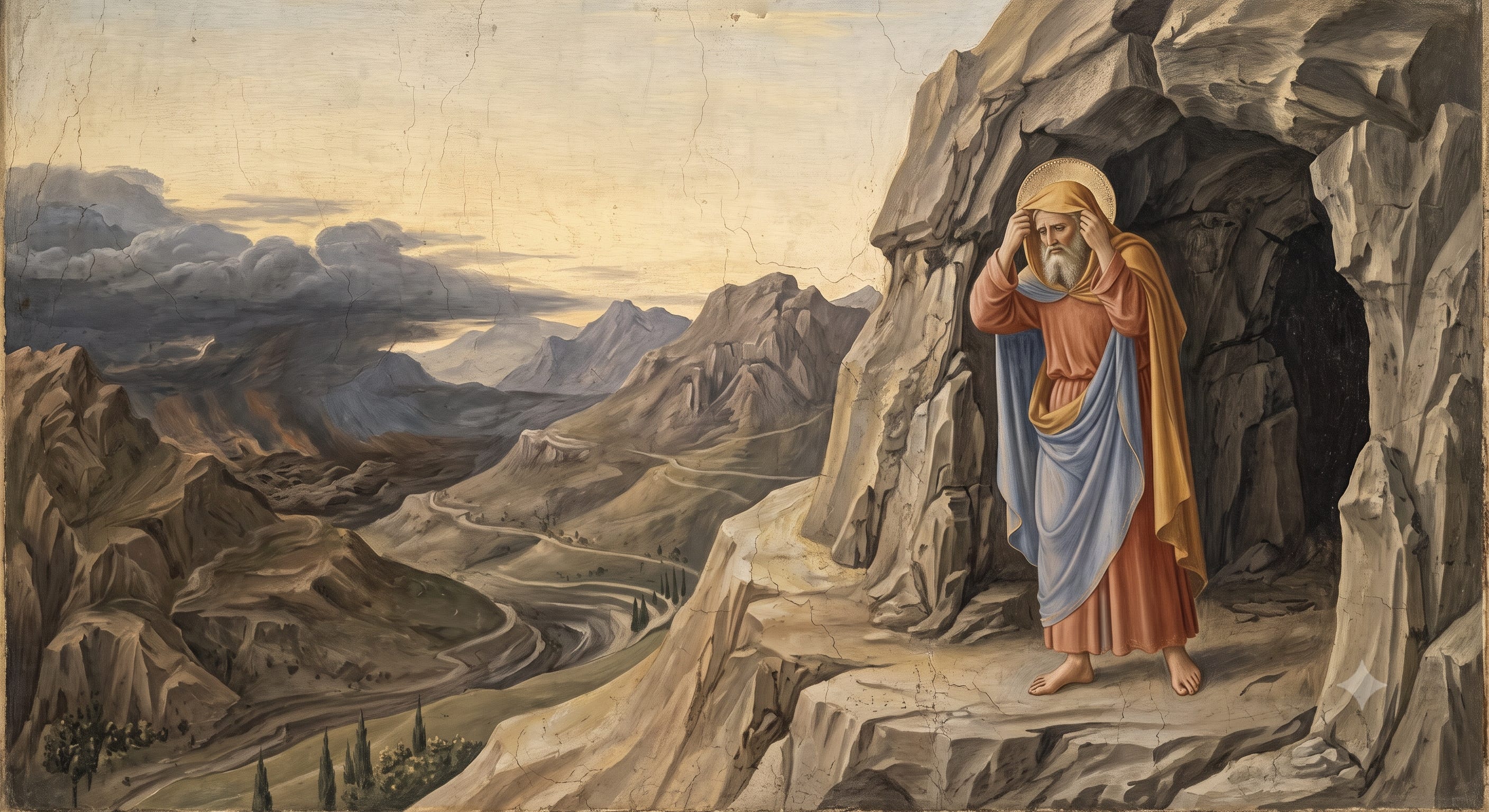
On that note, I’ll call it a wrap. But since I’m not writing a separate Sunday Faith Reflection today, I’ll just end with this passage from today’s readings, from 1 Kings. It’s Elijah’s encounter with the Lord. It’s lovely to think about it as a metaphor for modernity’s appalling noise and mess, and the voice that, despite everything, is still audible after the storm. One last moment of truth before we come down off the mountain.
At the mountain of God, Horeb,
Elijah came to a cave where he took shelter.
Then the LORD said to him,
“Go outside and stand on the mountain before the LORD;
the LORD will be passing by.”
A strong and heavy wind was rending the mountains
and crushing rocks before the LORD—
but the LORD was not in the wind.
After the wind there was an earthquake—
but the LORD was not in the earthquake.
After the earthquake there was fire—
but the LORD was not in the fire.
After the fire there was a tiny whispering sound.
When he heard this,
Elijah hid his face in his cloak
and went and stood at the entrance of the cave.1 Kings 19:9-13
Truth is no less powerful when it’s quiet.
Thanks again for reading. I know that time and attention are precious, and I hope it’s been worth it.